



Laboratory Analysis of Tularemia in Wild-Trapped, Commercially Traded Prairie Dogs, Texas, 2002
Supporting Files
Public Domain

-
Mar 2004
File Language:
English
Details
-
Alternative Title:Emerg Infect Dis
-
Personal Author:Petersen, Jeannine M. ; Schriefer, Martin E. ; Carter, Leon G. ; Zhou, Yan ; Sealy, Tara ; Bawiec, Darcy ; Yockey, Brook ; Urich, Sandra ; Zeidner, Nordin S. ; Avashia, Swati ; Kool, Jacob L. ; Buck, Jan ; Lindley, Connie ; Celeda, Leos ; Monteneiri, John A. ; Gage, Kenneth L. ; Chu, May C.
-
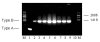
Description:Oropharyngeal tularemia was identified as the cause of a die-off in captured wild prairie dogs at a commercial exotic animal facility in Texas. From this point source, Francisella tularensis-infected prairie dogs were traced to animals distributed to the Czech Republic and to a Texas pet shop. F. tularensis culture isolates were recovered tissue specimens from 63 prairie dogs, including one each from the secondary distribution sites. Molecular and biochemical subtyping indicated that all isolates were F. tularensis subsp. holarctica (Type B). Microagglutination assays detected antibodies against F. tularensis, with titers as great as 1:4,096 in some live animals. All seropositive animals remained culture positive, suggesting that prairie dogs may act as chronic carriers of F. tularensis. These findings demonstrate the need for additional studies of tularemia in prairie dogs, given the seriousness of the resulting disease, the fact that prairie dogs are sold commercially as pets, and the risk for pet-to-human transmission.
-
Subjects:
-
Source:Emerg Infect Dis. 10(3):419-425.
-
Document Type:
-
Place as Subject:
-
Location:
-
Volume:10
-
Issue:3
-
Download URL:
-
File Type:
 [PDF - 87.85 KB]
 -
Collection(s):
-
Main Document Checksum:urn:sha-512:67a7556f94d187ffd960cae8e216f2f21231ab908ae9b5d2ec4f8acd90a6e39e8a37cffec3f54b7221edbf0809caa23a02eb30fd606c58a782f91d4f10781695
Supporting Files


File Language:
English
 Was this page helpful?
 Found an issue?




CDC STACKS serves as an archival repository of CDC-published products including
scientific findings, journal articles, guidelines, recommendations, or other public health information authored or
co-authored by CDC or funded partners.
As a repository, CDC STACKS retains documents in their original published format to ensure public access to scientific information.
As a repository, CDC STACKS retains documents in their original published format to ensure public access to scientific information.
You May Also Like
COLLECTION
Emerging Infectious Diseases