



Patient contact is the main risk factor for vancomycin-resistant Enterococcus contamination of healthcare workers’ gloves and gowns in the intensive care unit
Supporting Files

-
9 2018
-
Available in CDC Stacks on September 01, 2019, 12:00 AM
File Language:
English
Details
-
Journal Article:Infect Control Hosp Epidemiol
-
Personal Author:
-
Corporate Authors:
-
Description:Objective:
To determine which healthcare worker (HCW) roles and patient care activities are associated with acquisition of vancomycin-resistant Enterococcus (VRE) on HCW gloves or gowns after patient care, as a surrogate for transmission to other patients.
Design:
Prospective cohort study.
Setting:
Medical and surgical intensive care units at a tertiary-care academic institution.
Participants:
VRE-colonized patients on Contact Precautions and their HCWs.
Methods:
Overall, 94 VRE-colonized patients and 469 HCW–patient interactions were observed. Research staff recorded patient care activities and cultured HCW gloves and gowns for VRE before doffing and exiting patient room.
Results:
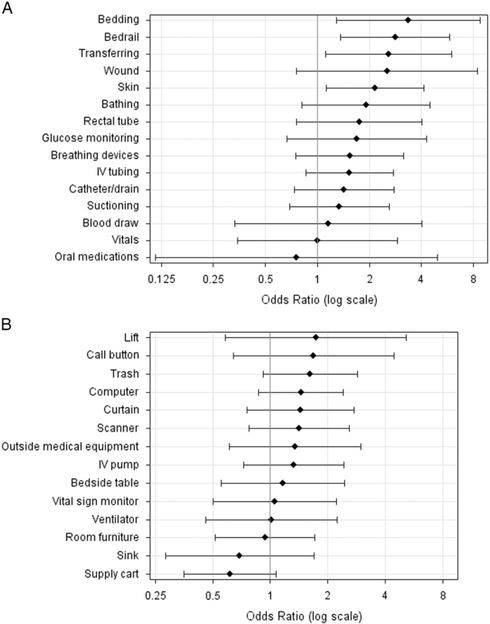
VRE were isolated from 71 of 469 HCWs’ gloves or gowns (15%) following patient care. Occupational/physical therapists, patient care technicians, nurses, and physicians were more likely than environmental services workers and other HCWs to have contaminated gloves or gowns. Compared to touching the environment alone, the odds ratio (OR) for VRE contamination associated with touching both the patient (or objects in the immediate vicinity of the patient) and environment was 2.78 (95% confidence interval CI, 0.99–0.77) and the OR associated with touching only the patient (or objects in the immediate vicinity) was 3.65 (95% CI, 1.17–11.41). Independent risk factors for transmission of VRE to HCWs were touching the patient’s skin (OR, 2.18; 95% CI, 1.15–4.13) and transferring the patient into or out of bed (OR, 2.66; 95% CI, 1.15–6.43).
Conclusion:
Patient contact is a major risk factor for HCW contamination and subsequent transmission. Interventions should prioritize contact precautions and hand hygiene for HCWs whose activities involve touching the patient. -
Keywords:
- Aged
- Cross Infection
- Equipment Contamination
- Female
- Gloves, Protective
- Gram-Positive Bacterial Infections
- Health Personnel
- Humans
- Infectious Disease Transmission, Professional-to-Patient
- Intensive Care Units
- Logistic Models
- Male
- Maryland
- Middle Aged
- Prospective Studies
- Protective Clothing
- Risk Factors
- Vancomycin Resistance
- Vancomycin-Resistant Enterococci
-
Source:Infect Control Hosp Epidemiol. 39(9):1063-1067
-
DOI:
-
Pubmed ID:30051793
-
Pubmed Central ID:PMC6442931
-
Document Type:
-
Funding:
-
Genre:
-
Volume:39
-
Issue:9
-
Download URL:
-
File Type:
 [PDF - 407.06 KB]
 -
Collection(s):
-
Main Document Checksum:urn:sha-512:ca7781140d80c6f110e8a8e094597197fdca79e2f176c9b0f10998d8aeb8cc3080ed9f3c77dc5d803da3c0c0a06dde707ecaf62f234a39b2dd4d81e66dab4fca
Supporting Files


File Language:
English
 Was this page helpful?
 Found an issue?

CDC STACKS serves as an archival repository of CDC-published products including
scientific findings, journal articles, guidelines, recommendations, or other public health information authored or
co-authored by CDC or funded partners.
As a repository, CDC STACKS retains documents in their original published format to ensure public access to scientific information.
As a repository, CDC STACKS retains documents in their original published format to ensure public access to scientific information.
You May Also Like
COLLECTION
CDC Public Access