



Comparison of Medicare claims-based proxy measures of poor function and associations with treatment receipt and mortality in older colon cancer patients.
Supporting Files

-
April 2019
-
Available in CDC Stacks on April 01, 2020, 12:00 AM
File Language:
English
Details
-
Journal Article:Med Care
-
Personal Author:
-
Description:Background:
Multiple claims-based proxy measures of poor function have been developed to address confounding in observational studies of drug effects in older adults. We evaluated agreement between these measures and their associations with treatment receipt and mortality in a cohort of older colon cancer patients.
Methods:
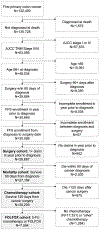
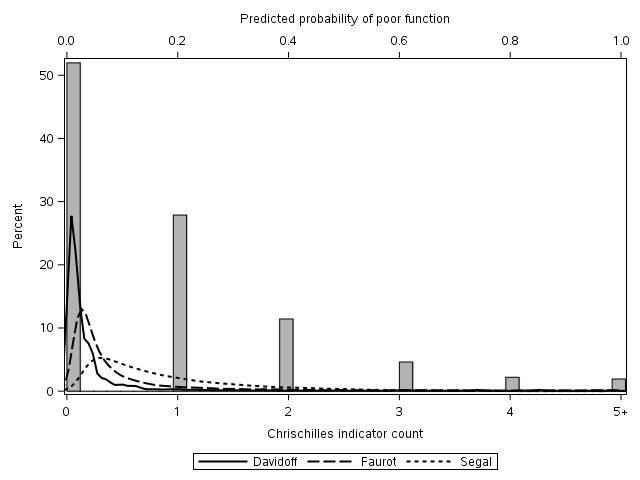
Medicare beneficiaries age 66+ diagnosed with stage II-III colon cancer were identified in the Surveillance, Epidemiology, and End Results-Medicare database (2004–2011). Poor function was operationalized by: (1) summing the total poor function indicators for each model and (2) estimating predicted probabilities of poor function at diagnosis. Agreement was evaluated using Fleiss’ kappa and Spearman’s correlation. Associations between proxy measures and (1) laparoscopic vs. open surgery, (2) chemotherapy vs. none, (3) 5-fluorouracil (5FU)+oxaliplatin (FOLFOX) vs. 5FU monotherapy, and (4) one-year mortality were estimated using log-binomial regression, controlling for age, sex, stage, and comorbidity. Survival estimates were stratified by functional group, age, and comorbidity.
Results:
Among 29,687 eligible colon cancer patients, 67% were 75+ years and 45% had stage III disease. Concordance across the poor function indicator counts was moderate (κ: 0.64) and correlation of predicted probability measures varied (ρ: 0.21–0.74). Worse function was associated with lower chemotherapy and FOLFOX receipt, and higher one-year mortality. Within age and comorbidity strata, poor function remained associated with mortality.
Conclusions:
While agreement varied across the claims-based proxy measures, each demonstrated anticipated associations with treatment receipt and mortality independent of comorbidity. Claims-based comparative effectiveness studies in older populations should consider applying one of these models to improve confounding control. -
Subjects:
- Article
- Frailty
- poor function
- algorithm
- administrative claims
- Medicare
- colon cancer
- Aged
- Aged, 80 and over
- Antineoplastic Combined Chemotherapy Protocols
- Chemotherapy, Adjuvant
- Colonic Neoplasms
- Comorbidity
- Female
- Fluorouracil
- Humans
- Insurance Claim Review
- Male
- Oxaliplatin
- SEER Program
- Treatment Outcome
- United States
-
Source:Med Care. 57(4):286-294
-
DOI:
-
Pubmed ID:30789540
-
Pubmed Central ID:PMC6417959
-
Document Type:
-
Funding:K12 CA120780/CA/NCI NIH HHS/United States ; UL1 TR001111/TR/NCATS NIH HHS/United States ; HHSN261201000140C/CA/NCI NIH HHS/United States ; HHSN261201000035C/CA/NCI NIH HHS/United States ; UL1 TR002489/TR/NCATS NIH HHS/United States ; HHSN261201000035I/CA/NCI NIH HHS/United States ; HHSN261201000034C/CA/NCI NIH HHS/United States ; U58 DP003862/DP/NCCDPHP CDC HHS/United States ; R01 AG056479/AG/NIA NIH HHS/United States
-
Genre:
-
Volume:57
-
Issue:4
-
Download URL:
-
File Type:
 [PDF - 558.22 KB]
 -
Collection(s):
-
Main Document Checksum:urn:sha-512:7cd2a6a7c64f73e6e2c84bcd60f9a521d5d7c2dc99a7f8acfd0c165e9731e2f9548a331023132dd02a18f1853b5ce3734f6c9e440cd95b333f498aa573bd0235
Supporting Files


File Language:
English
 Was this page helpful?
 Found an issue?



CDC STACKS serves as an archival repository of CDC-published products including
scientific findings, journal articles, guidelines, recommendations, or other public health information authored or
co-authored by CDC or funded partners.
As a repository, CDC STACKS retains documents in their original published format to ensure public access to scientific information.
As a repository, CDC STACKS retains documents in their original published format to ensure public access to scientific information.
You May Also Like
COLLECTION
CDC Public Access