



Potentially functional genetic variants in the complement-related immunity gene-set are associated with non-small cell lung cancer survival
Supporting Files

-
4 15 2019 ; 4-15-
-
Available in CDC Stacks on 2020-04-15T00:00:00Z
File Language:
English
Details
-
Alternative Title:Int J Cancer
-
Personal Author:Qian, Danwen ; Liu, Hongliang ; Wang, Xiaomeng ; Ge, Jie ; Luo, Sheng ; Patz, Edward F. ; Moorman, Patricia G. ; Su, Li ; Shen, Sipeng ; Christiani, David C. ; Wei, Qingyi
-
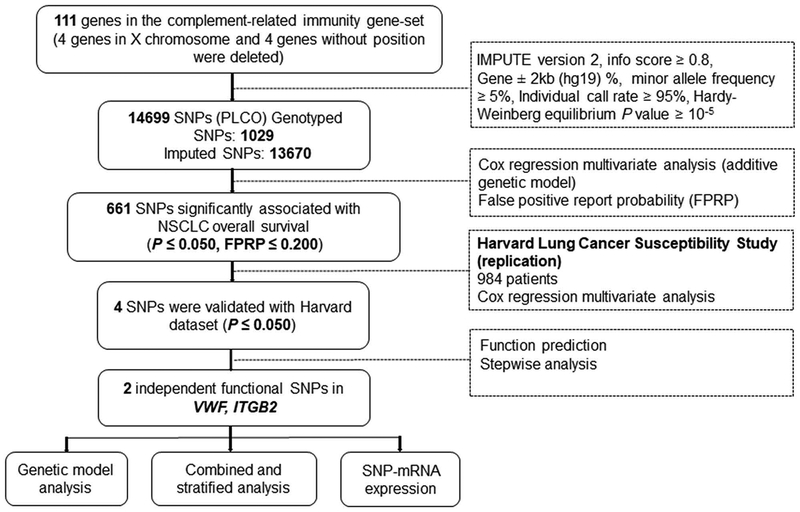
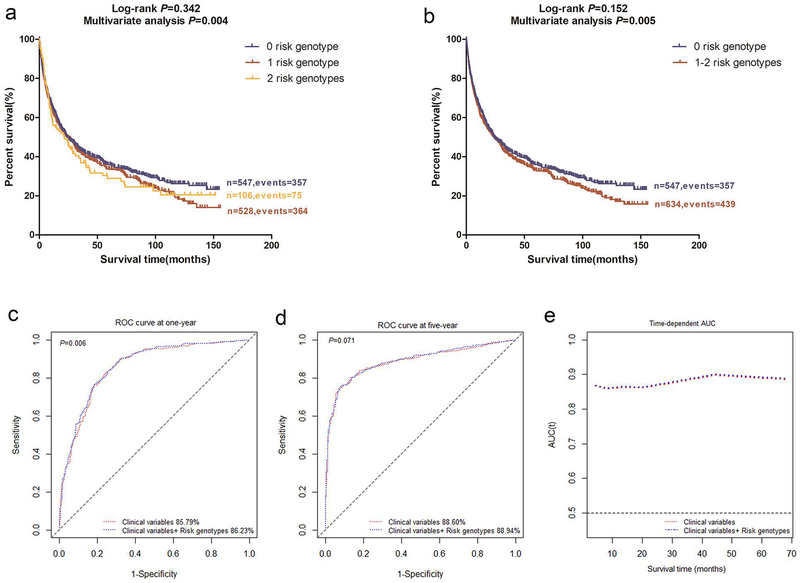
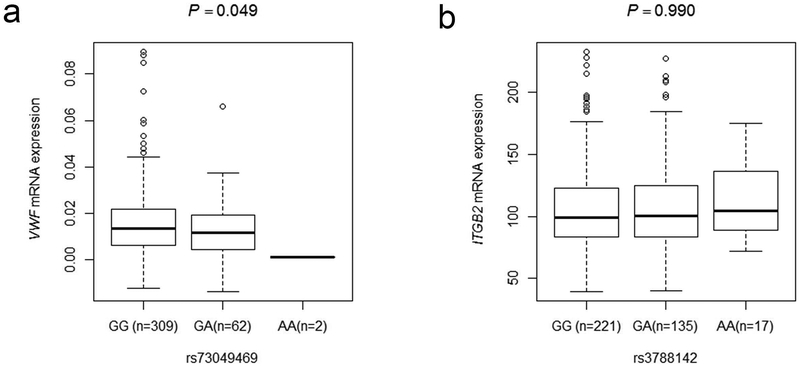
Description:The complement system plays an important role in the innate and adaptive immunity, complement components mediate tumor cytolysis of antibody-based immunotherapy, and complement activation in the tumor microenvironment may promote tumor progression or inhibition, depending on the mechanism of action. In the present study, we conducted a two-phase analysis of two independently published genome-wide association studies (GWASs) for associations between genetic variants in a complement-related immunity gene-set and overall survival of non-small cell lung cancer (NSCLC). The GWAS dataset from Prostate, Lung, Colorectal and Ovarian (PLCO) Cancer Screening Trial was used as the discovery, and multivariate Cox proportional hazards regression with false-positive report probability for multiple test corrections were performed to evaluate associations between 14,699 single-nucleotide polymorphisms (SNPs) in 111 genes and survival of 1,185 NSCLC patients. The identified significant SNPs in a single-locus analysis were further validated with 984 NSCLC patients in the GWAS dataset from the Harvard Lung Cancer Susceptibility (HLCS) Study. The results showed that two independent, potentially functional SNPs in two genes (VWF rs73049469 and ITGB2 rs3788142) were significantly associated with NSCLC survival, with a combined hazards ratio (HR) of 1.22 95% confidence interval (CI) = 1.07-1.40, P = 0.002 and 1.16 (1.07-1.27, 6.45 × 10| ), respectively. Finally, we performed expression quantitative trait loci (eQTL) analysis and found that survival-associated genotypes of VWF rs73049469 were also significantly associated with mRNA expression levels of the gene. These results indicated that genetic variants of the complement-related immunity genes might be predictors of NSCLC survival, particularly for the short-term survival, possibly by modulating the expression of genes involved in the host immunity.
-
Subjects:
- Adult
- Carcinoma, Non-Small-Cell Lung
- Complement Activation
- Complement System Proteins
- Datasets as Topic
- Female
- Follow-Up Studies
- Genome-Wide Association Study
- Humans
- Lung Neoplasms
- Male
- Polymorphism, Single Nucleotide
- Quantitative Trait Loci
- Survival Analysis
- Tumor Microenvironment
- Young Adult
- von Willebrand Factor
-
Keywords:
-
Source:Int J Cancer. 144(8):1867-1876
-
Pubmed ID:30259978
-
Pubmed Central ID:PMC6377316
-
Document Type:
-
Funding:P20 CA090578/CA/NCI NIH HHSUnited States/ ; R01 NS091307/NS/NINDS NIH HHSUnited States/ ; R01 CA092824/CA/NCI NIH HHSUnited States/ ; R35 CA197449/CA/NCI NIH HHSUnited States/ ; T42 OH008416/OH/NIOSH CDC HHSUnited States/ ; R01 CA074386/CA/NCI NIH HHSUnited States/ ; P50 CA090578/CA/NCI NIH HHSUnited States/ ; P30 CA014236/CA/NCI NIH HHSUnited States/ ; U01 CA209414/CA/NCI NIH HHSUnited States/
-
Volume:144
-
Issue:8
-
Download URL:
-
File Type:
 [PDF - 949.76 KB]
 -
Collection(s):
-
Main Document Checksum:urn:sha256:b0758d2e32a6fb4989885eceec0cd4664c89c7cf6aca1b2dbd4e145e6b4436ee
Supporting Files


File Language:
English
 Was this page helpful?
 Found an issue?

CDC STACKS serves as an archival repository of CDC-published products including
scientific findings, journal articles, guidelines, recommendations, or other public health information authored or
co-authored by CDC or funded partners.
As a repository, CDC STACKS retains documents in their original published format to ensure public access to scientific information.
As a repository, CDC STACKS retains documents in their original published format to ensure public access to scientific information.
You May Also Like
COLLECTION
CDC Public Access