



Associations between maternal plasma measurements of inflammatory markers and urinary levels of phenols and parabens during pregnancy: a repeated measures study
Supporting Files

-
2 10 2019
-
Available in CDC Stacks on February 10, 2020, 12:00 AM
File Language:
English
Details
-
Journal Article:Sci Total Environ
-
Personal Author:
-
Description:Background:
Maternal immune system regulation is critical for maintenance of a healthy pregnancy and fetal development. Exposure to phenols and parabens is widespread, and may be linked to systemic inflammation and alteration of circulating immunological biomarkers.
Objective:
We sought to characterize associations between repeated measures of individual urinary phenols, parabens and plasma inflammatory markers across pregnancy.
Methods:
In the LIFECODES prospective birth cohort, we conducted a nested preterm birth case-control study, including 130 cases and 352 controls. In urine samples collected from each participant at up to four study visits during pregnancy, we measured concentrations of six phenols and four parabens, as well as five plasma inflammatory markers. We used multivariable linear mixed models to analyze repeated measures of exposures on inflammatory markers. We created and applied inverse probability weights to account for the sampling approach.
Results:
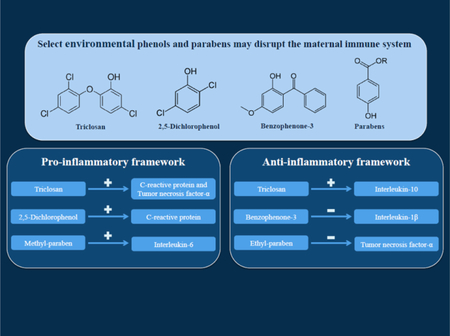
We observed bidirectional associations between select phenols and parabens and inflammatory markers. An interquartile range increase in triclosan (55.2 ng/mL) was associated with a 12.5% (95% CI: 3.67, 22.0) increase in C-reactive protein, a 7.95% (95% CI: 1.95, 14.3) increase in interleukin 10, and a 7.93% (95% CI: 3.82, 12,2) increase in tumor necrosis factor-α. Additionally, an interquartile range increase in 2,5-dichlorophenol (11.0 ng/mL) was associated with a 10% increase in C-reactive protein (95% CI: 1.92, 18.7). Conversely, an interquartile range increase in ethyl paraben (10.4 ng/mL) was associated with a 7.7% decrease in interleukin-1β (95% CI: −14.1, −0.86).
Conclusions:
Our findings can be organized into two thematic frameworks, one where concentrations of urinary phenols and parabens during pregnancy reflected a pro-inflammatory relationship with immunological biomarkers, and the other contrary theme – an anti-inflammatory relationship. These findings have implications for fetal development and reproductive outcomes, and emphasize the need for further research on immunological mechanisms of phenol and paraben action during pregnancy. -
Subjects:
-
Keywords:
-
Source:Sci Total Environ. 650(Pt 1):1131-1140
-
DOI:
-
Pubmed ID:30308801
-
Pubmed Central ID:PMC6236678
-
Document Type:
-
Funding:T42 OH008455/OH/NIOSH CDC HHSUnited States/ ; U2C ES026553/ES/NIEHS NIH HHSUnited States/ ; R01 ES018872/ES/NIEHS NIH HHSUnited States/ ; R01 MD013299/MD/NIMHD NIH HHSUnited States/ ; P01 ES022844/ES/NIEHS NIH HHSUnited States/ ; P42 ES017198/ES/NIEHS NIH HHSUnited States/ ; P50 ES026049/ES/NIEHS NIH HHSUnited States/ ; R01 AG055406/AG/NIA NIH HHSUnited States/ ; P30 ES017885/ES/NIEHS NIH HHSUnited States/
-
Genre:
-
Volume:650
-
Download URL:
-
File Type:
 [PDF - 423.65 KB]
 -
Collection(s):
-
Main Document Checksum:urn:sha-512:6c10351d94eaf62c62a19a9e41d13255d1d8d4d3bc13b2d7ae37f8ebe6f5b73bca65e47d14b975fcadb82f6c71b67de35a9b11312a7f469dc827ed23763586f0
Supporting Files


File Language:
English
 Was this page helpful?
 Found an issue?

CDC STACKS serves as an archival repository of CDC-published products including
scientific findings, journal articles, guidelines, recommendations, or other public health information authored or
co-authored by CDC or funded partners.
As a repository, CDC STACKS retains documents in their original published format to ensure public access to scientific information.
As a repository, CDC STACKS retains documents in their original published format to ensure public access to scientific information.
You May Also Like
COLLECTION
CDC Public Access