



Environmental phenol associations with ultrasound and delivery measures of fetal growth
Supporting Files

-
3 2018
-
Available in CDC Stacks on March 01, 2019, 12:00 AM
File Language:
English
Details
-
Alternative Title:Environ Int
-
Personal Author:
-
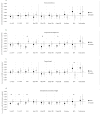
Description:Environmental phenols are used commonly in personal care products and exposure is widespread in pregnant women. In this study, we sought to assess the association between maternal urinary phenol concentrations in pregnancy and fetal growth. The study population included 476 mothers who participated in the prospective LIFECODES birth cohort between 2006 and 2008 at Brigham and Women's Hospital in Boston, Massachusetts, USA. Dichlorophenols (DCPs), benzophenone-3, parabens, triclosan, triclocarban, and bisphenol-S were measured in urine from three time points during pregnancy and averaged. Outcome measures were all standardized to create gestational-age specific z-scores and included: 1) birth weight; 2) ultrasound parameters measured at up to two time points in pregnancy (head and abdominal circumference and femur length); and 3) ultrasound estimates of fetal weight from two time points in combination with birth weight. Models were stratified to investigate sex differences. Inverse associations were observed between average 2,4- and 2,5-DCP concentrations and birth weight z-scores in males. For example, an interquartile range difference in 2,4-DCP was associated with a 0.18 standard deviation decrease in birth weight z-score (95% confidence interval CI=-0.33, -0.02). These associations were observed in models that included repeated ultrasound estimates of fetal weight during gestation as well. Also in males, we noted inverse associations between average triclosan exposure over pregnancy and estimated fetal weight combined with birth weight in repeated measures models. For females, associations were generally null. However, mothers with a detectable concentration of bisphenol-S at any of the study visits had lower weight females. In conclusion, we observed inverse associations between indicators of maternal phenol exposure during pregnancy and fetal growth, with several differences observed by sex.
-
Subjects:
-
Keywords:
-
Source:Environ Int. 112:243-250
-
Pubmed ID:29294443
-
Pubmed Central ID:PMC5899051
-
Document Type:
-
Funding:P42 ES017198/ES/NIEHS NIH HHSUnited States/ ; P50 ES026049/ES/NIEHS NIH HHSUnited States/ ; T42 OH008455/OH/NIOSH CDC HHSUnited States/ ; R01 ES018872/ES/NIEHS NIH HHSUnited States/ ; P01 ES022844/ES/NIEHS NIH HHSUnited States/ ; ZIA ES103321-01/Intramural NIH HHSUnited States/ ; P30 ES017885/ES/NIEHS NIH HHSUnited States/
-
Volume:112
-
Download URL:
-
File Type:
 [PDF - 463.95 KB]
 -
Collection(s):
-
Main Document Checksum:urn:sha-512:8bfeedf2ac9d7ef87032ceb5785ca15600f394915624a9ffc24e4148d6b3c8ad843945f9556b085b498a14957fac5911768ace9a346804339f180b2bb19bfc32
Supporting Files


File Language:
English
 Was this page helpful?
 Found an issue?


CDC STACKS serves as an archival repository of CDC-published products including
scientific findings, journal articles, guidelines, recommendations, or other public health information authored or
co-authored by CDC or funded partners.
As a repository, CDC STACKS retains documents in their original published format to ensure public access to scientific information.
As a repository, CDC STACKS retains documents in their original published format to ensure public access to scientific information.
You May Also Like
COLLECTION
CDC Public Access