


Risk Factors for Elizabethkingia Acquisition and Clinical Characteristics of Patients, South Korea
Supporting Files
Public Domain

-
January 2019
-
File Language:
English
Details
-
Alternative Title:Emerg Infect Dis
-
Personal Author:
-
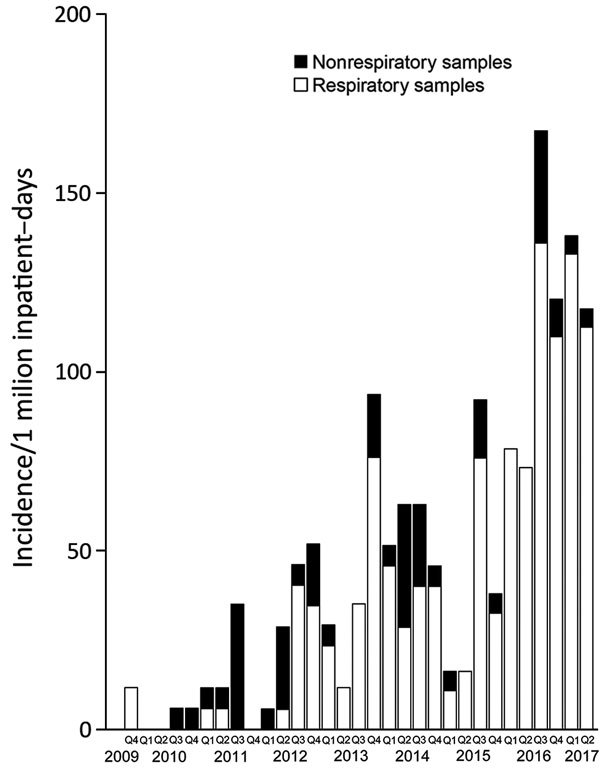
Description:Elizabethkingia infections are difficult to treat because of intrinsic antimicrobial resistance, and their incidence has recently increased. We conducted a propensity score-matched case-control study during January 2016-June 2017 in South Korea and retrospectively studied data from patients who were culture positive for Elizabethkingia species during January 2009-June 2017. Furthermore, we conducted epidemiologic studies of the hospital environment and mosquitoes. The incidence of Elizabethkingia increased significantly, by 432.1%, for 2016-2017 over incidence for 2009-2015. Mechanical ventilation was associated with the acquisition of Elizabethkingia species. Because Elizabethkingia infection has a high case-fatality rate and is difficult to eliminate, intensive prevention of contamination is needed.
-
Subjects:
-
Source:Emerg Infect Dis. 25(1):42-51
-
Pubmed ID:30561316
-
Pubmed Central ID:PMC6302585
-
Document Type:
-
Place as Subject:
-
Location:
-
Volume:25
-
Issue:1
-
Collection(s):
-
Main Document Checksum:urn:sha256:f7f55b802ac61578037bb56bc1495e0e85cb475891361fbd383b518d30413966
-
Download URL:
-
File Type:
 [PDF
- 2.44 MB
]
[PDF
- 2.44 MB
]
Supporting Files


File Language:
English
ON THIS PAGE




CDC STACKS serves as an archival repository of CDC-published products including
scientific findings,
journal articles, guidelines, recommendations, or other public health information authored or
co-authored by CDC or funded partners.
As a repository, CDC STACKS retains documents in their original published format to ensure public access to scientific information.
As a repository, CDC STACKS retains documents in their original published format to ensure public access to scientific information.
You May Also Like
COLLECTION
Emerging Infectious Diseases