



Antiretroviral drug concentrations in breastmilk, maternal HIV viral load, and HIV transmission to the infant: results from the BAN study
Supporting Files

-
4 01 2019
-
Available in CDC Stacks on April 01, 2020, 12:00 AM
File Language:
English
Details
-
Journal Article:J Acquir Immune Defic Syndr
-
Personal Author:
-
Description:Background:
Concentration of antiretroviral (ARV) drug found in plasma, and amounts of drug excreted into breastmilk, may affect HIV viral load and potentially perinatal HIV transmission.
Methods:
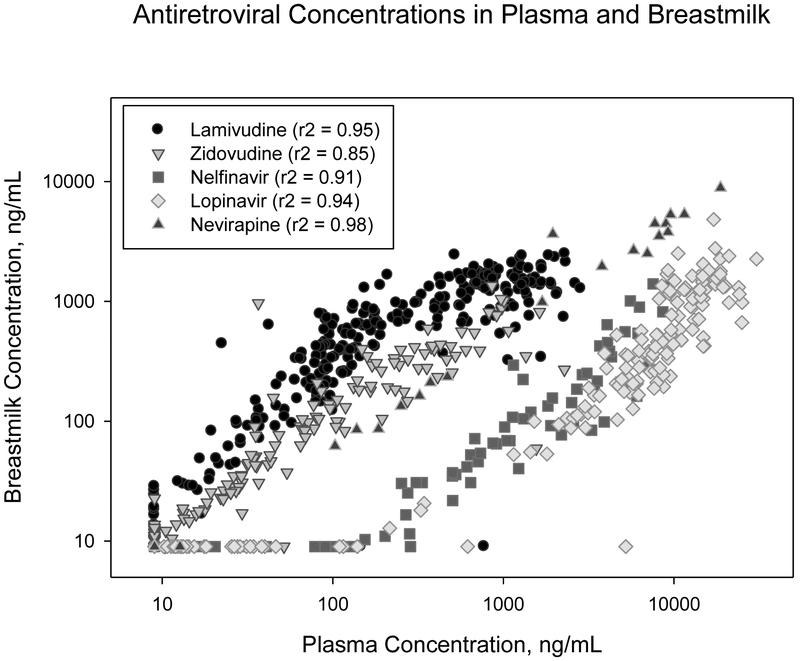
In this cohort study with two-phase sampling, we included mothers randomized to postpartum maternal ARVs or daily infant nevirapine during 28 weeks of breastfeeding in the Breastfeeding, Antiretrovirals and Nutrition (BAN) study. Among these, we included all mothers who transmitted HIV to their infants between 2-28 weeks and 15% of mothers who did not (n=27 and 227, respectively). Spearman correlation coefficients (r2) were used to assess correlation between maternal plasma and breastmilk ARV concentration. Associations between the median effective drug concentration (EC50) and detectable maternal viral load (plasma: >40 copies/ml, breastmilk: >56 copies/ml) were assessed using mixed effects models. Cox models were used to estimate the association between maternal or infant plasma drug concentration and breastmilk HIV transmission from 2-28 weeks.
Results:
All ARV compounds exhibited substantial correlations between maternal plasma and breastmilk concentrations (r2: 0.85-0.98, p-value <0.0001). Having plasma drug concentration above the EC50 was associated with lower odds of having detectable HIV RNA (maternal plasma OR 0.64, 95%CI 0.45-0.91; breastmilk OR 0.22, 95% CI 0.14-0.35) and a reduced rate of breastmilk HIV transmission (HR 0.40, 95% CI 0.18-0.93). Having breastmilk drug concentration above the EC50 was also associated with lower odds of having detectable maternal HIV RNA (plasma OR 0.62, 95%CI 0.45-0.85; breastmilk OR 0.42, 95% CI 0.29-0.59).
Conclusion:
Ensuring adequate drug concentration is important for viral suppression and preventing breastmilk HIV transmission. -
Subjects:
-
Source:J Acquir Immune Defic Syndr. 80(4):467-473
-
DOI:
-
Pubmed ID:30570527
-
Pubmed Central ID:PMC6391211
-
Document Type:
-
Funding:D43 TW001039/TW/FIC NIH HHSUnited States/ ; U48DP001944/ACL/ACL HHSUnited States/ ; R56 AI091547/AI/NIAID NIH HHSUnited States/ ; U01 AI068632/AI/NIAID NIH HHSUnited States/ ; R24 TW007988/TW/FIC NIH HHSUnited States/ ; CC999999/ImCDC/Intramural CDC HHSUnited States/ ; U48 DP000059/DP/NCCDPHP CDC HHSUnited States/ ; P30 AI050410/AI/NIAID NIH HHSUnited States/ ; T32 AI070114/AI/NIAID NIH HHSUnited States/ ; R03 AI100694/AI/NIAID NIH HHSUnited States/
-
Genre:
-
Volume:80
-
Issue:4
-
Download URL:
-
File Type:
 [PDF - 226.98 KB]
 -
Collection(s):
-
Main Document Checksum:urn:sha-512:a31735e8b40eb1bdb110837b86c2825ca45939d3242e66cdd8722f1c3b7cbe96c565f6ce75a1d5768804266d747870f7f3b99ace0f6935c16f94bf0cb803a381
Supporting Files


File Language:
English
 Was this page helpful?
 Found an issue?


CDC STACKS serves as an archival repository of CDC-published products including
scientific findings, journal articles, guidelines, recommendations, or other public health information authored or
co-authored by CDC or funded partners.
As a repository, CDC STACKS retains documents in their original published format to ensure public access to scientific information.
As a repository, CDC STACKS retains documents in their original published format to ensure public access to scientific information.
You May Also Like
COLLECTION
CDC Public Access