



Relationship of Joint Hypermobility with Ankle and Foot Radiographic Osteoarthritis and Symptoms in a Community-Based Cohort
Supporting Files

-
4 2019 ; 4-2019
-
Available in CDC Stacks on April 01, 2020, 12:00 AM

File Language:
English
Details
-
Alternative Title:Arthritis Care Res (Hoboken)
-
Personal Author:
-
Description:Objective.
To explore associations of joint hypermobility (a condition where range of motion is greater than normal) with ankle and foot radiographic osteoarthritis and symptoms in a large community-based cohort of African American and Caucasian adults 55–94 years old.
Methods.
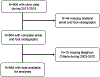
Ankle and foot radiographs and joint hypermobility data (Beighton Criteria) were available for 848 participants (2003–2010) in this cross-sectional study. General joint hypermobility was defined as a Beighton score ≥4 (range 0–9); knee hypermobility was defined as hyperextension of at least one knee. Standing anteroposterior and lateral foot radiographs were read with standard atlases for Kellgren-Lawrence grade, osteophytes and joint space narrowing at the tibiotalar joint and for osteophytes and joint space narrowing to define osteoarthritis at five foot joints. Ankle or foot symptoms were self-reported. Separate person-based logistic regression models were used to estimate associations of ankle and foot osteoarthritis and symptom outcomes with hypermobility measures, adjusting for age, sex, race, body mass index, and history of ankle/foot injury.
Results.
This sample was: 68% women and 33% African American; mean age=71 years; mean body mass index=31 kg/m2; general joint hypermobility=7%, knee hypermobility=4%; ankle injury=11.5%, foot injury=3.8%. Although general joint hypermobility was not associated with ankle and foot outcomes, knee hypermobility was associated with ankle symptoms, foot symptoms, and talonavicular osteoarthritis (adjusted odds ratios of 4.4, 2.4, and 3.0, respectively).
Conclusions.
Knee joint hypermobility may be related to talonavicular osteoarthritis and to ankle and foot symptoms. -
Keywords:
-
Source:Arthritis Care Res (Hoboken). 71(4):538-544
-
Pubmed ID:29953742
-
Pubmed Central ID:PMC6310667
-
Document Type:
-
Funding:R01 AR067743/AR/NIAMS NIH HHSUnited States/ ; U01 DP006266/DP/NCCDPHP CDC HHSUnited States/ ; K23 AR061406/AR/NIAMS NIH HHSUnited States/ ; S3486/CDC/Association of Schools of Public HealthInternational/ ; U01 DP003206/DP/NCCDPHP CDC HHSUnited States/ ; U01DP003206/ACL/ACL HHSUnited States/ ; S043/CDC/Association of Schools of Public HealthInternational/ ; P30 AG028716/AG/NIA NIH HHSUnited States/ ; P30 AR072580/AR/NIAMS NIH HHSUnited States/ ; R01 AR047853/AR/NIAMS NIH HHSUnited States/ ; P60 AR064166/AR/NIAMS NIH HHSUnited States/
-
Volume:71
-
Issue:4
-
Download URL:
-
File Type:
 [PDF - 429.35 KB]
 -
Collection(s):
-
Main Document Checksum:urn:sha256:197c83f778f32db3447bbcfe99fbfed9d6987eb5d4b86f3654c1f32fa17a52cf
Supporting Files


File Language:
English
 Was this page helpful?
 Found an issue?


CDC STACKS serves as an archival repository of CDC-published products including
scientific findings, journal articles, guidelines, recommendations, or other public health information authored or
co-authored by CDC or funded partners.
As a repository, CDC STACKS retains documents in their original published format to ensure public access to scientific information.
As a repository, CDC STACKS retains documents in their original published format to ensure public access to scientific information.
You May Also Like
COLLECTION
CDC Public Access