



Effect of Media Use on Adolescent Body Weight
Supporting Files
Public Domain

-
Nov 21 2018
File Language:
English
Details
-
Journal Article:Preventing Chronic Disease (PCD)
-
Personal Author:
-
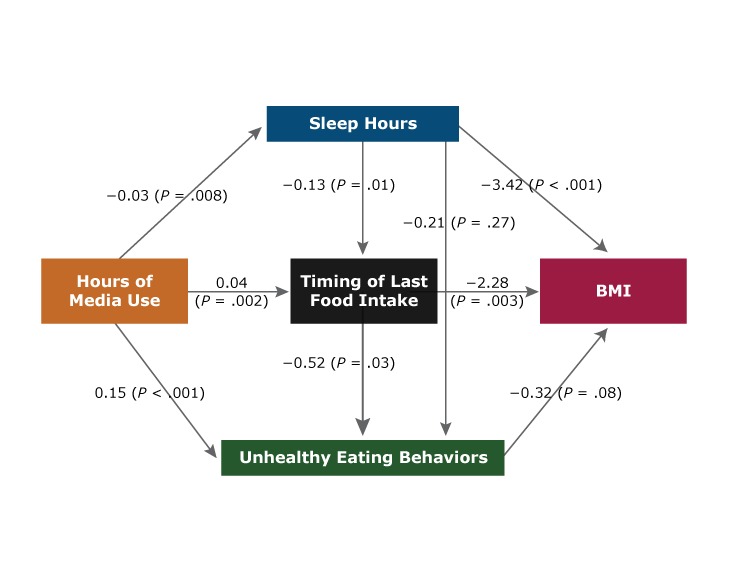
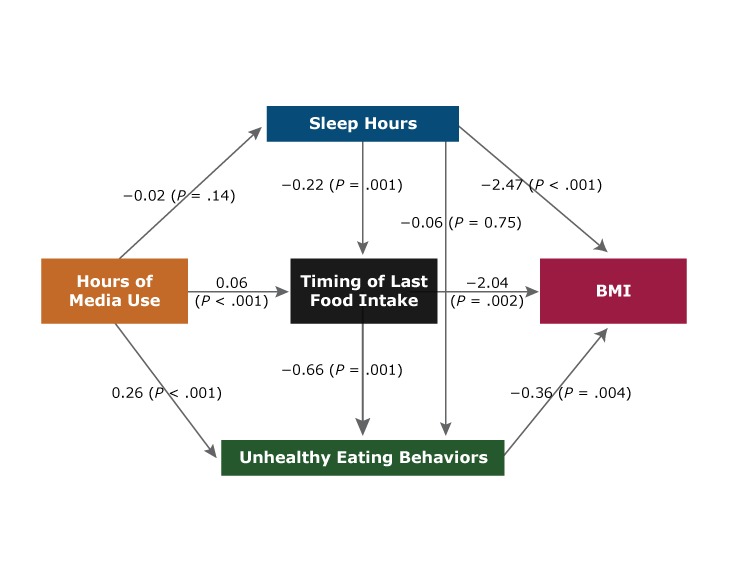
Description:Introduction ; Adolescents spend a substantial amount of time consuming media, including watching television, playing video games, and using electronic devices to access the internet. We examined the relationship between prolonged media use on screen devices and its potential association with obesity through several mechanisms. ; Methods ; We used data from 659,288 eighth and eleventh grade students who participated in the 2015–2016 School Physical Activity and Nutrition (SPAN) survey in Texas to examine the associations between hours of media use per day and 3 behaviors related to obesity: timing of last food intake, unhealthy eating behavior, and sleep hours. Also, mediation analyses were conducted to examine the pathways between hours of media use and body mass index (BMI). ; Results ; Compared with adolescents who used media 2 hours or less per day, those who used media 6 hours or more had higher odds of nighttime eating (odds ratio OR, 3.16; 95% confidence interval CI, 1.76–5.66) and inadequate sleep (OR, 1.57; 95% CI, 1.05–2.36) and a higher coefficient for Unhealthy Eating Index score (3.87; 95% CI, 1.3–6.37). Mediation analysis demonstrated that for males sleep hours and timing of last food intake mediated the pathway between hours of media use and BMI. For females, unhealthy eating behavior mediated this pathway. ; Conclusion ; Adolescents who used electronic media 6 or more hours at night had higher odds of unhealthy eating behavior and inadequate sleep hours than those with 2 hours’ use or less. Attention to behaviors associated with adolescents’ prolonged media use is needed to reduce risk of obesity.
-
Subjects:
-
Source:Prev Chronic Dis. 15
-
DOI:
-
ISSN:1545-1151
-
Pubmed ID:30468423
-
Pubmed Central ID:PMC6266426
-
Document Type:
-
Place as Subject:
-
Location:
-
Volume:15
-
Download URL:
-
File Type:
 [PDF - 410.05 KB]
 -
Collection(s):
-
Main Document Checksum:urn:sha-512:0cd44e34e514dbaeae51b38fe1db98e290bda2f6f1cc5acfa53ff8fc3545839357080df714bc7becb7049abefccb936db4a58851938ce4fb613c185174959774
Supporting Files


File Language:
English
 Was this page helpful?
 Found an issue?

CDC STACKS serves as an archival repository of CDC-published products including
scientific findings, journal articles, guidelines, recommendations, or other public health information authored or
co-authored by CDC or funded partners.
As a repository, CDC STACKS retains documents in their original published format to ensure public access to scientific information.
As a repository, CDC STACKS retains documents in their original published format to ensure public access to scientific information.
You May Also Like
COLLECTION
Preventing Chronic Disease