



Human Exposure to Novel Bartonella Species from Contact with Fruit Bats
Supporting Files
Public Domain

-
December 2018
File Language:
English
Details
-
Alternative Title:Emerg Infect Dis
-
Personal Author:Bai, Ying ; Osinubi, Modupe O.V. ; Osikowicz, Lynn ; McKee, Clifton ; Vora, Neil M. ; Rizzo, Maria Rosales ; Recuenco, Sergio ; Davis, Lora ; Niezgoda, Mike ; Ehimiyein, Ajoke M. ; Kia, Grace S.N. ; Oyemakinde, Akin ; Adeniyi, Olufunmilayo Sanni ; Gbadegesin, Yemi H. ; Saliman, Olugbon A. ; Ogunniyi, Abiodun ; Ogunkoya, Albert B. ; Kosoy, Michael Y.
-
Corporate Authors:
-
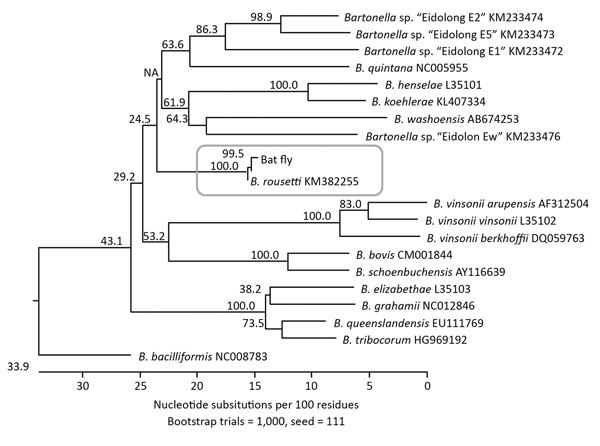
Description:Twice a year in southwestern Nigeria, during a traditional bat festival, community participants enter designated caves to capture bats, which are then consumed for food or traded. We investigated the presence of Bartonella species in Egyptian fruit bats (Rousettus aegyptiacus) and bat flies (Eucampsipoda africana) from these caves and assessed whether Bartonella infections had occurred in persons from the surrounding communities. Our results indicate that these bats and flies harbor Bartonella strains, which multilocus sequence typing indicated probably represent a novel Bartonella species, proposed as Bartonella rousetti. In serum from 8 of 204 persons, we detected antibodies to B. rousetti without cross-reactivity to other Bartonella species. This work suggests that bat-associated Bartonella strains might be capable of infecting humans.
-
Subjects:
-
Source:Emerg Infect Dis. 24(12):2317-2323
-
Pubmed ID:30457529
-
Pubmed Central ID:PMC6256376
-
Document Type:
-
Place as Subject:
-
Location:
-
Volume:24
-
Issue:12
-
Download URL:
-
File Type:
 [PDF - 794.60 KB]
 -
Collection(s):
-
Main Document Checksum:urn:sha256:d766eed5c765c21f331886bcc0656afe5ec9782bfeff84b8dcf9b5feb13cbbbd
Supporting Files


File Language:
English
 Was this page helpful?
 Found an issue?

CDC STACKS serves as an archival repository of CDC-published products including
scientific findings, journal articles, guidelines, recommendations, or other public health information authored or
co-authored by CDC or funded partners.
As a repository, CDC STACKS retains documents in their original published format to ensure public access to scientific information.
As a repository, CDC STACKS retains documents in their original published format to ensure public access to scientific information.
You May Also Like
COLLECTION
Emerging Infectious Diseases