


Autochthonous Human Case of Seoul Virus Infection, the Netherlands
Supporting Files
Public Domain

-
December 17 2018
-
File Language:
English
Details
-
Alternative Title:Emerg Infect Dis
-
Personal Author:
-
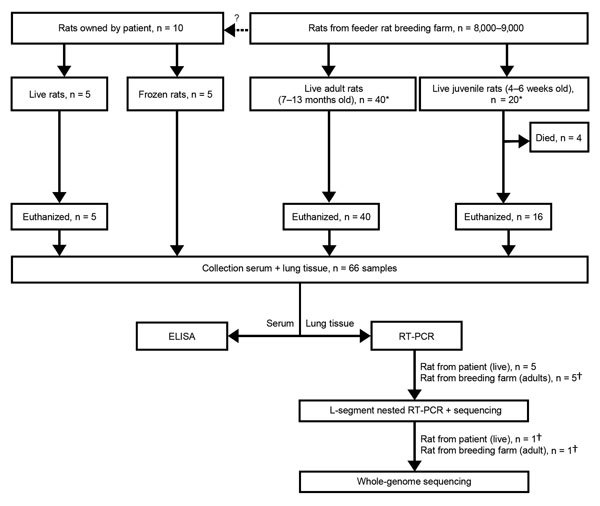
Description:Orthohantaviruses are a group of rodentborne viruses with a worldwide distribution. The orthohantavirus Seoul virus (SEOV) can cause hemorrhagic fever with renal syndrome in humans and is distributed worldwide, like its reservoir host, the rat. Cases of SEOV in wild and pet rats have been described in several countries, and human cases have been reported in the United Kingdom, France, Canada, and the United States. In the Netherlands, SEOV has previously been found in wild brown rats. We describe an autochthonous human case of SEOV infection in the Netherlands. This patient had nonspecific clinical symptoms of an orthohantavirus infection (gastrointestinal symptoms and distinct elevation of liver enzymes). Subsequent source investigation revealed 2 potential sources, the patient's feeder rats and a feeder rat farm. At both sources, a high prevalence of SEOV was found in the rats. The virus closely resembled the Cherwell and Turckheim SEOV strains that were previously found in Europe.
-
Subjects:
-
Source:Emerg Infect Dis. 24(12):2158-2163
-
Pubmed ID:30067176
-
Pubmed Central ID:PMC6256391
-
Document Type:
-
Place as Subject:
-
Volume:24
-
Issue:12
-
Collection(s):
-
Main Document Checksum:urn:sha256:6c16cd251fc8293b5466a65eb2e2709fe2d3a63f428f288581abef28b4a71b8b
-
Download URL:
-
File Type:
 [PDF
- 766.96 KB
]
[PDF
- 766.96 KB
]
Supporting Files


File Language:
English
ON THIS PAGE



CDC STACKS serves as an archival repository of CDC-published products including
scientific findings,
journal articles, guidelines, recommendations, or other public health information authored or
co-authored by CDC or funded partners.
As a repository, CDC STACKS retains documents in their original published format to ensure public access to scientific information.
As a repository, CDC STACKS retains documents in their original published format to ensure public access to scientific information.
You May Also Like
COLLECTION
Emerging Infectious Diseases