


Crimean-Congo Hemorrhagic Fever Virus, Mongolia, 2013–2014
Supporting Files
Public Domain

-
December 2018
-
File Language:
English
Details
-
Alternative Title:Emerg Infect Dis
-
Personal Author:
-
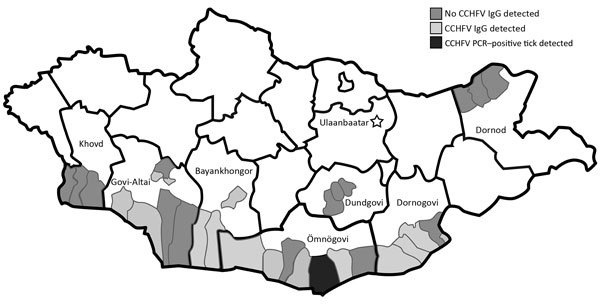
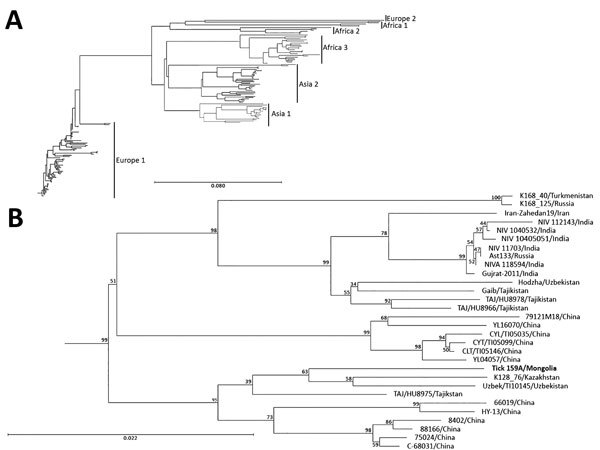
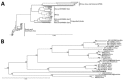
Description:During 2013-2014, we collected 1,926 serum samples from humans and 4,583 ticks (Hyalomma asiaticum or Dermacentor nuttalli) in select regions of Mongolia to determine the risk for Crimean-Congo hemorrhagic fever virus (CCHFV) infection among humans in this country. Testing of human serum samples by ELISA demonstrated an overall CCHFV antibody prevalence of 1.4%; Bayankhongor Province had the highest prevalence, 2.63%. We pooled and analyzed tick specimens by real-time reverse transcription PCR; 1 CCHFV-positive H. asiaticum tick pool from Ömnögovi was identified. In phylogenetic analyses, the virus's partial small segment clustered with CCHFV isolates from Central Asia, and the complete medium segment grouped with CCHFV isolates from Africa, Asia, and the Middle East. This study confirms CCHFV endemicity in Mongolia and provides information on risk for CCHFV infection. Further research is needed to better define the risk for CCHFV disease to improve risk mitigation, diagnostics, and surveillance.
-
Subjects:
-
Source:Emerg Infect Dis. 24(12):2202-2209
-
Pubmed ID:30457521
-
Pubmed Central ID:PMC6256378
-
Document Type:
-
Genre:
-
Place as Subject:
-
Volume:24
-
Issue:12
-
Collection(s):
-
Main Document Checksum:urn:sha256:0a81d186c523161fe601fcd0e2e1fa93c53a4698c06214e0d57a563a0efdcf20
-
Download URL:
-
File Type:
 [PDF
- 909.62 KB
]
[PDF
- 909.62 KB
]
Supporting Files


File Language:
English
ON THIS PAGE


CDC STACKS serves as an archival repository of CDC-published products including
scientific findings,
journal articles, guidelines, recommendations, or other public health information authored or
co-authored by CDC or funded partners.
As a repository, CDC STACKS retains documents in their original published format to ensure public access to scientific information.
As a repository, CDC STACKS retains documents in their original published format to ensure public access to scientific information.
You May Also Like
COLLECTION
Emerging Infectious Diseases