


Environmental Assessment and Blood Lead Levels of Children in Owino Uhuru and Bangladesh Settlements in Kenya
Supporting Files
Public Domain

-
Jun 11 2018
-
File Language:
English
Details
-
Alternative Title:J Health Pollut
-
Personal Author:
-
Description:Background.
Lead exposure is linked to intellectual disability and anemia in children. The United States Centers for Disease Control and Prevention (CDC) recommends biomonitoring of blood lead levels (BLLs) in children with BLL ≥5 μg/dL and chelation therapy for those with BLL ≥45 μg/dL.
Objectives.
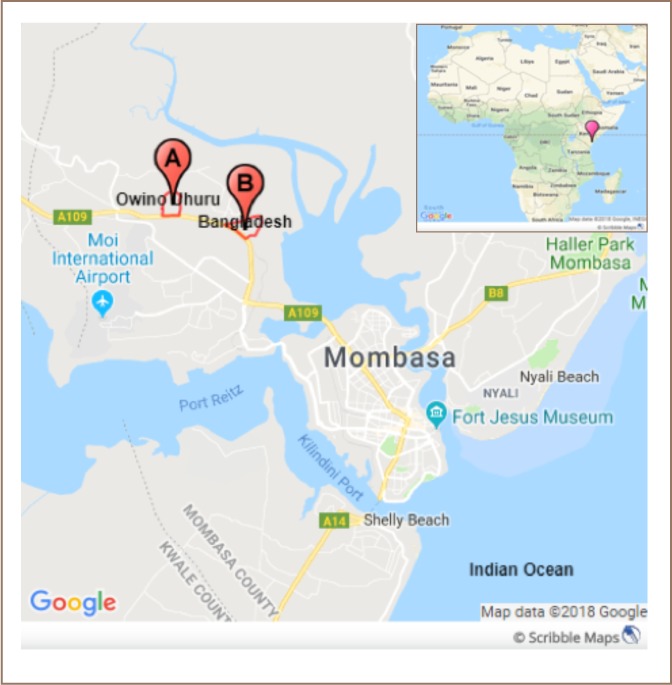
This study aimed to determine blood and environmental lead levels and risk factors associated with elevated BLL among children from Owino Uhuru and Bangladesh settlements in Mombasa County, Kenya.
Methods.
The present study is a population-based, cross-sectional study of children aged 12–59 months randomly selected from households in two neighboring settlements, Owino Uhuru, which has a lead smelter, and Bangladesh settlement (no smelter). Structured questionnaires were administered to parents and 1–3 ml venous blood drawn from each child was tested for lead using a LeadCare ® II portable analyzer. Environmental samples collected from half of the sampled households were tested for lead using graphite furnace atomic absorption spectroscopy.
Results:
We enrolled 130 children, 65 from each settlement. Fifty-nine (45%) were males and the median age was 39 months (interquartile range (IQR): 30–52 months). BLLs ranged from 1 μg/dL to 31 μg/dL, with 45 (69%) children from Owino Uhuru and 18 (28%) children from Bangladesh settlement with BLLs >5 μg/dL. For Owino Uhuru, the geometric mean BLL in children was 7.4 μg/dL (geometric standard deviation (GSD); 1.9) compared to 3.7 μg/dL (GSD: 1.9) in Bangladesh settlement (p<0.05). The geometric mean lead concentration of soil samples from Owino Uhuru was 146.5 mg/Kg (GSD: 5.2) and 11.5 mg/Kg (GSD: 3.9) (p<0.001) in Bangladesh settlement. Children who resided <200 m from the lead smelter were more likely to have a BLL ≥5 μg/dL than children residing ≥200 m from the lead smelter (adjusted odds ratio (aOR): 33.6 (95% confidence interval (CI): 7.4–153.3). Males were also more likely than females to have a BLL ≥5 μg/dL (39, 62%) compared to a BLL<5 μg/dL [aOR: 2.4 (95% CI: 1.0–5.5)].
Conclusions.
Children in Owino Uhuru had significantly higher BLLs compared with children in Bangladesh settlement. Interventions to diminish continued exposure to lead in the settlement should be undertaken. Continued monitoring of levels in children with detectable levels can evaluate whether interventions to reduce exposure are effective.
Participant Consent.
Obtained
Ethics Approval.
Scientific approval for the study was obtained from the Ministry of Health, lead poisoning technical working group. Since this investigation was considered a public health response of immediate concern, expedited ethical approval was obtained from the Kenya Medical Research Institute and further approval from the Mombasa County Department of Health Services. The investigation was considered a non-research public health response activity by the CDC.
Competing Interests.
The authors declare no competing financial interests.
-
Subjects:
-
Source:J Health Pollut. 2018; 8(18)
-
Pubmed Central ID:PMC6239056
-
Document Type:
-
Place as Subject:
-
Volume:8
-
Issue:18
-
Collection(s):
-
Main Document Checksum:urn:sha256:c42469293dafe25f004818fd9c0d5927a8b127e4192ceb44d8dfa5f5576f993d
-
Download URL:
-
File Type:
 [PDF
- 2.62 MB
]
[PDF
- 2.62 MB
]
Supporting Files


File Language:
English
ON THIS PAGE


CDC STACKS serves as an archival repository of CDC-published products including
scientific findings,
journal articles, guidelines, recommendations, or other public health information authored or
co-authored by CDC or funded partners.
As a repository, CDC STACKS retains documents in their original published format to ensure public access to scientific information.
As a repository, CDC STACKS retains documents in their original published format to ensure public access to scientific information.
You May Also Like
COLLECTION
CDC Public Access