


Low T-cell subsets prior to development of virus-associated cancer in HIV-seronegative men who have sex with men
Supporting Files

-
2018
-
File Language:
English
Details
-
Alternative Title:Cancer Causes Control
-
Personal Author:
-
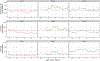
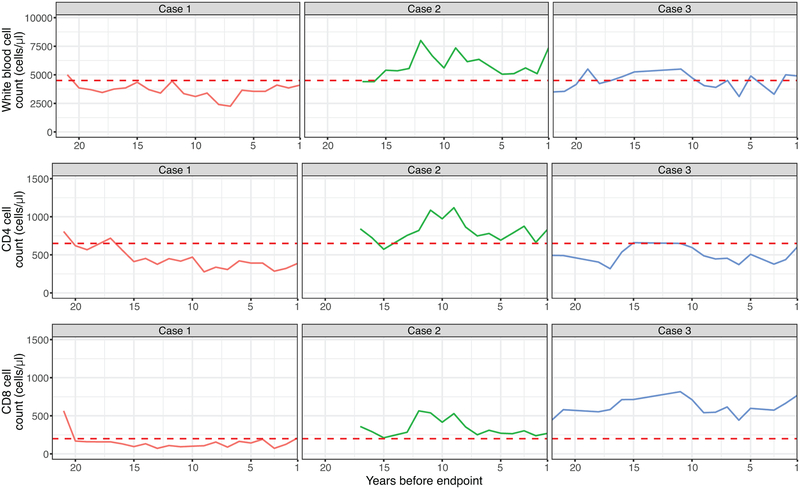
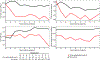
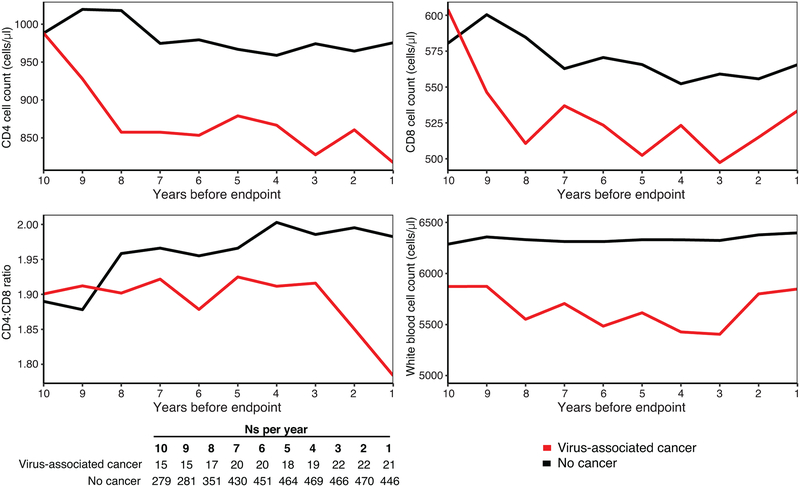
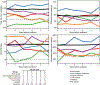
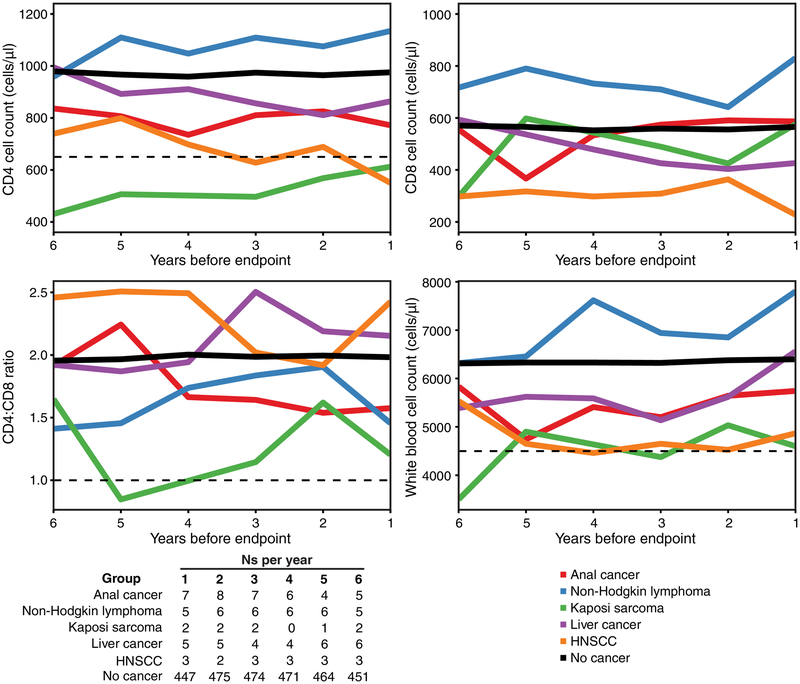
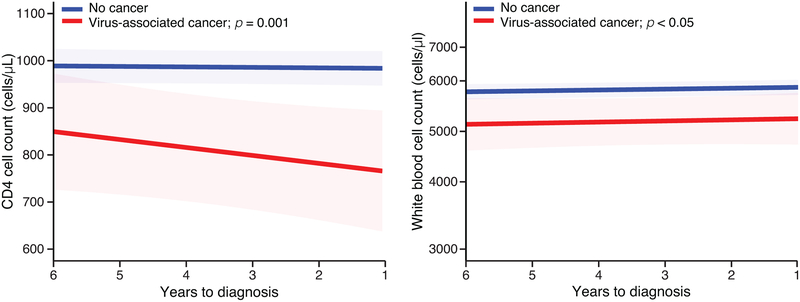
Description:Immunological parameters that influence susceptibility to virus-associated cancers in HIV-seronegative individuals are unclear. We conducted a case-control cohort study of immunological parameters associated with development of incident virus-associated cancers among 532 HIV-seronegative men who have sex with men (MSM) enrolled in the Multicenter AIDS Cohort Study (MACS) with median (IQR) 21 (8-26) years of follow-up. Thirty-two incident virus-associated cancers (anal cancer, non-Hodgkin lymphoma, liver cancer, other cancers with etiologies linked to human papillomavirus, Epstein-Barr virus, hepatitis B virus, or human herpesvirus-8) were identified among 3,408 HIV-seronegative men in the MACS during 1984-2010. Cases were matched for demographics, smoking, and follow-up to 500 controls without cancer. Mixed-effects and Cox regression models were used to examine associations between nadir or recent CD4, CD8, and white blood cell (WBC) counts or CD4:CD8 ratios and subsequent diagnosis of virus-associated cancers. Men with incident virus-associated cancers had lower CD4 and WBC counts over a 6-year window prior to diagnosis compared to men without cancer (p = 0.001 and 0.03, respectively). Low CD4 cell count and nadir, CD4 count-nadir differential, and CD4:CD8 ratio nadir were associated with increased 2-year risk of incident virus-associated cancers in models adjusted for demographics and smoking (hazard ratios 1.2-1.3 per 100 or 0.1 unit decrease, respectively; p < 0.01). Other associated factors included heavy smoking and past or current hepatitis B virus infection. These findings show that low CD4 cell counts, CD4 nadir, and CD4:CD8 cell ratios are independent predictors for subsequent risk of virus-associated cancers in HIV-seronegative MSM.
-
Subjects:
-
Keywords:
-
Source:Cancer Causes Control. 29(11):1131-1142
-
Pubmed ID:30315476
-
Pubmed Central ID:PMC6245112
-
Document Type:
-
Funding:U01 AI035042/AI/NIAID NIH HHSUnited States/ ; DA028994/DA/NIDA NIH HHSUnited States/ ; T32 AI007386/AI/NIAID NIH HHSUnited States/ ; DA30985/DA/NIDA NIH HHSUnited States/ ; T32 CA070083/CA/NCI NIH HHSUnited States/ ; U01 AI035041/AI/NIAID NIH HHSUnited States/ ; UM1 AI035043/AI/NIAID NIH HHSUnited States/ ; U58 DP000795/DP/NCCDPHP CDC HHSUnited States/ ; R01 DA030985/DA/NIDA NIH HHSUnited States/ ; DP1 DA028994/DA/NIDA NIH HHSUnited States/ ; HHSN261201000035I/CA/NCI NIH HHSUnited States/ ; U58 DP003862/DP/NCCDPHP CDC HHSUnited States/ ; U01 AI035040/AI/NIAID NIH HHSUnited States/ ; U01 AI035039/AI/NIAID NIH HHSUnited States/ ; HHSN261201000140C/CA/NCI NIH HHSUnited States/ ; DA40391/DA/NIDA NIH HHSUnited States/ ; T32 AG000222/AG/NIA NIH HHSUnited States/ ; TR000424/TR/NCATS NIH HHSUnited States/ ; UL1 TR000424/TR/NCATS NIH HHSUnited States/ ; AG000222/AG/NIA NIH HHSUnited States/ ; HHSN261201000035C/PC/NCI NIH HHSUnited States/ ; HHSN261201000034C/CA/NCI NIH HHSUnited States/ ; U01 AI035043/AI/NIAID NIH HHSUnited States/ ; R01 DA040391/DA/NIDA NIH HHSUnited States/ ; UL1 TR001102/TR/NCATS NIH HHSUnited States/ ; TR001102/TR/NCATS NIH HHSUnited States/ ; UL1 TR003098/TR/NCATS NIH HHSUnited States/
-
Volume:29
-
Issue:11
-
Collection(s):
-
Main Document Checksum:urn:sha256:e6ffff09e8e4d69310e1949eae785c11b936cdad9b0cfc5b6a6608814fc3105f
-
Download URL:
-
File Type:
 [PDF
- 1.12 MB
]
[PDF
- 1.12 MB
]
Supporting Files


File Language:
English
ON THIS PAGE

CDC STACKS serves as an archival repository of CDC-published products including
scientific findings,
journal articles, guidelines, recommendations, or other public health information authored or
co-authored by CDC or funded partners.
As a repository, CDC STACKS retains documents in their original published format to ensure public access to scientific information.
As a repository, CDC STACKS retains documents in their original published format to ensure public access to scientific information.
You May Also Like
COLLECTION
CDC Public Access