



Associations of Cumulative Exposure to Heavy Metal Mixtures with Obesity and Its Comorbidities Among U.S. Adults in NHANES 2003-2014
Supporting Files

-
12 2018 ; 12-2018
-
Available in CDC Stacks on December 01, 2019, 12:00 AM
File Language:
English
Details
-
Alternative Title:Environ Int
-
Personal Author:
-
Description:Background:
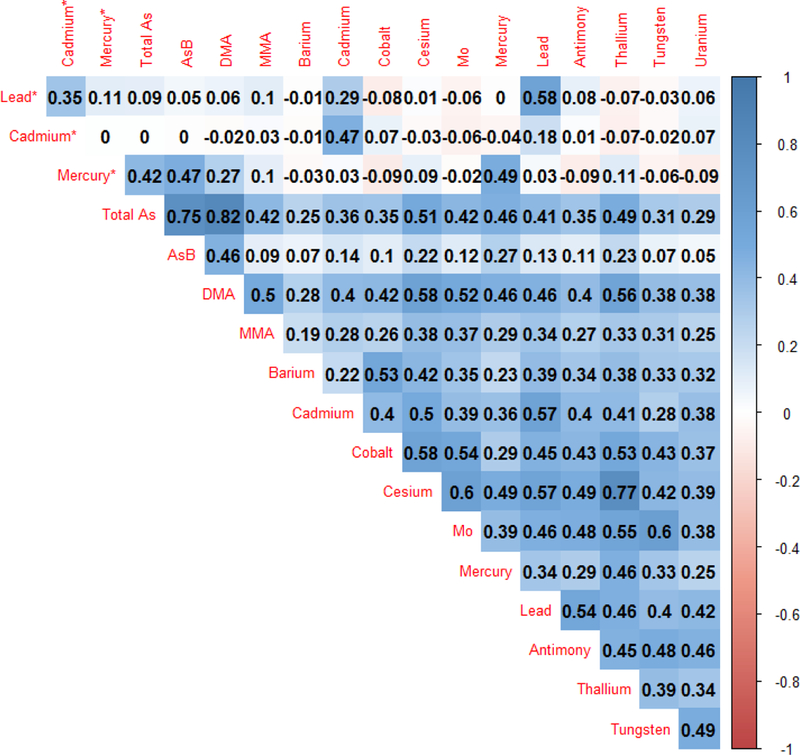
Some heavy metals (e.g., arsenic, cadmium, lead, mercury) have been associated with obesity and obesity comorbidities. The analytical approach for those associations has typically focused on individual metals. There is a growing interest in evaluating the health effects of cumulative exposure to metal mixtures.
Objectives:
We utilized our Environmental Risk Score (ERS), a summary measure to examine the risk of exposure to multi-pollutants in epidemiologic research, to evaluate the associations of cumulative exposure to a mixture of correlated heavy metals with obesity and its comorbidities including hypertension, and type-2 diabetes mellitus (T2DM) while accounting for high degree correlations and interactions among metal mixtures components.
Methods:
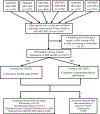
We examined blood and urinary markers of 18 heavy metals among 9,537 adults in NHANES 2003–2014. We randomly split data into a training set for the construction of ERS (n=6,675) and a testing set for the evaluation of its statistical performance (n=2,862). ERS of heavy metal mixtures was computed for waist circumference using adaptive elastic-net (AENET) with 189 predictors including 18 main effects, 18 squared terms, and 153 pairwise interactions of heavy metals. Regression analyses with complex survey designs were performed to assess the associations of ERS with other obesity measures, hypertension and T2DM.
Results:
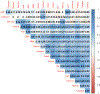
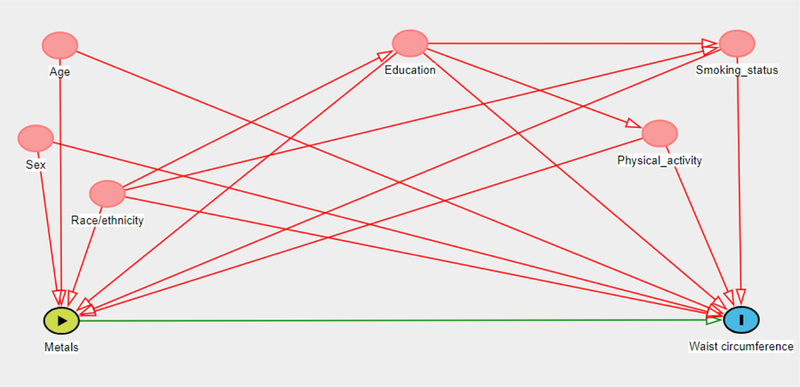
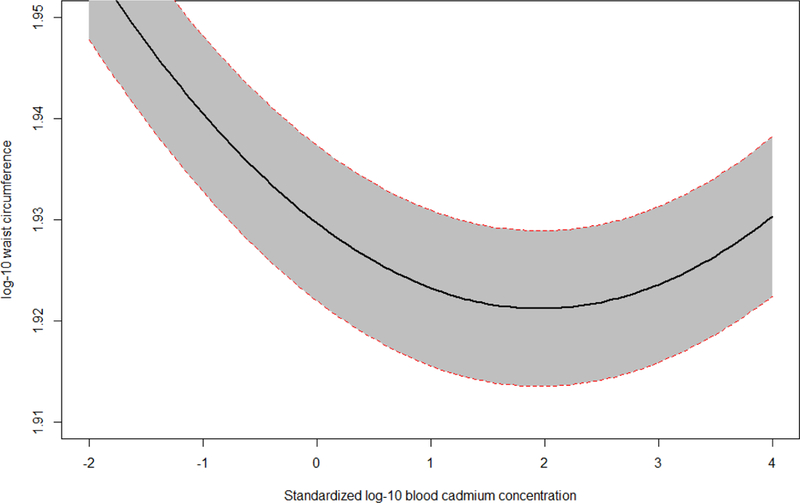
7 main effects (blood lead, blood cadmium, blood mercury, and urinary markers of monomethylarsonic acid (MMA), barium, mercury and thallium), 4 squared terms (blood cadmium, urinary cadmium, urinary antimony and urinary tungsten), and 7 pairwise interactions (blood lead & urinary cadmium, blood lead & urinary MMA, blood lead & urinary uranium, urinary cadmium & urinary MMA, urinary dimethylarsinic acid (DMA) & urinary tungsten, urinary MMA & urinary cobalt, and urinary lead & urinary antimony) were selected by AENET for construction of ERS of waist circumference-related metal mixtures. An increase in ERS from 10th percentile to 90th percentile in the overall study population was significantly associated with 4.50 kg/m2 (95% CI: 4.06, 4.94) higher BMI, 4.16 mm (95% CI: 3.56, 4.76) higher skinfold thickness, and 4.11 kg (95% CI: 0.83, 7.40) higher total body fat, independent of age, sex, race/ethnicity, education, smoking status, physical activity and NHANES cycle (Ps < 0.05). Significant associations of ERS with both hypertension and T2DM were also observed (Ps < 0.05).
Conclusions:
Our study suggests that cumulative exposure to heavy metals as mixtures is associated with obesity and its related chronic conditions such as hypertension and T2DM. Additional research is needed to confirm these findings in longitudinal settings. -
Keywords:
-
Source:Environ Int. 121(Pt 1):683-694
-
Pubmed ID:30316184
-
Pubmed Central ID:PMC6268112
-
Document Type:
-
Funding:T42 OH008455/OH/NIOSH CDC HHSUnited States/ ; P30 DK092926/DK/NIDDK NIH HHSUnited States/ ; T42OH008455/ACL/ACL HHSUnited States/ ; P30 ES017885/ES/NIEHS NIH HHSUnited States/ ; R01 ES026578/ES/NIEHS NIH HHSUnited States/ ; R21 ES020811/ES/NIEHS NIH HHSUnited States/ ; P30 DK020572/DK/NIDDK NIH HHSUnited States/ ; R01 ES026964/ES/NIEHS NIH HHSUnited States/ ; U01 AG017719/AG/NIA NIH HHSUnited States/
-
Volume:121
-
Download URL:
-
File Type:
 [PDF - 861.82 KB]
 -
Collection(s):
-
Main Document Checksum:urn:sha256:3916d975196d1a69f70dace1feaa9ef5cd38a5e8669f4e5aacb5b41a9aaa33a7
Supporting Files


File Language:
English
 Was this page helpful?
 Found an issue?




CDC STACKS serves as an archival repository of CDC-published products including
scientific findings, journal articles, guidelines, recommendations, or other public health information authored or
co-authored by CDC or funded partners.
As a repository, CDC STACKS retains documents in their original published format to ensure public access to scientific information.
As a repository, CDC STACKS retains documents in their original published format to ensure public access to scientific information.
You May Also Like
COLLECTION
CDC Public Access