



Multimorbidity is associated with uptake of influenza vaccination
Supporting Files

-
6 14 2018
-
Available in CDC Stacks on 2019-06-14T00:00:00Z
File Language:
English
Details
-
Journal Article:Vaccine
-
Personal Author:
-
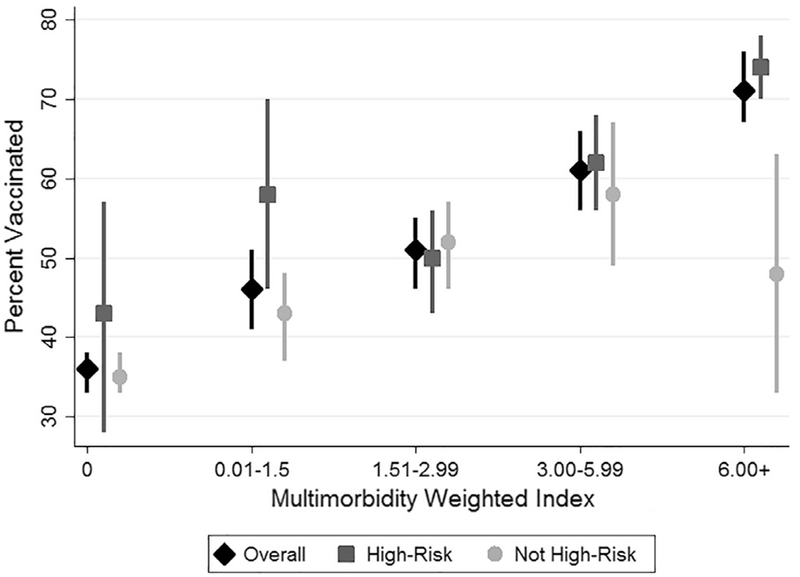
Description:Objective: ; Patients with chronic conditions have higher rates of severe influenza-related illness and mortality. However, influenza vaccination coverage in high-risk populations continues to be suboptimal. We describe the association between cumulative disease morbidity, measured by a previously validated multimorbidity index, and influenza vaccination among community-dwelling adults. ; Methods: ; We obtained interview and medical record data for participants ≥18 years who sought outpatient care for influenza-like illness between 2011 and 2016 as part of an outpatient-based study of influenza vaccine effectiveness. We defined cumulative disease morbidity by using medical diagnosis codes to calculate a multimorbidity-weighted index (MWI) for each participant. MWI and influenza vaccination status was evaluated by logistic regression. Akaike information criterion was calculated for all models. ; Results: ; Overall, 1458 (48%) of participants out of a total of 3033 received influenza vaccination. The median MWI was 0.9 (IQR 0.00–3.5) and was higher among vaccinated participants (median 1.6 versus 0.0; p < 0.001). We found a positive linear association between MWI and vaccination, and vaccination percentages were compared between categories of MWI. Compared to patients with no multimorbidity (MWI = 0), odds of vaccination were 17% higher in the second category (MWI 0.01–1.50; OR: 1.17, 95% CI: 0.92–1.50), 58% higher in the third category (MWI 1.51–3.00; OR: 1.58, 95% CI: 1.26–1.99), 130% higher in the fourth category (MWI 3.01–6.00; OR: 2.30, 95% CI: 1.78–2.98) and 214% higher in the fifth category (MWI 6.01–45.00; OR: 3.14, 95% CI: 2.41–4.10). Participants defined as high-risk had 86% greater odds of being vaccinated than non-high-risk individuals (OR: 1.86, 95% CI: 1.56–2.21). The AIC was lowest for MWI compared with high-risk conditions. ; Conclusions: ; Our results suggest a dose response relationship between level of multimorbidity and likelihood of influenza vaccination. Compared with high-risk condition designations, MWI provided improved precision and a better model fit for the measurement of chronic disease and influenza vaccination.
-
Subjects:
-
Keywords:
-
Source:Vaccine. 36(25):3635-3640
-
DOI:
-
Pubmed ID:29748031
-
Pubmed Central ID:PMC6258008
-
Document Type:
-
Funding:
-
Genre:
-
Volume:36
-
Issue:25
-
Download URL:
-
File Type:
 [PDF - 127.38 KB]
 -
Collection(s):
-
Main Document Checksum:urn:sha-512:6c57904a26e59ac732200f5b8b92a3cf187db76c7b419db440fa30b35adf6d9a6a8bc05fe90533493cd94cb044e1cb88463546e0b15da01c0732730b6cd06378
Supporting Files


File Language:
English
 Was this page helpful?
 Found an issue?


CDC STACKS serves as an archival repository of CDC-published products including
scientific findings, journal articles, guidelines, recommendations, or other public health information authored or
co-authored by CDC or funded partners.
As a repository, CDC STACKS retains documents in their original published format to ensure public access to scientific information.
As a repository, CDC STACKS retains documents in their original published format to ensure public access to scientific information.
You May Also Like
COLLECTION
CDC Public Access