



Factors Predicting Client Re-Enrollment in Tobacco Cessation Services in a State Quitline
Supporting Files

-
Oct 18 2018
File Language:
English
Details
-
Journal Article:Preventing Chronic Disease (PCD)
-
Personal Author:
-
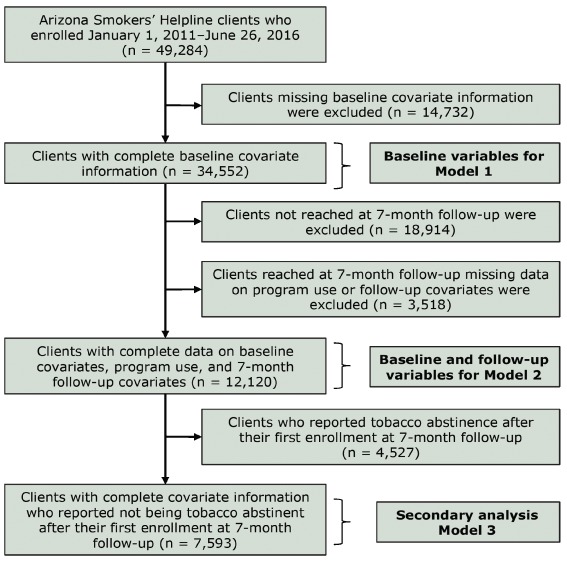
Description:Introduction ; Quitlines are an integral part of tobacco treatment programs and reach groups of smokers who have a wide range of barriers to cessation. Although tobacco dependence is chronic and relapsing, little research exists on factors that predict the likelihood of clients re-engaging and reconnecting with quitlines for treatment. The objective of this study was to describe factors that predict the re-enrollment of clients in Arizona’s state quitline. ; Methods ; This was a retrospective analysis of data collected from clients (N = 49,284) enrolled in the Arizona Smokers’ Helpline from January 2011 through June 2016. We used logistic regression to analyze predictors of re-enrollment in services after controlling for theoretically relevant baseline variables (eg, nicotine dependence, smokers in the home) and follow-up variables (eg, program use, quit outcome). ; Results ; Compared with clients who reported being quit after their first enrollment, clients who reported not being quit were almost 3 times as likely to re-enroll (odds ratio = 2.89; 95% confidence interval, 2.54–3.30). Other predictors were having a chronic condition or a mental health condition, greater nicotine dependence, and lower levels of social support. Women and clients not having other smokers in the home were more likely to re-enroll than were men and clients not living with other smokers. ; Conclusion ; Understanding baseline and in-program factors that predict client-initiated re-enrollment can help quitlines tailor strategies to proactively re-engage clients who may have difficulty maintaining long-term abstinence.
-
Subjects:
-
Source:Prev Chronic Dis. 15
-
DOI:
-
ISSN:1545-1151
-
Pubmed ID:30339773
-
Pubmed Central ID:PMC6198673
-
Document Type:
-
Funding:
-
Volume:15
-
Download URL:
-
File Type:
 [PDF - 393.77 KB]
 -
Collection(s):
-
Main Document Checksum:urn:sha-512:fc5b15ff4bc5cffde24b27bca24794a8840aac4c9aecaf12d403c89c83c41c05689843bda3597bfb35f556d457ae8f8232f3e2faab398f790c4ffdd8e8f48d02
Supporting Files


File Language:
English
 Was this page helpful?
 Found an issue?


CDC STACKS serves as an archival repository of CDC-published products including
scientific findings, journal articles, guidelines, recommendations, or other public health information authored or
co-authored by CDC or funded partners.
As a repository, CDC STACKS retains documents in their original published format to ensure public access to scientific information.
As a repository, CDC STACKS retains documents in their original published format to ensure public access to scientific information.
You May Also Like
COLLECTION
Preventing Chronic Disease