


Multihospital Outbreak of a Middle East Respiratory Syndrome Coronavirus Deletion Variant, Jordan: A Molecular, Serologic, and Epidemiologic Investigation
Supporting Files
Public Domain

-
Apr 28 2018
-
File Language:
English
Details
-
Journal Article:Open Forum Infect Dis
-
Personal Author:Payne, Daniel C. ; Biggs, Holly M. ; Al-Abdallat, Mohammad Mousa ; Alqasrawi, Sultan ; Lu, Xiaoyan ; Abedi, Glen R. ; Haddadin, Aktham ; Iblan, Ibrahim ; Alsanouri, Tarek ; Al Nsour, Mohannad ; Sheikh Ali, Sami ; Rha, Brian ; Trivedi, Suvang U. ; Rasheed, Mohammed Ata Ur ; Tamin, Azaibi ; Lamers, Mart M. ; Haagmans, Bart L. ; Erdman, Dean D. ; Thornburg, Natalie J. ; Gerber, Susan I.
-
Description:Background
An outbreak of Middle East respiratory syndrome coronavirus (MERS-CoV) in Jordan in 2015 involved a variant virus that acquired distinctive deletions in the accessory open reading frames. We conducted a molecular and seroepidemiologic investigation to describe the deletion variant’s transmission patterns and epidemiology.
Methods
We reviewed epidemiologic and medical chart data and analyzed viral genome sequences from respiratory specimens of MERS-CoV cases. In early 2016, sera and standardized interviews were obtained from MERS-CoV cases and their contacts. Sera were evaluated by nucleocapsid and spike protein enzyme immunoassays and microneutralization.
Results
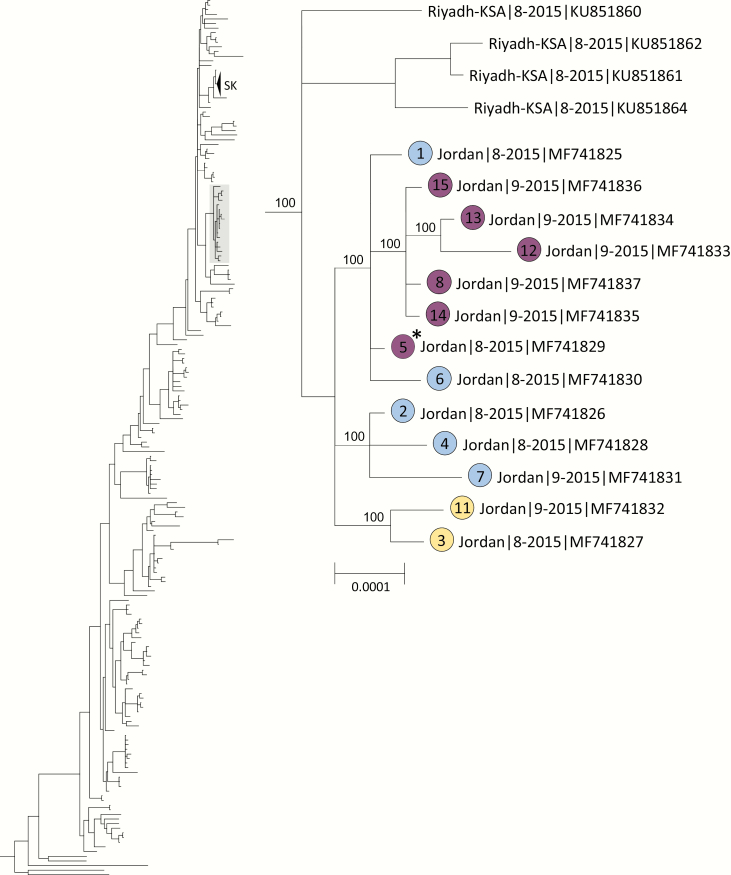
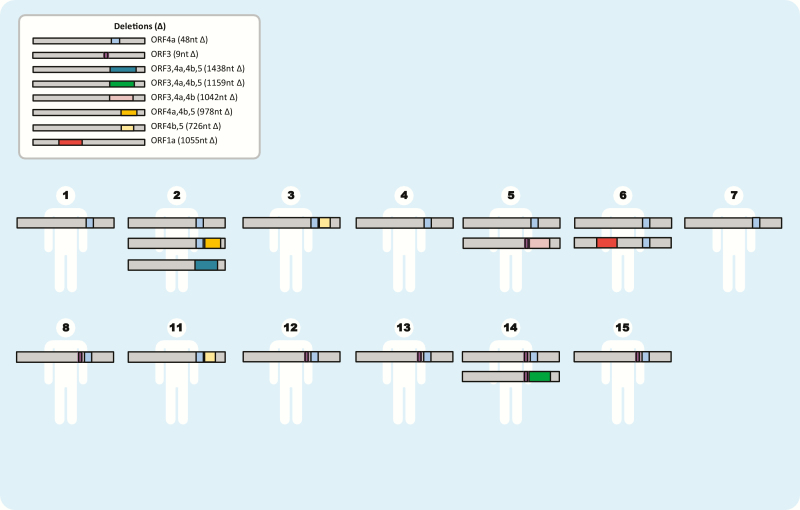
Among 16 cases, 11 (69%) had health care exposure and 5 (31%) were relatives of a known case; 13 (81%) were symptomatic, and 7 (44%) died. Genome sequencing of MERS-CoV from 13 cases revealed 3 transmissible deletions associated with clinical illness during the outbreak. Deletion variant sequences were epidemiologically clustered and linked to a common transmission chain. Interviews and sera were collected from 2 surviving cases, 23 household contacts, and 278 health care contacts; 1 (50%) case, 2 (9%) household contacts, and 3 (1%) health care contacts tested seropositive.
Conclusions
The MERS-CoV deletion variants retained human-to-human transmissibility and caused clinical illness in infected persons despite accumulated mutations. Serology suggested limited transmission beyond that detected during the initial outbreak investigation.
-
Subjects:
-
Source:Open Forum Infect Dis. 2018; 5(5).
-
DOI:
-
Pubmed ID:30294616
-
Pubmed Central ID:PMC5965092
-
Document Type:
-
Genre:
-
Place as Subject:
-
Volume:5
-
Issue:5
-
Collection(s):
-
Main Document Checksum:urn:sha-512:e76fb9895f9eed2e76be88a2aaf723b8df240f3a4c34310e7f1e81ba94dfadf7eb6bfb1679c690e6fa909bdee2b395d655144d306e99189828a239f6201393f1
-
Download URL:
-
File Type:
 [PDF
- 265.64 KB
]
[PDF
- 265.64 KB
]
Supporting Files


File Language:
English
ON THIS PAGE



CDC STACKS serves as an archival repository of CDC-published products including
scientific findings,
journal articles, guidelines, recommendations, or other public health information authored or
co-authored by CDC or funded partners.
As a repository, CDC STACKS retains documents in their original published format to ensure public access to scientific information.
As a repository, CDC STACKS retains documents in their original published format to ensure public access to scientific information.
You May Also Like
COLLECTION
CDC Public Access