



Restriction enzyme digestion of host DNA enhances universal detection of parasitic pathogens in blood via targeted amplicon deep sequencing
Supporting Files
Public Domain

-
September 17 2018
-
Available in CDC Stacks on September 17, 2018, 12:00 AM
File Language:
English
Details
-
Alternative Title:Microbiome
-
Personal Author:
-
Description:Background
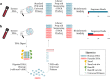
Targeted amplicon deep sequencing (TADS) of the 16S rRNA gene is commonly used to explore and characterize bacterial microbiomes. Meanwhile, attempts to apply TADS to the detection and characterization of entire parasitic communities have been hampered since conserved regions of many conserved parasite genes, such as the 18S rRNA gene, are also conserved in their eukaryotic hosts. As a result, targeted amplification of 18S rRNA from clinical samples using universal primers frequently results in competitive priming and preferential amplification of host DNA. Here, we describe a novel method that employs a single pair of universal primers to capture all blood-borne parasites while reducing host 18S rRNA template and enhancing the amplification of parasite 18S rRNA for TADS. This was achieved using restriction enzymes to digest the 18S rRNA gene at cut sites present only in the host sequence prior to PCR amplification.
Results
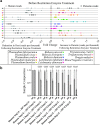
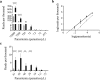
This method was validated against 16 species of blood-borne helminths and protozoa. Enzyme digestion prior to PCR enrichment and Illumina amplicon deep sequencing led to a substantial reduction in human reads and a corresponding 5- to 10-fold increase in parasite reads relative to undigested samples. This method allowed for discrimination of all common parasitic agents found in human blood, even in cases of multi-parasite infection, and markedly reduced the limit of detection in digested versus undigested samples.
Conclusions
The results herein provide a novel methodology for the reduction of host DNA prior to TADS and establish the validity of a next-generation sequencing-based platform for universal parasite detection.
Electronic supplementary material
The online version of this article (10.1186/s40168-018-0540-2) contains supplementary material, which is available to authorized users. -
Subjects:
-
Source:Microbiome. 6
-
Pubmed ID:30223888
-
Pubmed Central ID:PMC6142370
-
Document Type:
-
Volume:6
-
Download URL:
-
File Type:
 [PDF - 1.80 MB]
 -
Collection(s):
-
Main Document Checksum:urn:sha256:8d7b718cbfa639eaa6fae24a901d11b683a1ddb0cf5ff1e40f70ac3ec57aa0b2
Supporting Files


File Language:
English
 Was this page helpful?
 Found an issue?










CDC STACKS serves as an archival repository of CDC-published products including
scientific findings, journal articles, guidelines, recommendations, or other public health information authored or
co-authored by CDC or funded partners.
As a repository, CDC STACKS retains documents in their original published format to ensure public access to scientific information.
As a repository, CDC STACKS retains documents in their original published format to ensure public access to scientific information.
You May Also Like
COLLECTION
CDC Public Access