


Pilot randomized controlled trial of a Mediterranean diet or diet supplemented with fish oil, walnuts, and grape juice in overweight or obese US adults
Supporting Files

-
May 31 2018
-
File Language:
English
Details
-
Alternative Title:BMC Nutr
-
Personal Author:
-
Description:Background:
The 2015–2020 Dietary Guidelines for Americans recommend a Mediterranean-type diet as one of three healthful eating patterns. However, only one previous trial has evaluated the effects of a Mediterranean diet intervention in a US sample population.
Methods:
To address this gap, we conducted a pilot, non-blinded, 8-week randomized controlled trial on the comparative efficacy of consumption of a Mediterranean diet or a diet supplemented with fish oil, walnuts, and grape juice versus controls. Participants (overweight or obese US adults; 73% female and mean age 51 years) were randomly assigned to one of three groups: (1) Mediterranean diet; (2) habitual high-fat American-type diet supplemented with fish oil, walnuts, and grape juice; or (3) habitual high-fat American-type diet (controls). Intent-to-treat analysis of within-subject differences (Student’s paired t-test or Wilcoxon sign ranks test) and between-subject differences (mixed-effects models with a group-by-time interaction term, adjusted for baseline health outcome) was conducted.
Results:
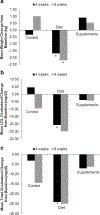
Participants in the Mediterranean diet arm (n = 11) had significantly greater weight loss despite no significant change in total caloric intake, and lower plasma cystine, indicative of decreased oxidative stress, compared to controls (n = 9) at both 4 and 8 weeks. Compared to controls, they also had significantly lower total cholesterol and low-density lipoprotein cholesterol levels at 4 weeks. Participants in the supplement arm (n = 10) had significantly lower adiponectin levels compared to controls at 4 weeks. No significant improvements in endothelial function or inflammatory biomarkers were observed in either intervention group compared to controls.
Conclusion:
These results suggest that adopting a dietary pattern reflecting a Mediterranean diet improves weight and cardio-metabolic health among overweight or obese US adults, and may be more beneficial than supplementing habitual American diets with fish oil, walnuts, and grape juice.
-
Subjects:
-
Source:BMC Nutr. 4.
-
Pubmed ID:30271610
-
Pubmed Central ID:PMC6159217
-
Document Type:
-
Funding:R56 HL126558/HL/NHLBI NIH HHS/United States ; K24 DK096574/DK/NIDDK NIH HHS/United States ; CC999999/Intramural CDC HHS/United States ; UL1 TR000454/TR/NCATS NIH HHS/United States ; U01 HL079156/HL/NHLBI NIH HHS/United States ; U10 HL110302/HL/NHLBI NIH HHS/United States ; P20 HL113451/HL/NHLBI NIH HHS/United States ; P01 HL101398/HL/NHLBI NIH HHS/United States
-
Volume:4
-
Collection(s):
-
Main Document Checksum:urn:sha256:f31ed0159017693e8bf3c2c7e6f2f43fd8de6a9f8f42f9b331477c735fe261a6
-
Download URL:
-
File Type:
 [PDF
- 633.99 KB
]
[PDF
- 633.99 KB
]
Supporting Files


File Language:
English
ON THIS PAGE


CDC STACKS serves as an archival repository of CDC-published products including
scientific findings,
journal articles, guidelines, recommendations, or other public health information authored or
co-authored by CDC or funded partners.
As a repository, CDC STACKS retains documents in their original published format to ensure public access to scientific information.
As a repository, CDC STACKS retains documents in their original published format to ensure public access to scientific information.
You May Also Like
COLLECTION
CDC Public Access