



The Neighborhood Alcohol Environment and Injury Risk: A Spatial Analysis of Pedestrian Injury in Baltimore City
Supporting Files

-
March 27 2018
-
File Language:
English
Details
-
Alternative Title:Inj Prev
-
Personal Author:
-
Description:Objectives:
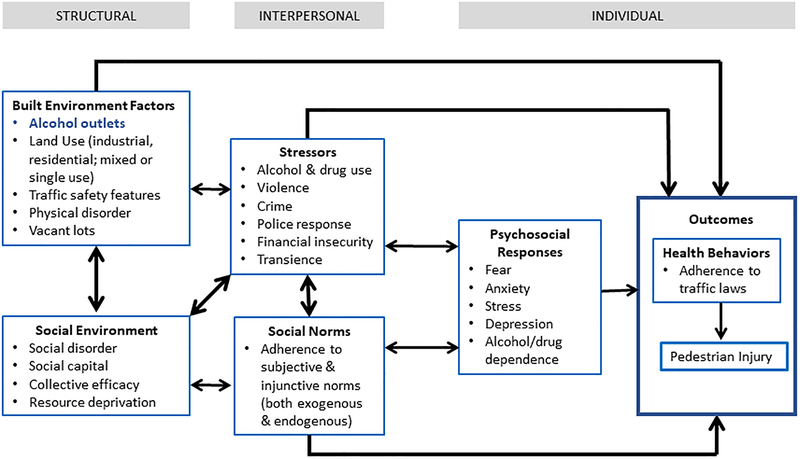
The purpose of this study was to investigate the contribution of neighborhood disorder around alcohol outlets to pedestrian injury risk.
Methods:
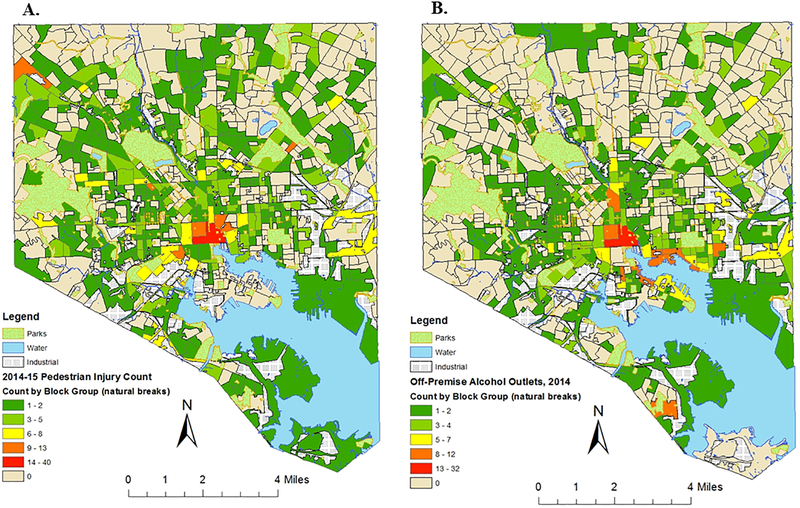
A spatial analysis was conducted on census block groups in Baltimore City. Data included pedestrian injury EMS records from January 1, 2014, to April 15, 2015 (n=858), off-premise alcohol outlet locations for 2014 (n=693), and neighborhood disorder indicators and demographics. Negative binomial regression models were used to determine the relationship between alcohol outlet count and pedestrian injuries at the block group level, controlling for other neighborhood factors. Attributable risk was calculated by comparing the total population count per census block group to the injured pedestrian count.
Results:
Each one-unit increase in the number of alcohol outlets was associated with a 14.2% (95%CI=(1.099, 1.192), p<0.001) increase in the relative risk of neighborhood pedestrian injury, adjusting for traffic volume, pedestrian volume, population density, percent of vacant lots, and median household income. The attributable risk was 10.4% (95% CI=(7.7, 12.7)) or 88 extra injuries. Vacant lots was the only significant neighborhood disorder indicator in the final adjusted model (RR=1.016, 95%CI=(1.007, 1.026), p=0.003). Vacant lots have not been previously investigated as possible risk factors for pedestrian injury.
Conclusions:
This study identifies modifiable risk factors for pedestrian injury previously unexplored in the literature and may provide evidence for alcohol control strategies (e.g., liquor store licensing, zoning, and enforcement).
-
Subjects:
-
Source:Inj Prev. 25(5):350-356
-
Pubmed ID:29588410
-
Pubmed Central ID:PMC6160351
-
Document Type:
-
Funding:
-
Place as Subject:
-
Volume:25
-
Issue:5
-
Collection(s):
-
Main Document Checksum:urn:sha256:5613adeefb19054c6fb8824d92d2f41dfddee363a8fba430012c8c16cc5df89d
-
Download URL:
-
File Type:
 [PDF
- 987.41 KB
]
[PDF
- 987.41 KB
]
Supporting Files


File Language:
English
 Was this page helpful?
 Found an issue?


CDC STACKS serves as an archival repository of CDC-published products including
scientific findings,
journal articles, guidelines, recommendations, or other public health information authored or
co-authored by CDC or funded partners.
As a repository, CDC STACKS retains documents in their original published format to ensure public access to scientific information.
As a repository, CDC STACKS retains documents in their original published format to ensure public access to scientific information.
You May Also Like
COLLECTION
CDC Public Access