


Oncologists’ influence on receipt of adjuvant chemotherapy: Does it matter whom you see for treatment of curable breast cancer?
Supporting Files

-
Jul 08 2017
-
File Language:
English
Details
-
Alternative Title:Breast Cancer Res Treat
-
Personal Author:
-
Description:Purpose
We know little about whether it matters which oncologist a breast cancer patient sees with regard to receipt of chemotherapy. We examined oncologists’ influence on use of recurrence score (RS) testing and chemotherapy in the community.
Methods
We identified 7,810 women with stages 0-II breast cancer treated in 2013–15 through the SEER registries of Georgia and Los Angeles County. Surveys were sent 2 months post-surgery, (70% response rate, n=5,080). Patients identified their oncologists (n=504) of whom 304 responded to surveys (60%). We conducted multi-level analyses on patients with ER positive HER2 negative invasive disease (N=2973) to examine oncologists’ influence on variation in RS testing and chemotherapy receipt, using patient and oncologist survey responses merged to SEER data.
Results
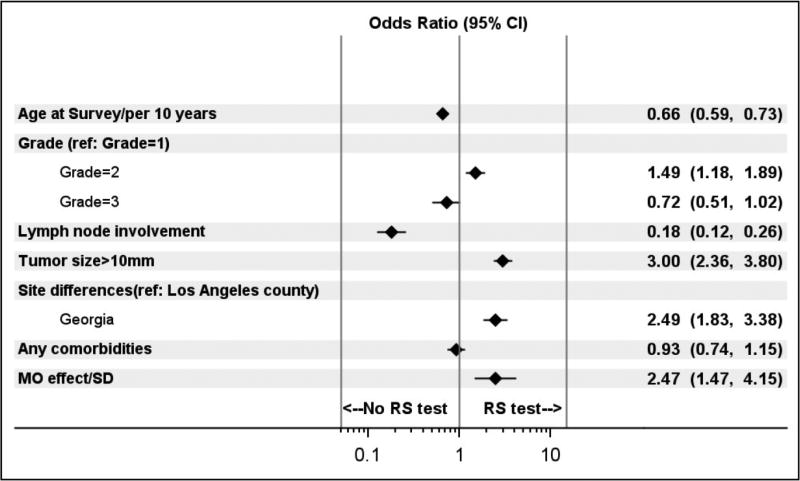
Half of patients (52.8%) received RS testing and 27.7% chemotherapy. One-third (35.9%) of oncologists treated >50 new breast cancer patients annually; mean years in practice was 15.8. Oncologists explained 17% of the variation in RS testing but little of the variation in chemotherapy receipt (3%) controlling for clinical factors. Patients seeing an oncologist who was one standard deviation above the mean use of RS testing had over two-times higher odds of receiving RS (2.47, 95% CI 1.47–4.15), but a parallel estimate of the association of oncologist with the odds of receiving chemotherapy was much smaller (1.39, CI 1.03–1.88).
Conclusions
Clinical algorithms have markedly reduced variation in chemotherapy use across oncologists. Oncologists’ large influence on variation in RS use suggests that they variably seek tumor profiling to inform treatment decisions.
-
Subjects:
-
Source:Breast Cancer Res Treat. 165(3):751-756.
-
Pubmed ID:28689364
-
Pubmed Central ID:PMC5709196
-
Document Type:
-
Funding:HHSN261201000140C/CA/NCI NIH HHS/United States ; 5NU58DP003862-04/DP003862/Centers for Disease Control and Prevention/ ; HHSN261201000035C/CA/NCI NIH HHS/United States ; P01 CA163233/CA/NCI NIH HHS/United States ; U58 DP003875/DP/NCCDPHP CDC HHS/United States ; HHSN261201000140C/National Cancer Institute/ ; 5NU58DP003875-04-00/Centers for Disease Control and Prevention/ ; HHSN261201300015C/RC/CCR NIH HHS/United States ; P01CA163233/National Cancer Institute/ ; HHSN261201000034C/National Cancer Institute/ ; HHSN261201300015I/HHSN26100006/National Cancer Institute/ ; HHSN261201000035I/CA/NCI NIH HHS/United States ; HHSN261201000034C/CA/NCI NIH HHS/United States ; U58 DP003862/DP/NCCDPHP CDC HHS/United States ; HHSN261201000035C/National Cancer Institute/
-
Volume:165
-
Issue:3
-
Collection(s):
-
Main Document Checksum:urn:sha256:95dbc3176bd902a1922a3712f09412378bfd1120b6bc63fa71478cbb7bead5af
-
Download URL:
-
File Type:
 [PDF
- 1.06 MB
]
[PDF
- 1.06 MB
]
Supporting Files


File Language:
English
ON THIS PAGE


CDC STACKS serves as an archival repository of CDC-published products including
scientific findings,
journal articles, guidelines, recommendations, or other public health information authored or
co-authored by CDC or funded partners.
As a repository, CDC STACKS retains documents in their original published format to ensure public access to scientific information.
As a repository, CDC STACKS retains documents in their original published format to ensure public access to scientific information.
You May Also Like
COLLECTION
CDC Public Access