



Milk feeding and first complementary foods during the first year of life in the TEDDY study
Supporting Files

-
Apr 25 2018
-
Available in CDC Stacks on 2019-10-01T00:00:00Z
File Language:
English
Details
-
Alternative Title:Matern Child Nutr
-
Personal Author:
-
Corporate Authors:
-
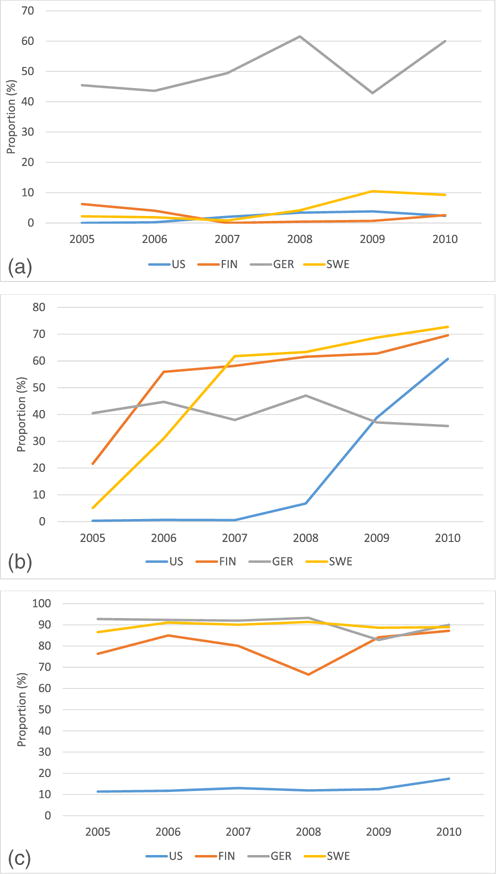
Description:The aim was to describe milk feeding patterns and first weaning foods during the first year of life in a large prospective birth cohort of infants with increased genetic risk for Type 1 diabetes (T1D) recruited in 4 different countries: the United States, Finland, Germany, and Sweden. All enrolled children with dietary information (n = 8,673) were included in the analyses; 1,307 (15%) children who dropped out before the first birthday were excluded from some analyses. Supplementary milk feeding in the first 3 days of life was common in all the four countries, although the type of the supplementary milk differed by country and by maternal T1D. Donated human milk was commonly used only in Finland. In all the countries, the most common first supplementary food was cow's milk-based infant formula, especially among offspring of mothers with T1D. The use of specific types of infant formulas differed notably by country: Extensively hydrolysed formulas were most used in Finland, partially hydrolysed ones in the United States and in Germany, and soy formulas only in the United States. Infant formulas commonly included probiotics, prebiotics, and starches. During the first year of life, most of the infants received conventional cow's milk. Overall, milk feeding during the first 3 days of life and thereafter until the first birthday differed markedly by maternal T1D status and across countries. These descriptive data may be useful in understanding early infant feeding practices and in planning potential interventions, which affect infant feeding.
-
Subjects:
-
Source:Matern Child Nutr. 14(4):e12611.
-
Pubmed ID:29693777
-
Pubmed Central ID:PMC6156929
-
Document Type:
-
Funding:U01 DK063821/DK/NIDDK NIH HHS/United States ; UC4 DK063863/DK/NIDDK NIH HHS/United States ; UC4 DK112243/JDRF/United States ; National Institute of Child Health and Human Development (NICHD)/ ; UL1 TR000064/TR/NCATS NIH HHS/United States ; U01 DK063836/DK/NIDDK NIH HHS/United States ; UC4 DK117483/JDRF/United States ; U01 DK63861/JDRF/United States ; U01 DK063829/DK/NIDDK NIH HHS/United States ; U01 DK063865/DK/NIDDK NIH HHS/United States ; UC4 DK095300/DK/NIDDK NIH HHS/United States ; UC4 DK063861/DK/NIDDK NIH HHS/United States ; UC4 DK063829/DK/NIDDK NIH HHS/United States ; UC4 DK63865/JDRF/United States ; National Institute of Environmental Health Sciences (NIEHS)/ ; UC4 DK106955/JDRF/United States ; UC4 DK063821/DK/NIDDK NIH HHS/United States ; UC4 DK117483/DK/NIDDK NIH HHS/United States ; U01 DK63821/JDRF/United States ; UC4 DK063836/DK/NIDDK NIH HHS/United States ; UC4 DK112243/DK/NIDDK NIH HHS/United States ; UC4 DK63836/JDRF/United States ; HHSN267200700014C/DK/NIDDK NIH HHS/United States ; U01 DK63836/JDRF/United States ; UC4 DK63863/JDRF/United States ; U01 DK063861/DK/NIDDK NIH HHS/United States ; U01 DK63829/JDRF/United States ; UC4 DK63861/JDRF/United States ; UC4 DK63821/JDRF/United States ; National Institute of Diabetes and Digestive and Kidney Diseases (NIDDK)/ ; UC4 DK063865/DK/NIDDK NIH HHS/United States ; U01 DK063863/DK/NIDDK NIH HHS/United States ; U01 DK063790/DK/NIDDK NIH HHS/United States ; National Institute of Allergy and Infectious Diseases (NIAID)/ ; UC4 DK106955/DK/NIDDK NIH HHS/United States ; UC4 DK100238/DK/NIDDK NIH HHS/United States ; U01 DK63790/JDRF/United States ; Centers for Disease Control and Prevention (CDC)/ ; HHSN267200700014C/JDRF/United States ; UL1 TR000064/NIH/NCATS Clinical and Translational Science Awards to the University of Florida/ ; U01 DK63865/JDRF/United States ; UL1 TR001082/TR/NCATS NIH HHS/United States ; UC4 DK100238/JDRF/United States ; UL1 TR001082/University of Colorado/ ; UC4 DK63829/JDRF/United States ; U01 DK63863/JDRF/United States ; UC4 DK95300/JDRF/United States
-
Volume:14
-
Issue:4
-
Download URL:
-
File Type:
 [PDF - 451.90 KB]
 -
Collection(s):
-
Main Document Checksum:urn:sha256:b0d5e1f4645bed090852fef285dcf180f77c1a063e98ed85bd8e55d2ccfa8d50
Supporting Files


File Language:
English
 Was this page helpful?
 Found an issue?


CDC STACKS serves as an archival repository of CDC-published products including
scientific findings, journal articles, guidelines, recommendations, or other public health information authored or
co-authored by CDC or funded partners.
As a repository, CDC STACKS retains documents in their original published format to ensure public access to scientific information.
As a repository, CDC STACKS retains documents in their original published format to ensure public access to scientific information.
You May Also Like
COLLECTION
CDC Public Access