



Air pollutant strategies to reduce adverse health impacts and health inequalities: a quantitative assessment for Detroit, Michigan
Supporting Files

-
5 2018
-
Available in CDC Stacks on 2019-05-01T00:00:00Z
File Language:
English
Details
-
Alternative Title:Air Qual Atmos Health
-
Personal Author:
-
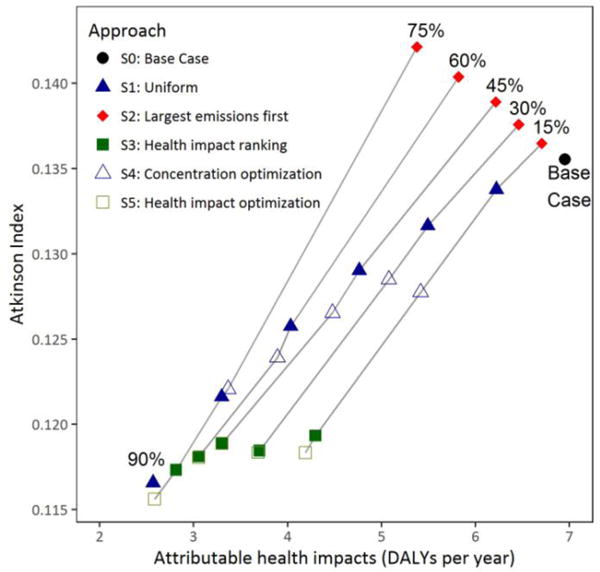
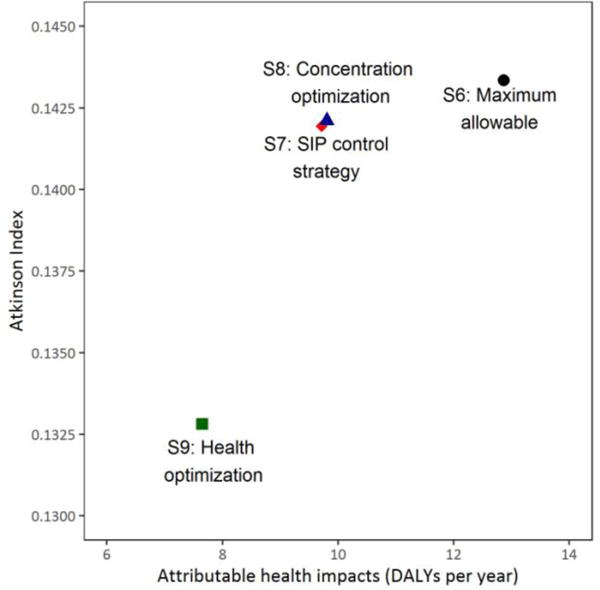
Description:The development of air quality management (AQM) strategies provides opportunities to improve public health and reduce health inequalities. This study evaluates health and inequality impacts of alternate SO| control strategies in Detroit, MI, a designated non-attainment area. Control alternatives include uniform reductions across sources, ranking approaches based on total emissions and health impacts per ton of pollutant emitted, and optimizations that meet concentration and health goals. Using dispersion modeling and quantitative health impact assessment (HIA), these strategies are evaluated in terms of ambient concentrations, health impacts, and the inequality in health risks. The health burden attributable to SO| emissions in Detroit falls primarily among children and includes 70 hospitalizations and 6,000 asthma-related respiratory symptom-days annually, equivalent to 7 disability-adjusted life years (DALYs). The health burden disproportionately falls on Hispanic/Latino residents, residents with less than a high school diploma, and foreign-born residents. Control strategies that target smaller facilities near exposed populations provide the greatest benefit in terms of the overall health burden reductions and the inequality of attributable health risk; conventional strategies that target the largest emission sources can increase inequality and provide only modest health benefits. The assessment is novel in using spatial analyses that account for urban scale gradients in exposure, demographics, vulnerability, and population health. We show that quantitative HIA methods can be used to develop AQM strategies that simultaneously meet environmental, public health, and environmental justice goals, advancing AQM beyond its current compliance-oriented focus.
-
Keywords:
-
Source:Air Qual Atmos Health. 11(4):409-422
-
Pubmed ID:30220936
-
Pubmed Central ID:PMC6136662
-
Document Type:
-
Funding:
-
Place as Subject:
-
Volume:11
-
Issue:4
-
Download URL:
-
File Type:
 [PDF - 599.66 KB]
 -
Collection(s):
-
Main Document Checksum:urn:sha256:98524ac67095884c93e2b0f4b203f4c0790a441d2cb71565d72da6334020656f
Supporting Files


File Language:
English
 Was this page helpful?
 Found an issue?





CDC STACKS serves as an archival repository of CDC-published products including
scientific findings, journal articles, guidelines, recommendations, or other public health information authored or
co-authored by CDC or funded partners.
As a repository, CDC STACKS retains documents in their original published format to ensure public access to scientific information.
As a repository, CDC STACKS retains documents in their original published format to ensure public access to scientific information.
You May Also Like
COLLECTION
CDC Public Access