


Case-control meta-analysis of blood DNA methylation and autism spectrum disorder
Supporting Files

-
Jun 28 2018
-
File Language:
English
Details
-
Alternative Title:Mol Autism
-
Personal Author:
-
Description:Background
Several reports have suggested a role for epigenetic mechanisms in ASD etiology. Epigenome-wide association studies (EWAS) in autism spectrum disorder (ASD) may shed light on particular biological mechanisms. However, studies of ASD cases versus controls have been limited by post-mortem timing and severely small sample sizes. Reports from in-life sampling of blood or saliva have also been very limited in sample size and/or genomic coverage. We present the largest case-control EWAS for ASD to date, combining data from population-based case-control and case-sibling pair studies.
Methods
DNA from 968 blood samples from children in the Study to Explore Early Development (SEED 1) was used to generate epigenome-wide array DNA methylation (DNAm) data at 485,512 CpG sites for 453 cases and 515 controls, using the Illumina 450K Beadchip. The Simons Simplex Collection (SSC) provided 450K array DNAm data on an additional 343 cases and their unaffected siblings. We performed EWAS meta-analysis across results from the two data sets, with adjustment for sex and surrogate variables that reflect major sources of biological variation and technical confounding such as cell type, batch, and ancestry. We compared top EWAS results to those from a previous brain-based analysis. We also tested for enrichment of ASD EWAS CpGs for being targets of meQTL associations using available SNP genotype data in the SEED sample.
Findings
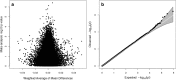
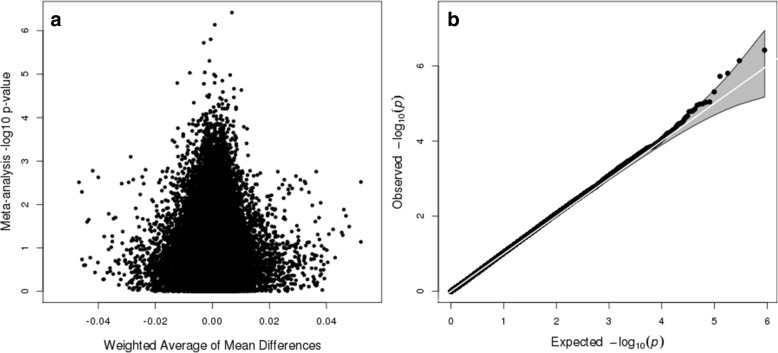
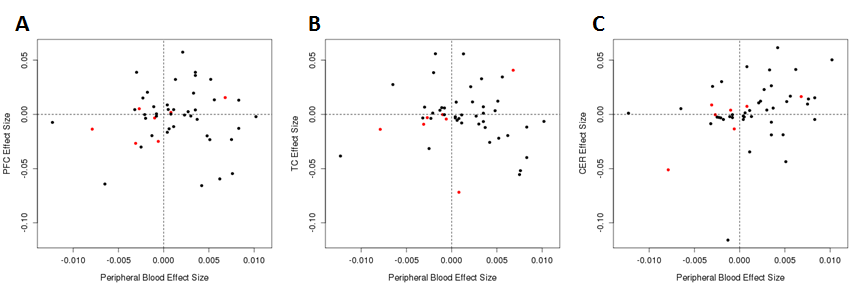
In this meta-analysis of blood-based DNA from 796 cases and 858 controls, no single CpG met a Bonferroni discovery threshold of p < 1.12 × 10− 7. Seven CpGs showed differences at p < 1 × 10− 5 and 48 at 1 × 10− 4. Of the top 7, 5 showed brain-based ASD associations as well, often with larger effect sizes, and the top 48 overall showed modest concordance (r = 0.31) in direction of effect with cerebellum samples. Finally, we observed suggestive evidence for enrichment of CpG sites controlled by SNPs (meQTL targets) among the EWAS CpG hits, which was consistent across EWAS and meQTL discovery p value thresholds.
Conclusions
No single CpG site showed a large enough DNAm difference between cases and controls to achieve epigenome-wide significance in this sample size. However, our results suggest the potential to observe disease associations from blood-based samples. Among the seven sites achieving suggestive statistical significance, we observed consistent, and stronger, effects at the same sites among brain samples. Discovery-oriented EWAS for ASD using blood samples will likely need even larger samples and unified genetic data to further understand DNAm differences in ASD.
Electronic supplementary material
The online version of this article (10.1186/s13229-018-0224-6) contains supplementary material, which is available to authorized users.
-
Subjects:
-
Source:Mol Autism. 9.
-
Pubmed ID:29988321
-
Pubmed Central ID:PMC6022498
-
Document Type:
-
Funding:
-
Volume:9
-
Collection(s):
-
Main Document Checksum:urn:sha-512:0ed364fda7e6fa91ecb15b7076b5a765ecd0f579ff751b5589126a4032902e65f3a8032b3312be41763f38e9e3add41b15fed18f00efffcfcaff94cd1be980d9
-
Download URL:
-
File Type:
 [PDF
- 746.66 KB
]
[PDF
- 746.66 KB
]
Supporting Files


File Language:
English
ON THIS PAGE

CDC STACKS serves as an archival repository of CDC-published products including
scientific findings,
journal articles, guidelines, recommendations, or other public health information authored or
co-authored by CDC or funded partners.
As a repository, CDC STACKS retains documents in their original published format to ensure public access to scientific information.
As a repository, CDC STACKS retains documents in their original published format to ensure public access to scientific information.
You May Also Like
COLLECTION
CDC Public Access