


Abnormal Helminth Egg Development, Strange Morphology, and the Identification of Intestinal Helminth Infections
Supporting Files
Public Domain

-
August 2018
File Language:
English
Details
-
Alternative Title:Emerg Infect Dis
-
Personal Author:
-
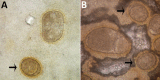
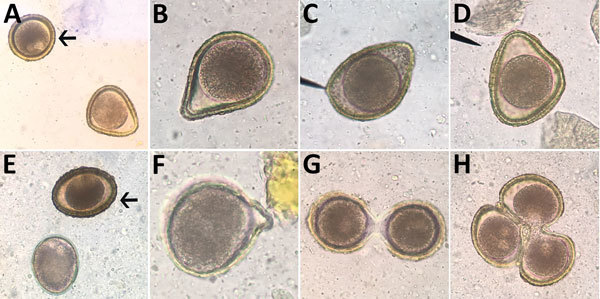
Description:Occasionally, abnormal forms of parasitic helminth eggs are detected during routine diagnostics. This finding can prove problematic in diagnosis because morphologic analysis based on tightly defined measurements is the primary method used to identify the infecting species and molecular confirmation of species is not always feasible. We describe instances of malformed nematode eggs (primarily from members of the superfamily Ascaridoidea) from human clinical practice and experimental trials on animals. On the basis of our observations and historical literature, we propose that unusual development and morphology of nematode and trematode eggs are associated with early infection. Further observational studies and experimentation are needed to identify additional factors that might cause abnormalities in egg morphology and production. Abnormal egg morphology can be observed early in the course of infection and can confound accurate diagnosis of intestinal helminthiases.
-
Subjects:
-
Source:Emerg Infect Dis. 24(8):1407-1411
-
Pubmed ID:30014830
-
Pubmed Central ID:PMC6056116
-
Document Type:
-
Volume:24
-
Issue:8
-
Collection(s):
-
Main Document Checksum:urn:sha256:2d129cdb86bd506f84015c77d37928cc292ca6bb16892b2bc71e0cc3c8fb8ac8
-
Download URL:
-
File Type:
 [PDF
- 2.48 MB
]
[PDF
- 2.48 MB
]
Supporting Files


File Language:
English
ON THIS PAGE




CDC STACKS serves as an archival repository of CDC-published products including
scientific findings,
journal articles, guidelines, recommendations, or other public health information authored or
co-authored by CDC or funded partners.
As a repository, CDC STACKS retains documents in their original published format to ensure public access to scientific information.
As a repository, CDC STACKS retains documents in their original published format to ensure public access to scientific information.
You May Also Like
COLLECTION
Emerging Infectious Diseases