


Clonal Expansion of Macrolide-Resistant Sequence Type 3 Mycoplasma pneumoniae, South Korea
Supporting Files
Public Domain

-
August 2018
-
File Language:
English
Details
-
Alternative Title:Emerg Infect Dis
-
Personal Author:
-
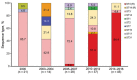
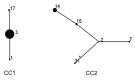
Description:To investigate the genetic background for the emergence of macrolide resistance, we characterized the genetic features of Mycoplasma pneumoniae using multilocus sequence typing. Of the 146 M. pneumoniae strains collected during the 5 consecutive outbreaks of M. pneumoniae pneumonia during 2000-2016 in South Korea, macrolide resistance increased from 0% in the first outbreak to 84.4% in the fifth. Among the 8 sequence types (STs) identified, ST3 (74.7%) was the most prevalent, followed by ST14 (15.1%). Macrolide-susceptible strains comprised 8 different STs, and all macrolide-resistant strains were ST3 (98.3%) except 1 with ST14. The proportion of macrolide-resistant strains in ST3 remained 2.2% (1/46) until the 2006-2007 outbreak and then markedly increased to 82.6% (19/23) during the 2010-2012 outbreak and 95.0% (38/40) during the 2014-2016 outbreak. The findings demonstrated that clonal expansion of ST3 M. pneumoniae was associated with the increase in macrolide resistance in South Korea.
-
Subjects:
-
Source:Emerg Infect Dis. 24(8):1465-1471
-
Pubmed ID:30014844
-
Pubmed Central ID:PMC6056092
-
Document Type:
-
Place as Subject:
-
Location:
-
Volume:24
-
Issue:8
-
Collection(s):
-
Main Document Checksum:urn:sha256:2c341fe3f00b4a9ae67228f7e8dde2422b61512f24b9930e078c7a07525280dc
-
Download URL:
-
File Type:
 [PDF
- 742.12 KB
]
[PDF
- 742.12 KB
]
Supporting Files


File Language:
English
ON THIS PAGE




CDC STACKS serves as an archival repository of CDC-published products including
scientific findings,
journal articles, guidelines, recommendations, or other public health information authored or
co-authored by CDC or funded partners.
As a repository, CDC STACKS retains documents in their original published format to ensure public access to scientific information.
As a repository, CDC STACKS retains documents in their original published format to ensure public access to scientific information.
You May Also Like
COLLECTION
Emerging Infectious Diseases