



Development of the PEA-PODS (Perceptions of the Environment and Patterns of Diet at School) Survey for Students
Supporting Files

-
Jun 28 2018
File Language:
English
Details
-
Journal Article:Preventing Chronic Disease (PCD)
-
Personal Author:
-
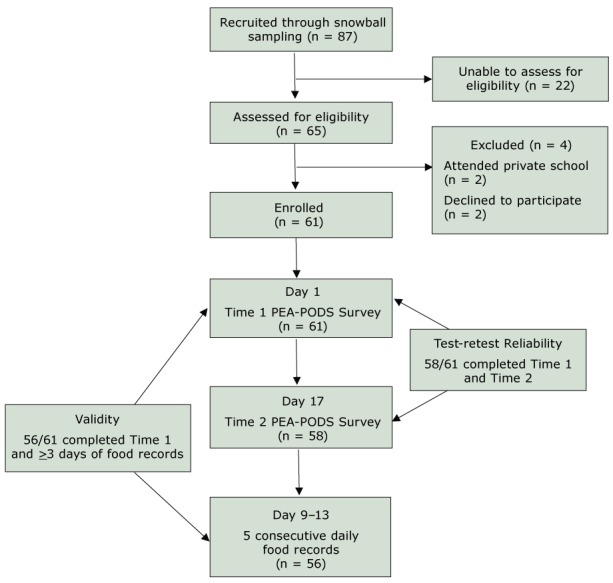
Description:Introduction ; Few instruments assess key outcomes of school-based obesity interventions, including student perceptions of school environments and school-specific dietary intake patterns. This study describes development of PEA-PODS (Perceptions of the Environment and Patterns of Diet at School), a 2-part survey to measure these outcomes. ; Methods ; Part 1 (PEA) assessed student perceptions of policies, physical environment, and practices related to healthy eating and physical activity at school. Part 2 (PODS) assessed usual intake (ie, frequency, location obtained, and foods consumed) of breakfast and lunch. Foods consumed were presented by MyPlate categories (eg, Fruits, Grains). Students in grades 3, 6, and 9 participated in 2 phases: cognitive pre-testing (n = 10) and reliability/validation testing (n = 58). Both surveys were administered 1 week apart to assess test-retest reliability and 5-day food records validated PODS. Analyses included percent agreement (70% = acceptable), Pearson correlations, and Cronbach α. ; Results ; Cognitive pre-testing provided feedback on content, length, and age-appropriateness. Percent agreements were acceptable for test-retest reliability of PEA (71%–96%). The final version included 34 items with Likert-type responses in 4 subscales (α ≥0.78). For PODS, agreement for breakfast and lunch location was ≥75% for both reliability and validation. For foods consumed at breakfast, reliability agreement ranged from 74% to 93%, and validation agreement from 68% to 91%. For foods consumed at lunch, agreement ranges were 76% to 95% and 73% to 88%, respectively. ; Conclusion ; Both parts of the instrument demonstrate acceptable reliability, and PODS demonstrates acceptable validity. This demonstrates appropriateness for assessing perceptions of the environment and usual dietary intake patterns for school-based obesity prevention initiatives.
-
Subjects:
-
Source:Prev Chronic Dis. 15.
-
DOI:
-
ISSN:1545-1151
-
Pubmed ID:29969093
-
Pubmed Central ID:PMC6040598
-
Document Type:
-
Funding:
-
Volume:15
-
Download URL:
-
File Type:
 [PDF - 400.06 KB]
 -
Collection(s):
-
Main Document Checksum:urn:sha-512:f48187f171e5f6f5328e72a778a5c7241272d4f0f8efe4b6e39311410fdac2794227059a87bc221917607e491dc608b95d24dadfa091be2ac7d13644a24d9319
Supporting Files


File Language:
English
 Was this page helpful?
 Found an issue?


CDC STACKS serves as an archival repository of CDC-published products including
scientific findings, journal articles, guidelines, recommendations, or other public health information authored or
co-authored by CDC or funded partners.
As a repository, CDC STACKS retains documents in their original published format to ensure public access to scientific information.
As a repository, CDC STACKS retains documents in their original published format to ensure public access to scientific information.
You May Also Like
COLLECTION
Preventing Chronic Disease