



Typhus Group Rickettsiosis, Germany, 2010–20171
Supporting Files
Public Domain

-
Jul 2018
File Language:
English
Details
-
Alternative Title:Emerg Infect Dis
-
Personal Author:
-
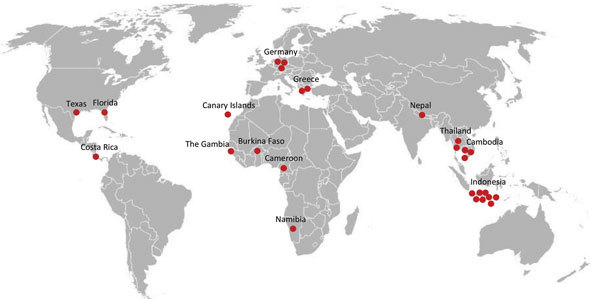
Description:Typhus group rickettsiosis is caused by the vectorborne bacteria Rickettsia typhi and R. prowazekii. R. typhi, which causes murine typhus, the less severe endemic form of typhus, is transmitted by fleas; R. prowazekii, which causes the severe epidemic form of typhus, is transmitted by body lice. To examine the immunology of human infection with typhus group rickettsiae, we retrospectively reviewed clinical signs and symptoms, laboratory changes, and travel destinations of 28 patients who had typhus group rickettsiosis diagnosed by the German Reference Center for Tropical Pathogens, Hamburg, Germany, during 2010-2017. Immunofluorescence assays of follow-up serum samples indicated simultaneous seroconversion of IgM, IgA, and IgG or concurrence in the first serum sample. Cytokine levels peaked during the second week of infection, coinciding with organ dysfunction and seroconversion. For 3 patients, R. typhi was detected by species-specific nested quantitative PCR. For all 28 patients, R. typhi was the most likely causative pathogen.
-
Subjects:
- Adolescent
- Adult
- Aged
- Animals
- Child
- Child, Preschool
- Exanthema
- Female
- Global Health
- History, 21St Century
- Humans
- Male
- Mice
- Middle Aged
- Molecular Diagnostic Techniques
- Public Health Surveillance
- Rickettsia Typhi
- Serologic Tests
- Siphonaptera
- Typhus, Endemic Flea-Borne/Diagnosis
- Typhus, Endemic Flea-Borne/Epidemiology
- Typhus, Endemic Flea-Borne/History
- Typhus, Endemic Flea-Borne/Microbiology
- Young Adult
- Zoonoses
-
Source:Emerg Infect Dis. 24(7):1213-1220.
-
Pubmed ID:29912688
-
Pubmed Central ID:PMC6038764
-
Document Type:
-
Genre:
-
Place as Subject:
-
Volume:24
-
Issue:7
-
Download URL:
-
File Type:
 [PDF - 1.17 MB]
 -
Collection(s):
-
Main Document Checksum:urn:sha256:c3b444f504949a9d225d56857524067cafbd53330001c17ca94c1afeb4da6168
Supporting Files


File Language:
English
 Was this page helpful?
 Found an issue?





CDC STACKS serves as an archival repository of CDC-published products including
scientific findings, journal articles, guidelines, recommendations, or other public health information authored or
co-authored by CDC or funded partners.
As a repository, CDC STACKS retains documents in their original published format to ensure public access to scientific information.
As a repository, CDC STACKS retains documents in their original published format to ensure public access to scientific information.
You May Also Like
COLLECTION
Emerging Infectious Diseases