



Mapping of the US Domestic Influenza Virologic Surveillance Landscape
Supporting Files
Public Domain

-
Jul 17 2018
File Language:
English
Details
-
Alternative Title:Emerg Infect Dis
-
Personal Author:Jester, Barbara ; Schwerzmann, Joy ; Mustaquim, Desiree ; Aden, Tricia ; Brammer, Lynnette ; Humes, Rosemary ; Shult, Pete ; Shahangian, Shahram ; Gubareva, Larisa ; Xu, Xiyan ; Miller, Joseph ; Jernigan, Daniel
-
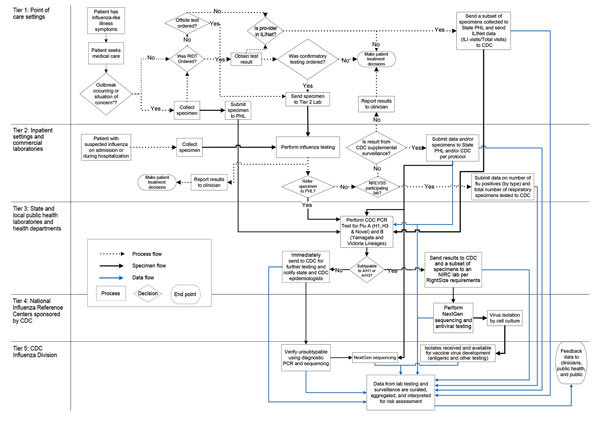
Description:Influenza virologic surveillance is critical each season for tracking influenza circulation, following trends in antiviral drug resistance, detecting novel influenza infections in humans, and selecting viruses for use in annual seasonal vaccine production. We developed a framework and process map for characterizing the landscape of US influenza virologic surveillance into 5 tiers of influenza testing: outpatient settings (tier 1), inpatient settings and commercial laboratories (tier 2), state public health laboratories (tier 3), National Influenza Reference Center laboratories (tier 4), and Centers for Disease Control and Prevention laboratories (tier 5). During the 2015-16 season, the numbers of influenza tests directly contributing to virologic surveillance were 804,000 in tiers 1 and 2; 78,000 in tier 3; 2,800 in tier 4; and 3,400 in tier 5. With the release of the 2017 US Pandemic Influenza Plan, the proposed framework will support public health officials in modeling, surveillance, and pandemic planning and response.
-
Subjects:
-
Source:Emerg Infect Dis. 24(7):1300-1306.
-
Pubmed ID:29715078
-
Pubmed Central ID:PMC6038762
-
Document Type:
-
Place as Subject:
-
Location:
-
Volume:24
-
Issue:7
-
Download URL:
-
File Type:
 [PDF - 690.16 KB]
 -
Collection(s):
-
Main Document Checksum:urn:sha256:c1cd960eb58dae0eaea84f650847bf7fb80246efcd3e0ed86528dcb713b1512a
Supporting Files


File Language:
English
 Was this page helpful?
 Found an issue?






CDC STACKS serves as an archival repository of CDC-published products including
scientific findings, journal articles, guidelines, recommendations, or other public health information authored or
co-authored by CDC or funded partners.
As a repository, CDC STACKS retains documents in their original published format to ensure public access to scientific information.
As a repository, CDC STACKS retains documents in their original published format to ensure public access to scientific information.
You May Also Like
COLLECTION
Emerging Infectious Diseases