


Reemergence of Restonebolavirus in Cynomolgus Monkeys, the Philippines, 2015
Supporting Files
Public Domain

-
Jul 2018
-
File Language:
English
Details
-
Alternative Title:Emerg Infect Dis
-
Personal Author:Demetria, Catalino ; Smith, Ina ; Tan, Titus ; Villarico, Daniel ; Simon, Edson Michael ; Centeno, Rex ; Tachedjian, Mary ; Taniguchi, Satoshi ; Shimojima, Masayuki ; Miranda, Noel Lee J. ; Miranda, Mary Elizabeth ; Rondina, Melissa Marie R. ; Capistrano, Rowena ; Tandoc, Amado ; Marsh, Glenn ; Eagles, Debbie ; Cruz, Ramses ; Fukushi, Shuetsu
-
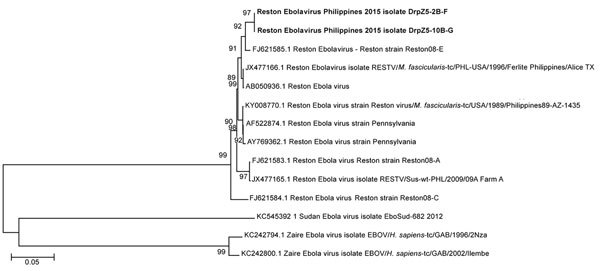
Description:In August 2015, a nonhuman primate facility south of Manila, the Philippines, noted unusual deaths of 6 cynomolgus monkeys (Macaca fascicularis), characterized by generalized rashes, inappetence, or sudden death. We identified Reston ebolavirus (RESTV) infection in monkeys by using serologic and molecular assays. We isolated viruses in tissues from infected monkeys and determined viral genome sequences. RESTV found in the 2015 outbreak is genetically closer to 1 of the 4 RESTVs that caused the 2008 outbreak among swine. Eight macaques, including 2 also infected with RESTV, tested positive for measles. Concurrently, the measles virus was circulating throughout the Philippines, indicating that the infection of the macaques may be a reverse zoonosis. Improved biosecurity measures will minimize the public health risk, as well as limit the introduction of disease and vectors.
-
Subjects:
-
Source:Emerg Infect Dis. 24(7):1285-1291.
-
Pubmed ID:29912712
-
Pubmed Central ID:PMC6038738
-
Document Type:
-
Place as Subject:
-
Location:
-
Volume:24
-
Issue:7
-
Collection(s):
-
Main Document Checksum:urn:sha256:7737a418b978c290ccfdffb1c68f7002ea7d76819abc0d610353f5b113df612f
-
Download URL:
-
File Type:
 [PDF
- 1.37 MB
]
[PDF
- 1.37 MB
]
Supporting Files


File Language:
English
ON THIS PAGE





CDC STACKS serves as an archival repository of CDC-published products including
scientific findings,
journal articles, guidelines, recommendations, or other public health information authored or
co-authored by CDC or funded partners.
As a repository, CDC STACKS retains documents in their original published format to ensure public access to scientific information.
As a repository, CDC STACKS retains documents in their original published format to ensure public access to scientific information.
You May Also Like
COLLECTION
Emerging Infectious Diseases