



Parallel evolution of vgsc mutations at domains IS6, IIS6 and IIIS6 in pyrethroid resistant Aedes aegypti from Mexico
Supporting Files

-
Apr 30 2018
File Language:
English
Details
-
Alternative Title:Sci Rep
-
Personal Author:
-
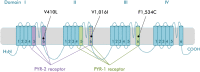
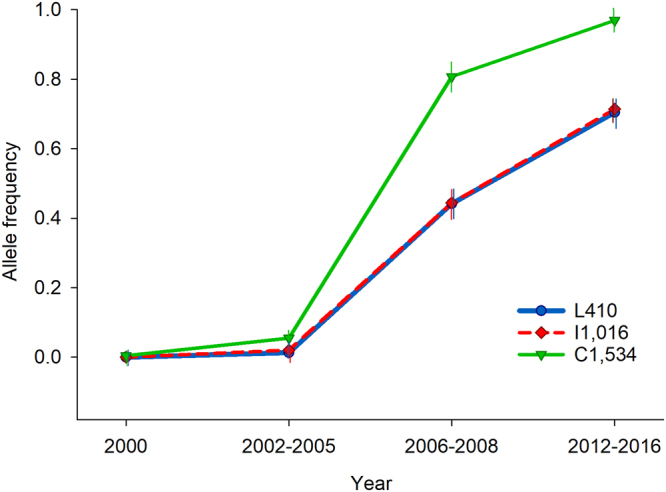
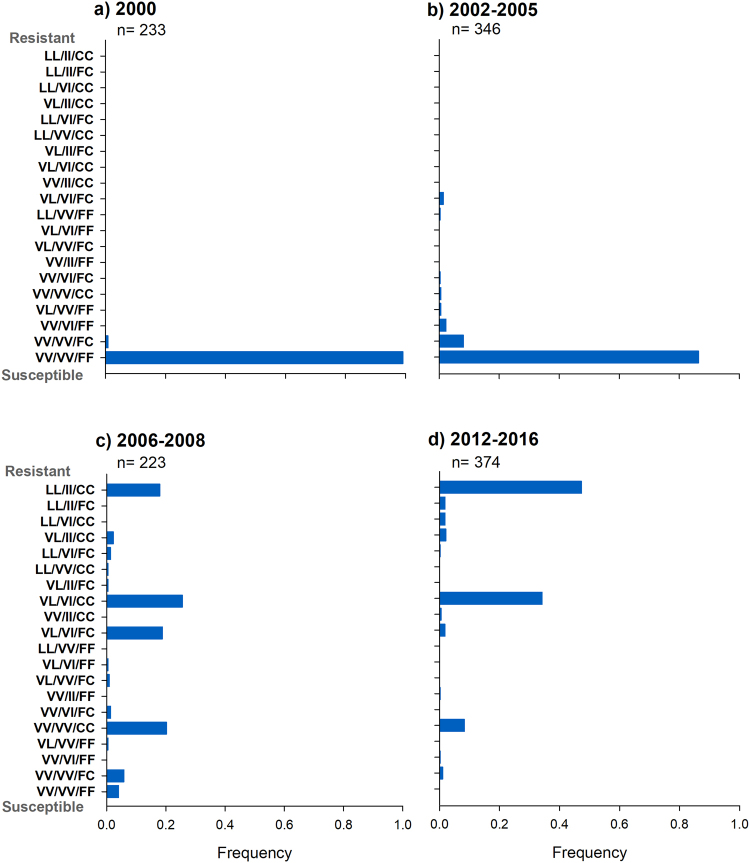
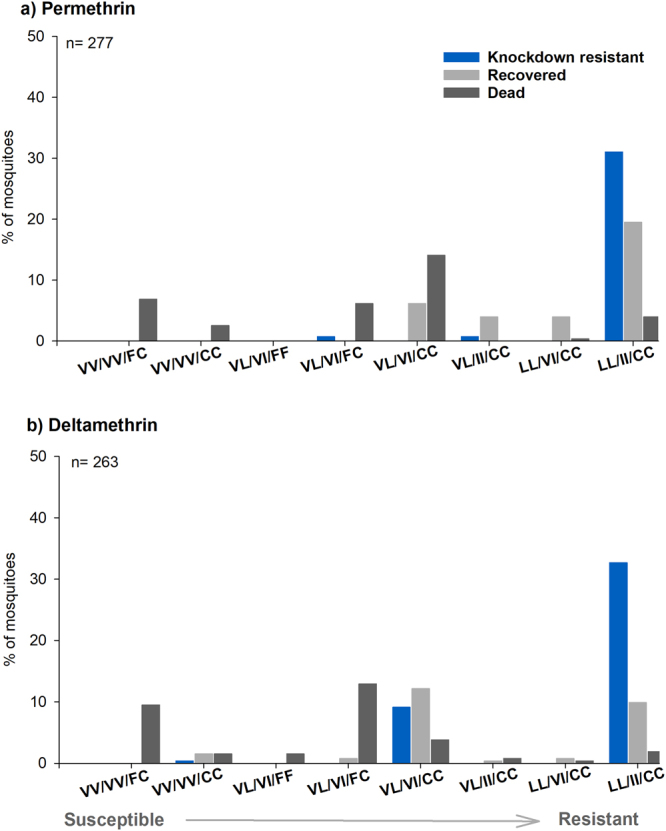
Description:Aedes aegypti is the primary urban mosquito vector of viruses causing dengue, Zika and chikungunya fevers -for which vaccines and effective pharmaceuticals are still lacking. Current strategies to suppress arbovirus outbreaks include removal of larval-breeding sites and insecticide treatment of larval and adult populations. Insecticidal control of Ae. aegypti is challenging, due to a recent rapid global increase in knockdown-resistance (kdr) to pyrethroid insecticides. Widespread, heavy use of pyrethroid space-sprays has created an immense selection pressure for kdr, which is primarily under the control of the voltage-gated sodium channel gene (vgsc). To date, eleven replacements in vgsc have been discovered, published and shown to be associated with pyrethroid resistance to varying degrees. In Mexico, F1,534C and V1,016I have co-evolved in the last 16 years across Ae. aegypti populations. Recently, a novel replacement V410L was identified in Brazil and its effect on vgsc was confirmed by electrophysiology. Herein, we screened V410L in 25 Ae. aegypti historical collections from Mexico, the first heterozygote appeared in 2002 and frequencies have increased in the last 16 years alongside V1,016I and F1,534C. Knowledge of the specific vgsc replacements and their interaction to confer resistance is essential to predict and to develop strategies for resistance management.
-
Subjects:
-
Source:Sci Rep. 8.
-
Pubmed ID:29712956
-
Pubmed Central ID:PMC5928250
-
Document Type:
-
Funding:
-
Place as Subject:
-
Volume:8
-
Collection(s):
-
Main Document Checksum:urn:sha256:dab229e44105fcee7dde8e5b40daf1279fea4558ed3c91f0858310ef0116f7d7
-
Download URL:
-
File Type:
 [PDF
- 1.45 MB
]
[PDF
- 1.45 MB
]
Supporting Files


File Language:
English
 Was this page helpful?
 Found an issue?



CDC STACKS serves as an archival repository of CDC-published products including
scientific findings,
journal articles, guidelines, recommendations, or other public health information authored or
co-authored by CDC or funded partners.
As a repository, CDC STACKS retains documents in their original published format to ensure public access to scientific information.
As a repository, CDC STACKS retains documents in their original published format to ensure public access to scientific information.
You May Also Like
COLLECTION
CDC Public Access