



Frailty Versus Stopping Elderly Accidents, Deaths and Injuries Initiative Fall Risk Score: Ability to Predict Future Falls
Supporting Files

-
2018/02/10
-
Available in CDC Stacks on 2019-03-01T00:00:00Z
File Language:
English
Details
-
Alternative Title:J Am Geriatr Soc
-
Personal Author:
-
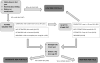
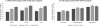
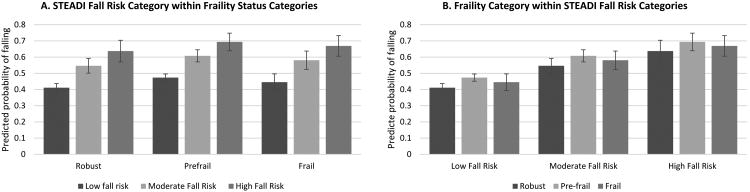
Description:Objectives ; To compare the ability of frailty status to predict fall risk with that of community fall risk screening tools. ; Design ; Setting ; National Health and Aging Trend Study (NHATS) 2011 ; Participants ; Individuals aged 65 and older (N=7,392). ; Measurements ; Fall risk was defined according to the Stopping Elderly Accidents, Deaths and Injuries (STEADI) initiative. Frailty was defined as exhaustion, weight loss, low activity, slow gait speed, and weak grip strength. Robust was defined as meeting 0 criteria, prefrailty as 1 or 2 criteria, and frailty as 3 or more criteria. Falls were self-reported and ascertained using NHATS subsequent rounds (2012-2015). We compared the ability of frailty to predict future falls with that of STEADI score, adjusting for age, race, sex, education, comorbidities, hearing and vision impairment, and disability. ; Results ; Of the 7,392 participants (58.5% female), there 3,545 (48.0%) were classified as being at low risk of falling, 2,966 (40.1%) as being at moderate risk, and 881 (11.9%) as being at high risk. The adjusted risk of falling over the 4 subsequent years was 2.5 times as great for the moderate-risk group (hazard ratio (HR)=2.50, 95% confidence interval (CI)=2.16-2.89) and almost 4 times as great (HR=3.79, 95% CI=2.76-5.21) for the high-risk group as for the low-risk group. Risk of falling was greater for those who were prefrail (HR=1.22, 95% CI=1.05-1.41) and frail (HR=1.12, 95% CI=0.87-1.44) than for those who were robust. ; Conclusion ; STEADI score is a strong predictor of future falls. Addition of frailty status does not improve the ability of the STEADI measure to predict future falls.
-
Subjects:
-
Source:J Am Geriatr Soc. 66(3):577-583
-
Pubmed ID:29427525
-
Pubmed Central ID:PMC5933526
-
Document Type:
-
Funding:R25 MH068502/MH/NIMH NIH HHS/United States ; R01 MH078052/MH/NIMH NIH HHS/United States ; R01 MH096441/MH/NIMH NIH HHS/United States ; R24 MH102794/MH/NIMH NIH HHS/United States ; T32 MH073553/MH/NIMH NIH HHS/United States ; R01 MH089811/MH/NIMH NIH HHS/United States ; UL1 TR001086/TR/NCATS NIH HHS/United States ; U48 DP005018/DP/NCCDPHP CDC HHS/United States ; U48DP005018/ACL HHS/United States ; K23 AG051681/AG/NIA NIH HHS/United States ; R01 MH102325/MH/NIMH NIH HHS/United States ; KL2 TR001088/TR/NCATS NIH HHS/United States
-
Genre:
-
Volume:66
-
Issue:3
-
Download URL:
-
File Type:
 [PDF - 417.58 KB]
 -
Collection(s):
-
Main Document Checksum:urn:sha-512:ead4fe0e4c7c23e1dbacca6bbf4a56064a2990172c3b5b926c2876a99bde51bbc75c6a31ab6dcb932b305c2087b2704866009e802871ba662accf143adcf4661
Supporting Files


File Language:
English
 Was this page helpful?
 Found an issue?


CDC STACKS serves as an archival repository of CDC-published products including
scientific findings, journal articles, guidelines, recommendations, or other public health information authored or
co-authored by CDC or funded partners.
As a repository, CDC STACKS retains documents in their original published format to ensure public access to scientific information.
As a repository, CDC STACKS retains documents in their original published format to ensure public access to scientific information.
You May Also Like
COLLECTION
CDC Public Access