


Language-concordant automated telephone queries to assess medication adherence in a diverse population: a cross-sectional analysis of convergent validity with pharmacy claims
Supporting Files

-
Apr 06 2018
-
File Language:
English
Details
-
Alternative Title:BMC Health Serv Res
-
Personal Author:
-
Description:Background
Clinicians have difficulty accurately assessing medication non-adherence within chronic disease care settings. Health information technology (HIT) could offer novel tools to assess medication adherence in diverse populations outside of usual health care settings. In a multilingual urban safety net population, we examined the validity of assessing adherence using automated telephone self-management (ATSM) queries, when compared with non-adherence using continuous medication gap (CMG) on pharmacy claims. We hypothesized that patients reporting greater days of missed pills to ATSM queries would have higher rates of non-adherence as measured by CMG, and that ATSM adherence assessments would perform as well as structured interview assessments.
Methods
As part of an ATSM-facilitated diabetes self-management program, low-income health plan members typed numeric responses to rotating weekly ATSM queries: “In the last 7 days, how many days did you MISS taking your …” diabetes, blood pressure, or cholesterol pill. Research assistants asked similar questions in computer-assisted structured telephone interviews. We measured continuous medication gap (CMG) by claims over 12 preceding months. To evaluate convergent validity, we compared rates of optimal adherence (CMG ≤ 20%) across respondents reporting 0, 1, and ≥ 2 missed pill days on ATSM and on structured interview.
Results
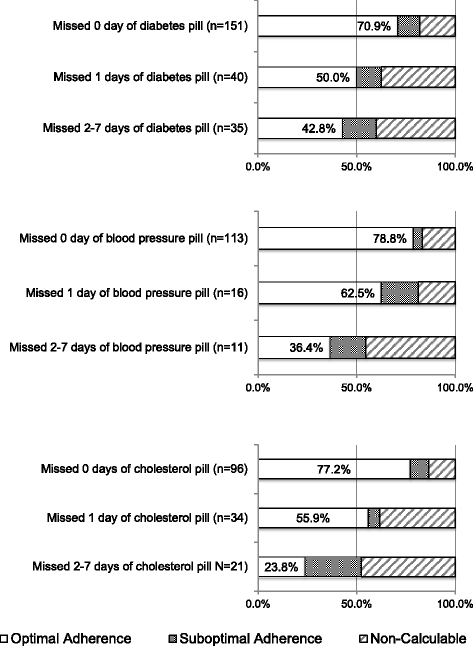
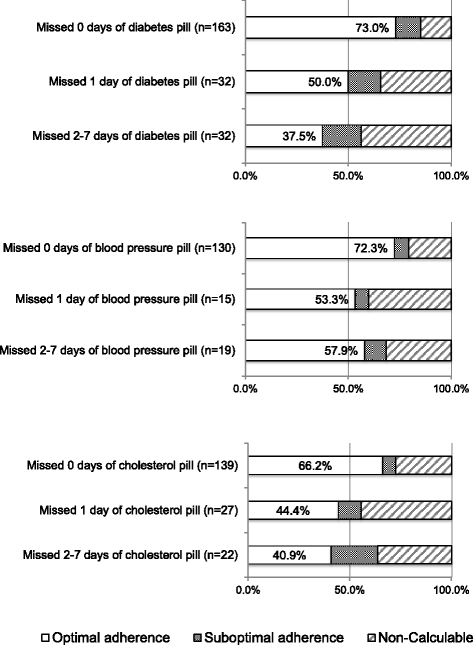
Among 210 participants, 46% had limited health literacy, 57% spoke Cantonese, and 19% Spanish. ATSM respondents reported ≥1 missed day for diabetes (33%), blood pressure (19%), and cholesterol (36%) pills. Interview respondents reported ≥1 missed day for diabetes (28%), blood pressure (21%), and cholesterol (26%) pills. Optimal adherence rates by CMG were lower among ATSM respondents reporting more missed days for blood pressure (p = 0.02) and cholesterol (p < 0.01); by interview, differences were significant for cholesterol (p = 0.01).
Conclusions
Language-concordant ATSM demonstrated modest potential for assessing adherence. Studies should evaluate HIT assessments of medication beliefs and concerns in diverse populations.
Trial registration
NCT00683020, registered May 21, 2008.
Electronic supplementary material
The online version of this article (10.1186/s12913-018-3071-4) contains supplementary material, which is available to authorized users.
-
Subjects:
-
Source:BMC Health Serv Res. 18.
-
Pubmed ID:29625571
-
Pubmed Central ID:PMC5889590
-
Document Type:
-
Funding:U58 DP002007/DP/NCCDPHP CDC HHS/United States ; KL2 TR000143/TR/NCATS NIH HHS/United States ; R18HS017261/Agency for Healthcare Research and Quality/ ; 5U58DP002007/Centers for Disease Control and Prevention/ ; UL1 RR024131/RR/NCRR NIH HHS/United States ; 1K08HS022561/Agency for Healthcare Research and Quality/ ; R03 HS020684/HS/AHRQ HHS/United States ; P30 HS023558/HS/AHRQ HHS/United States ; R18 HS017261/HS/AHRQ HHS/United States ; P30 DK092924/DK/NIDDK NIH HHS/United States ; 1P30-DK092924/National Institute of Diabetes and Digestive and Kidney Diseases/ ; 1R03HS020684/Agency for Healthcare Research and Quality/ ; K08 HS022561/HS/AHRQ HHS/United States
-
Volume:18
-
Collection(s):
-
Main Document Checksum:urn:sha256:2560eb42bccb4a912e59bb403761e321bd21689081fa029d44537950ca5821b7
-
Download URL:
-
File Type:
 [PDF
- 829.57 KB
]
[PDF
- 829.57 KB
]
Supporting Files


File Language:
English
ON THIS PAGE



CDC STACKS serves as an archival repository of CDC-published products including
scientific findings,
journal articles, guidelines, recommendations, or other public health information authored or
co-authored by CDC or funded partners.
As a repository, CDC STACKS retains documents in their original published format to ensure public access to scientific information.
As a repository, CDC STACKS retains documents in their original published format to ensure public access to scientific information.
You May Also Like
COLLECTION
CDC Public Access