


Comorbidity Amplifies the Effects of Post-9/11 Posttraumatic Stress Disorder Trajectories on Health-Related Quality of Life
Supporting Files

-
2017/12/20
-
File Language:
English
Details
-
Journal Article:Qual Life Res
-
Personal Author:
-
Description:Purpose
The present study aims to examine the impact of physical and mental health comorbidities on the association between post-9/11 posttraumatic stress disorder (PTSD) trajectories over 10 years and health-related quality of life (HRQOL) among 9/11-exposed persons.
Methods
30,002 responding adult World Trade Center Health Registry enrollees reporting no pre-9/11 PTSD were studied. PTSD trajectories (chronic, delayed, remitted, no PTSD) were defined based on a 17-item PTSD Checklist-Specific to 9/11 across three waves of survey data. Three indicators of poor HRQOL were defined based on CDC HRQOL-4 measures. We computed age-adjusted prevalence of physical and mental health comorbidity (depression/anxiety) by PTSD trajectory and used modified Poisson regression to assess the effect of PTSD trajectory on poor HRQOL prevalence, accounting for comorbidity.
Results
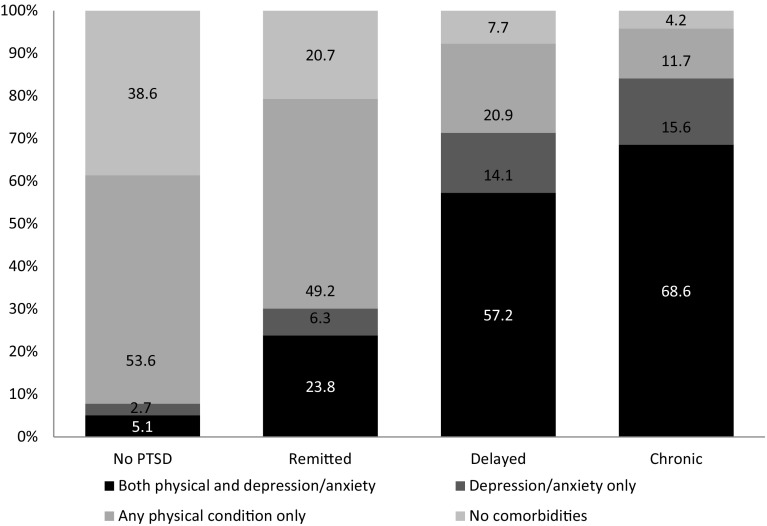
Age-adjusted prevalence of overall comorbid conditions was 95.8 and 61.4% among the chronic and no-PTSD groups, respectively. Associations between 9/11-related PTSD trajectories and poor HRQOL were significant and became greater when comorbidity was included. Adjusted prevalence ratios were elevated for fair/poor health status (APR 7.3, 95% CI 6.5, 8.2), ≥ 14 unhealthy days (4.7; 95% CI 4.4, 5.1), and ≥ 14 activity limitation days during the last 30 days (9.6; 95% CI 8.1, 11.4) in the chronic PTSD group with physical and mental health comorbidity compared to those without PTSD and comorbidity; similar associations were observed for delayed PTSD.
Conclusions
Ten years post-9/11 physical and mental health comorbidities have a substantial impact on the PTSD trajectories and HRQOL association. The need for early identification and treatment of PTSD and comorbidity should be emphasized to potentially improve HRQOL.
Electronic supplementary material
The online version of this article (10.1007/s11136-017-1764-5) contains supplementary material, which is available to authorized users.
-
Subjects:
-
Keywords:
-
Source:Qual Life Res. 27(3):651-660.
-
Pubmed ID:29260446
-
Pubmed Central ID:PMC5845593
-
Document Type:
-
Funding:
-
Genre:
-
Place as Subject:
-
CIO:
-
Topic:
-
Location:
-
Pages in Document:10 pdf pages
-
Volume:27
-
Issue:3
-
NIOSHTIC Number:nn:20050745 ; nn:20044874
-
Federal Fiscal Year:2018
-
Performing Organization:New York City Health/Mental Hygiene
-
Peer Reviewed:True
-
Collection(s):
-
Main Document Checksum:urn:sha-512:641a17e11680aef2860c3badbc11a175b0067e2d4402abcf33ed4cdf62a9ba3cb7f3f612b3c4b20f51f5b16c2103f7117b8d9939c238b90c44ec1553607e8882
-
Download URL:
-
File Type:
 [PDF
- 760.91 KB
]
[PDF
- 760.91 KB
]
Supporting Files


File Language:
English
ON THIS PAGE

CDC STACKS serves as an archival repository of CDC-published products including
scientific findings,
journal articles, guidelines, recommendations, or other public health information authored or
co-authored by CDC or funded partners.
As a repository, CDC STACKS retains documents in their original published format to ensure public access to scientific information.
As a repository, CDC STACKS retains documents in their original published format to ensure public access to scientific information.
You May Also Like