



Polio-Free Certification and Lessons Learned — South-East Asia Region, March 2014
Supporting Files
Public Domain

-
Oct 24 2014
Details
-
Journal Article:Morbidity and Mortality Weekly Report (MMWR)
-
Personal Author:Bahl, Sunil ; Kumar, Rakesh ; Menabde, Nata ; Thapa, Arun ; McFarland, Jeffrey ; Swezy, Virginia ; Tangermann, Rudolph H. ; Jafari, Hamid S. ; Elsner, Linda ; Wassilak, Steven G.F. ; Kew, Olen M. ; Cochi, Stephen L.
-
Corporate Authors:
-
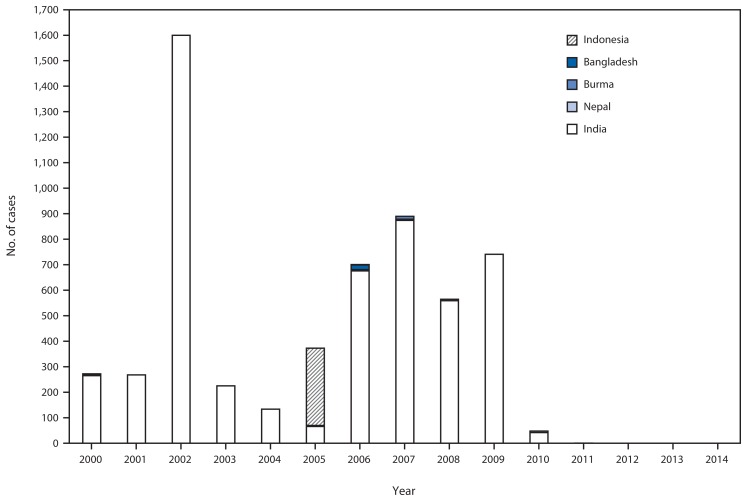
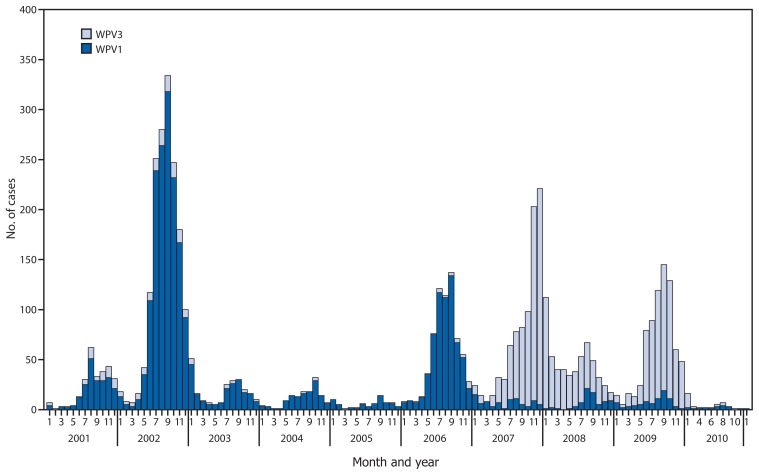
Description:In 1988, the World Health Assembly resolved to interrupt wild polioVirus (WPV) Transmission Worldwide. By 2006, the annual number of WPV cases had decreased by more than 99%, and only four remaining countries had never interrupted WPV Transmission: Afghanistan, India, Nigeria, and Pakistan. The last confirmed WPV case in India occurred in January 2011, leading the World Health Organization (WHO) South-East Asia Regional Commission for the Certification of Polio Eradication (SEA-RCC) in March 2014 to declare the 11-country South-East Asia Region (SEAR), which includes India, to be free from circulating indigenous WPV. SEAR became the fourth region among WHO's six regions to be certified as having interrupted all indigenous WPV circulation; the Region of the Americas was declared polio-free in 1994, the Western Pacific Region in 2000, and the European Region in 2002. Approximately 80% of the world's population now lives in countries of WHO regions that have been certified polio-free. This report summarizes steps taken to certify polio eradication in SEAR and outlines eradication activities and lessons learned in India, the largest member state in the region and the one for which eradication was the most difficult.
-
Subjects:
-
Source:MMWR Morbidity Mortal Weekly Rep. 2014; 63(42):941-946.
-
Series:
-
ISSN:0149-2195 (print) ; 1545-861X (digital)
-
Pubmed ID:25340910
-
Pubmed Central ID:PMC5779468
-
Document Type:
-
Place as Subject:
-
Pages in Document:6 pdf pages
-
Volume:63
-
Issue:42
-
Download URL:
-
File Type:
 [PDF - 308.02 KB]
 -
Collection(s):
-
Main Document Checksum:urn:sha-512:89c54f9b257d96d773d920cc07042aca26faf0b68752632e165414522dfee83d83c71912565828bb357891e54f0d130fa2d73225d8a6299fc7f9b4c8bc06b139
Supporting Files


 Was this page helpful?
 Found an issue?

CDC STACKS serves as an archival repository of CDC-published products including
scientific findings, journal articles, guidelines, recommendations, or other public health information authored or
co-authored by CDC or funded partners.
As a repository, CDC STACKS retains documents in their original published format to ensure public access to scientific information.
As a repository, CDC STACKS retains documents in their original published format to ensure public access to scientific information.
You May Also Like
COLLECTION
Morbidity and Mortality Weekly Report (MMWR)