


Age- and CGG Repeat-Related Slowing of Manual Movement in Fragile X Carriers: A Prodrome of FXTAS?
Supporting Files

-
4 2018
-
File Language:
English
Details
-
Alternative Title:Mov Disord
-
Personal Author:
-
Description:Background
Fragile X premutation carriers are at increased risk for fragile X-associated tremor ataxia syndrome (FXTAS), but to date we know little about prediction of onset and rate of progression, and even less about treatment of this neurodegenerative disease. Thus, longitudinal study of carriers, and identification of potential biomarkers and prodromal states, is essential. Here, we present results of baseline assessments from an ongoing longitudinal project.
Methods
The cohort consisted of 73 males, 48 with the fragile X mental retardation 1 (FMR1) premutation (55–200 cytosine-cytosine-guanine, CGG repeats) and 25 well-matched controls (< 40 repeats) between 40 and 75 years. At enrollment, none met criteria for FXTAS or had any clinically-significant tremor or ataxia by blinded neurological examination. The battery consisted of measures of visual memory, spatial working memory, response inhibition, motor speed and control, planning and problem solving, sustained attention, and a standardized movement disorder evaluation.
Results
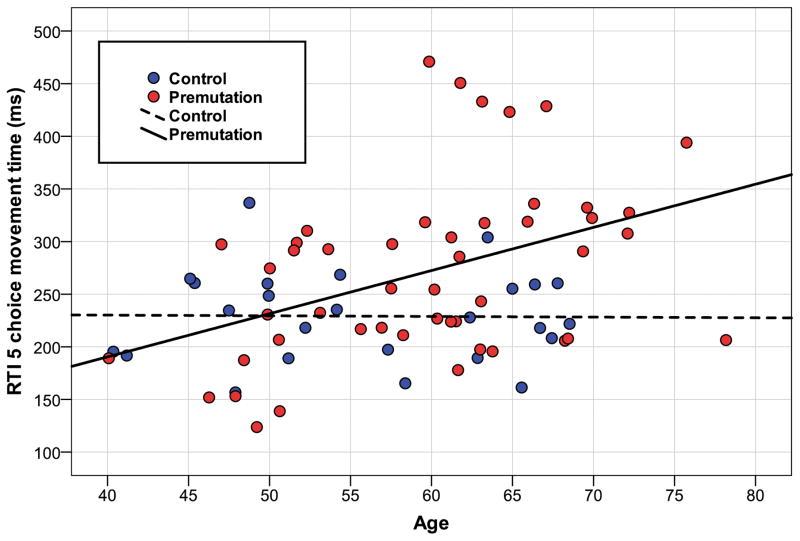
Contrary to expectations, there were no significant differences between premutation carriers and controls on any measure of executive function. However, premutation carriers had significantly longer manual movement and reaction times than controls, and the significant interaction between CGG repeat and age revealed the slowest movement times among older carriers with higher CGG repeat alleles. A subset of premutation carriers had marginally lower scores on the ataxia evaluation, and they performed no differently from controls on the parkinsonism assessment.
Conclusion
Early-developing cerebellar or fronto-motor tract white matter changes, previously documented in MRI studies, may underlie motor slowing that occurs before clinically observable neurological symptoms.
-
Keywords:
-
Source:Mov Disord. 33(4):628-636
-
Pubmed ID:29389022
-
Pubmed Central ID:PMC5889332
-
Document Type:
-
Funding:U54 HD083091/HD/NICHD NIH HHSUnited States/ ; R01 NS110100/NS/NINDS NIH HHSUnited States/ ; P30 HD002274/HD/NICHD NIH HHSUnited States/ ; R01 MH078041/MH/NIMH NIH HHSUnited States/ ; U54 HD079125/HD/NICHD NIH HHSUnited States/ ; U50 DD000596/DD/NCBDD CDC HHSUnited States/ ; RL1 AG032115/AG/NIA NIH HHSUnited States/ ; R01 HD036071/HD/NICHD NIH HHSUnited States/
-
Volume:33
-
Issue:4
-
Collection(s):
-
Main Document Checksum:urn:sha256:9a4e0d5882206b3b3e63ce7453f6ef469f38c8b7ca362819f79a5b26b86c1c21
-
Download URL:
-
File Type:
 [PDF
- 535.39 KB
]
[PDF
- 535.39 KB
]
Supporting Files


File Language:
English
ON THIS PAGE

CDC STACKS serves as an archival repository of CDC-published products including
scientific findings,
journal articles, guidelines, recommendations, or other public health information authored or
co-authored by CDC or funded partners.
As a repository, CDC STACKS retains documents in their original published format to ensure public access to scientific information.
As a repository, CDC STACKS retains documents in their original published format to ensure public access to scientific information.
You May Also Like
COLLECTION
CDC Public Access