


Trends in lipid profiles and descriptive characteristics of U.S. adults with and without diabetes and cholesterol-lowering medication use—National Health and Nutrition Examination Survey, 2003–2012, United States
Supporting Files
Public Domain

-
Mar 06 2018
-
File Language:
English
Details
-
Alternative Title:PLoS One
-
Personal Author:
-
Description:Background
With a cholesterol-lowering focus for diabetic adults and in the age of polypharmacy, it is important to understand how lipid profile levels differ among those with and without diabetes.
Objective
Investigate the means, differences, and trends in lipid profile measures [TC, total cholesterol; LDL-c, low-density lipoprotein; HDL-c, high-density lipoprotein; and TG, triglycerides] among US adults by diabetes status and cholesterol-lowering medication.
Methods
Population number and proportion of adults aged ≥21 years with diabetes and taking cholesterol-lowering medication were estimated using data on 10,384 participants from NHANES 2003–2012. Age-standardized means, trends, and differences in lipid profile measures were estimated by diabetes status and cholesterol medication use. For trends and differences, linear regression analysis were used adjusted for age, gender, and race/ethnicity.
Results
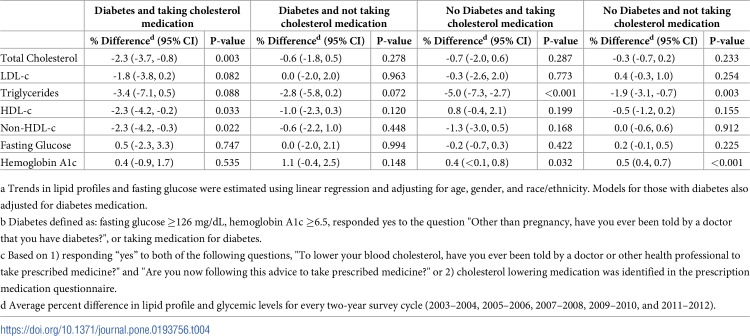
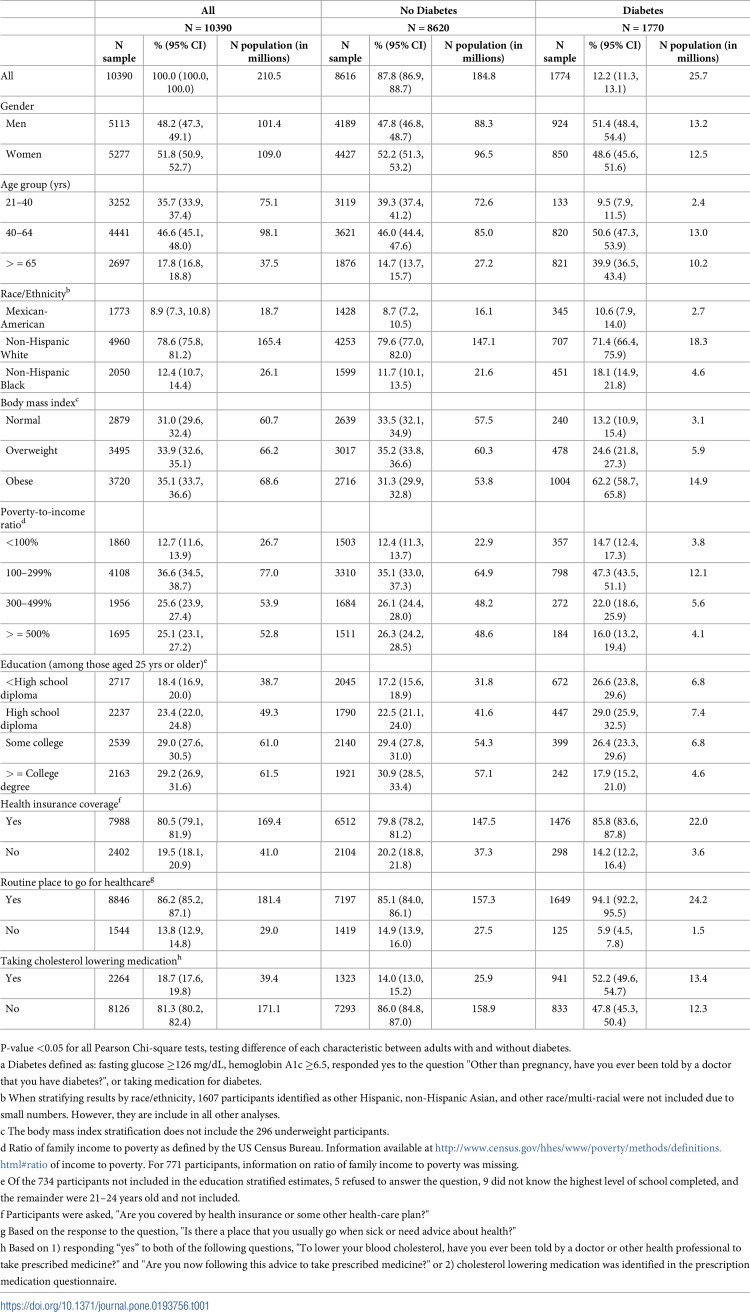
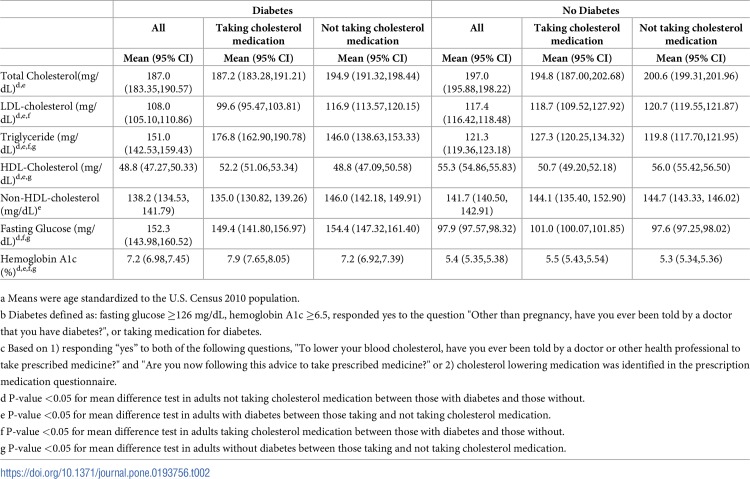
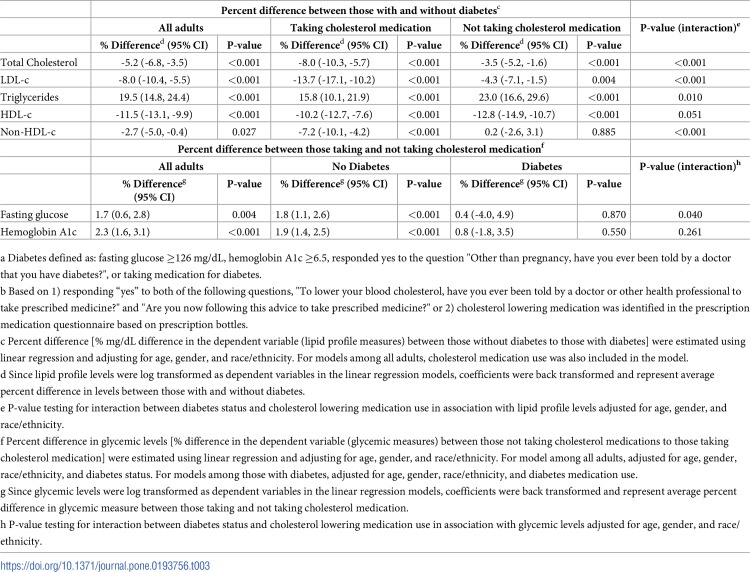
Among diabetic adults, 52% were taking cholesterol-lowering medication compared to the 14% taking cholesterol-lowering medication without diabetes. Although diabetic adults had significantly lower TC and LDL-c levels than non-diabetic adults [% difference (95% confidence interval): TC = -5.2% (-6.8 –-3.5), LDL-c = -8.0% (-10.4 –-5.5)], the percent difference was greater among adults taking cholesterol medication [TC = -8.0% (-10.3 –-5.7); LDL-c = -13.7% (-17.1 –-10.2)] than adults not taking cholesterol medication [TC = -3.5% (-5.2 –-1.6); LDL-c = -4.3% (-7.1 –-1.5)] (interaction p-value: TC = <0.001; LDL-c = <0.001). From 2003–2012, mean TC and HDL-c significantly decreased among diabetic adults taking cholesterol medication [% difference per survey cycle (p-value for linear trend): TC = -2.3% (0.003) and HDL-c = -2.3% (0.033)]. Mean TC, HDL-c, and LDL-c levels did not significantly change from 2003 to 2012 in non-diabetic adults taking cholesterol medication or for adults not taking cholesterol medications.
Conclusions
Diabetic adults were more likely to have lower lipid levels, except for triglyceride levels, than non-diabetic adults with profound differences when considering cholesterol medication use, possibly due to the positive effects from clinical diabetes management.
-
Subjects:
-
Source:PLoS One. 13(3).
-
Pubmed ID:29509776
-
Pubmed Central ID:PMC5839584
-
Document Type:
-
Name as Subject:
-
Place as Subject:
-
Volume:13
-
Issue:3
-
Collection(s):
-
Main Document Checksum:urn:sha256:bb640b91b19b5f1b046592b464d04a249a5235f03f8164a3d6840b7081b8d3e1
-
Download URL:
-
File Type:
 [PDF
- 661.14 KB
]
[PDF
- 661.14 KB
]
Supporting Files


File Language:
English
ON THIS PAGE



CDC STACKS serves as an archival repository of CDC-published products including
scientific findings,
journal articles, guidelines, recommendations, or other public health information authored or
co-authored by CDC or funded partners.
As a repository, CDC STACKS retains documents in their original published format to ensure public access to scientific information.
As a repository, CDC STACKS retains documents in their original published format to ensure public access to scientific information.
You May Also Like
COLLECTION
CDC Public Access