


Etiology of Severe Acute Watery Diarrhea in Children in the Global Rotavirus Surveillance Network Using Quantitative Polymerase Chain Reaction
Supporting Files

-
Jul 15 2017
-
File Language:
English
Details
-
Alternative Title:J Infect Dis
-
Personal Author:Operario, Darwin J ; Platts-Mills, James A ; Nadan, Sandrama ; Page, Nicola ; Seheri, Mapaseka ; Mphahlele, Jeffrey ; Praharaj, Ira ; Kang, Gagandeep ; Araujo, Irene T ; Leite, Jose Paulo G ; Cowley, Daniel ; Thomas, Sarah ; Kirkwood, Carl D ; Dennis, Francis ; Armah, George ; Mwenda, Jason M ; Wijesinghe, Pushpa Ranjan ; Rey, Gloria ; Grabovac, Varja ; Berejena, Chipo ; Simwaka, Chibumbya J ; Uwimana, Jeannine ; Sherchand, Jeevan B ; Thu, Hlaing Myat ; Galagoda, Geethani ; Bonkoungou, Isidore J O ; Jagne, Sheriffo ; Tsolenyanu, Enyonam ; Diop, Amadou ; Enweronu-Laryea, Christabel ; Borbor, Sam-Aliyah ; Liu, Jie ; McMurry, Timothy ; Lopman, Benjamin ; Parashar, Umesh ; Gentsch, John ; Steele, A Duncan ; Cohen, Adam ; Serhan, Fatima ; Houpt, Eric R
-
Description:Background
The etiology of acute watery diarrhea remains poorly characterized, particularly after rotavirus vaccine introduction.
Methods
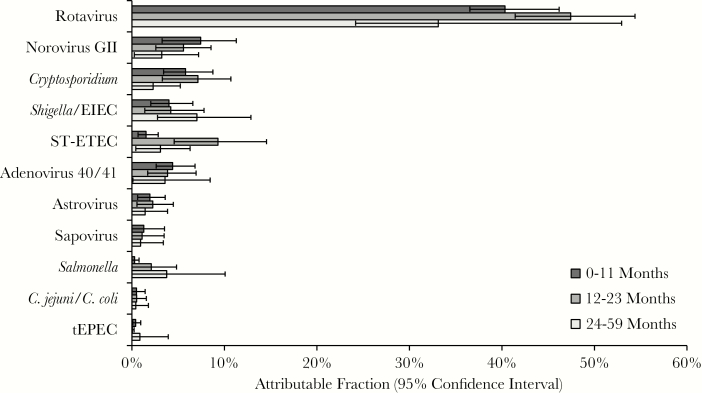
We performed quantitative polymerase chain reaction for multiple enteropathogens on 878 acute watery diarrheal stools sampled from 14643 episodes captured by surveillance of children <5 years of age during 2013–2014 from 16 countries. We used previously developed models of the association between pathogen quantity and diarrhea to calculate pathogen-specific weighted attributable fractions (AFs).
Results
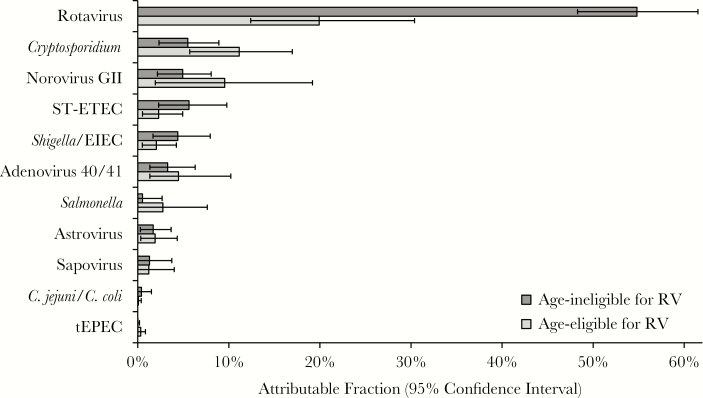
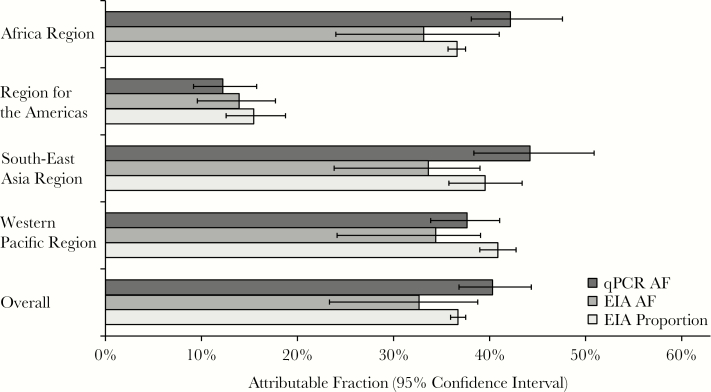
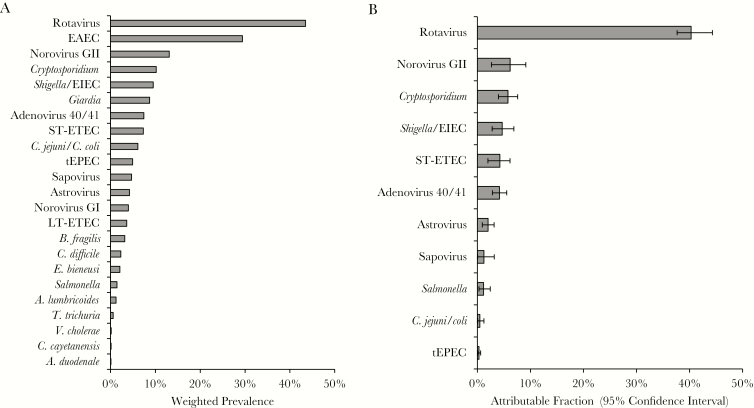
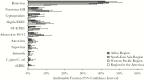
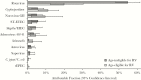
Rotavirus remained the leading etiology (overall weighted AF, 40.3% [95% confidence interval {CI}, 37.6%–44.3%]), though the AF was substantially lower in the Americas (AF, 12.2 [95% CI, 8.9–15.6]), based on samples from a country with universal rotavirus vaccination. Norovirus GII (AF, 6.2 [95% CI, 2.8–9.2]), Cryptosporidium (AF, 5.8 [95% CI, 4.0–7.6]), Shigella (AF, 4.7 [95% CI, 2.8–6.9]), heat-stable enterotoxin-producing Escherichia coli (ST-ETEC) (AF, 4.2 [95% CI, 2.0–6.1]), and adenovirus 40/41 (AF, 4.2 [95% CI, 2.9–5.5]) were also important. In the Africa Region, the rotavirus AF declined from 54.8% (95% CI, 48.3%–61.5%) in rotavirus vaccine age-ineligible children to 20.0% (95% CI, 12.4%–30.4%) in age-eligible children.
Conclusions
Rotavirus remained the leading etiology of acute watery diarrhea despite a clear impact of rotavirus vaccine introduction. Norovirus GII, Cryptosporidium, Shigella, ST-ETEC, and adenovirus 40/41 were also important. Prospective surveillance can help identify priorities for further reducing the burden of diarrhea.
-
Subjects:
-
Source:J Infect Dis. 2017; 216(2):220-227.
-
Pubmed ID:28838152
-
Pubmed Central ID:PMC5853801
-
Document Type:
-
Funding:
-
Name as Subject:
-
Place as Subject:
-
Volume:216
-
Issue:2
-
Collection(s):
-
Main Document Checksum:urn:sha256:cd94238224f1f5fdd9e5489ca6e740e23630b36dbdd47361ffe9f5fe9e10afb6
-
Download URL:
-
File Type:
 [PDF
- 245.67 KB
]
[PDF
- 245.67 KB
]
Supporting Files


File Language:
English
ON THIS PAGE




CDC STACKS serves as an archival repository of CDC-published products including
scientific findings,
journal articles, guidelines, recommendations, or other public health information authored or
co-authored by CDC or funded partners.
As a repository, CDC STACKS retains documents in their original published format to ensure public access to scientific information.
As a repository, CDC STACKS retains documents in their original published format to ensure public access to scientific information.
You May Also Like
COLLECTION
CDC Public Access