


Estimates of the Burden of Group B Streptococcal Disease Worldwide for Pregnant Women, Stillbirths, and Children
Supporting Files

-
Nov 2017
-
File Language:
English
Details
-
Alternative Title:The Burden of Group B Streptococcus Worldwide for Pregnant Women, Stillbirths, and Children
-
Personal Author:Seale, Anna C ; Bianchi-Jassir, Fiorella ; Russell, Neal J ; Kohli-Lynch, Maya ; Tann, Cally J ; Hall, Jenny ; Madrid, Lola ; Blencowe, Hannah ; Cousens, Simon ; Baker, Carol J ; Bartlett, Linda ; Cutland, Clare ; Gravett, Michael G ; Heath, Paul T ; Ip, Margaret ; Le Doare, Kirsty ; Madhi, Shabir A ; Rubens, Craig E ; Saha, Samir K ; Schrag, Stephanie J ; Sobanjo-ter Meulen, Ajoke ; Vekemans, Johan ; Lawn, Joy E
-
Description:Background
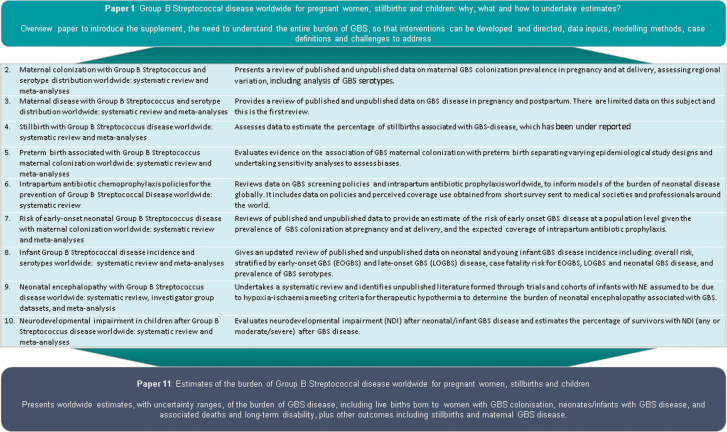
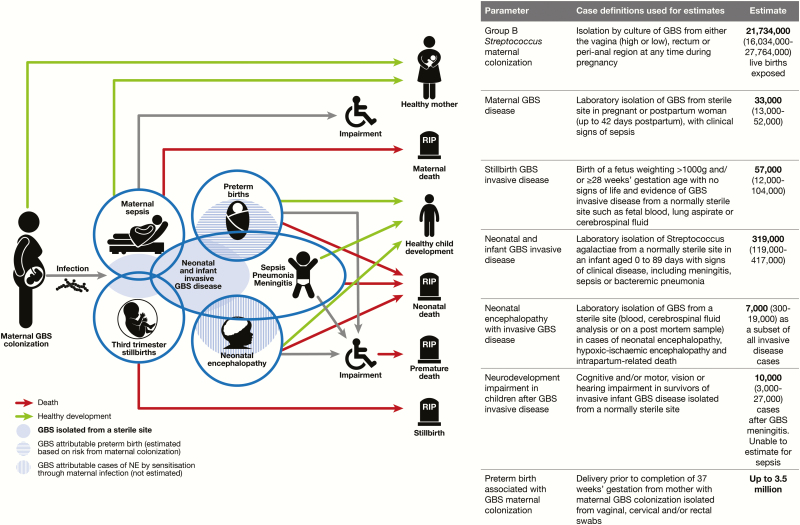
We aimed to provide the first comprehensive estimates of the burden of group B Streptococcus (GBS), including invasive disease in pregnant and postpartum women, fetal infection/stillbirth, and infants. Intrapartum antibiotic prophylaxis is the current mainstay of prevention, reducing early-onset infant disease in high-income contexts. Maternal GBS vaccines are in development.
Methods
For 2015 live births, we used a compartmental model to estimate (1) exposure to maternal GBS colonization, (2) cases of infant invasive GBS disease, (3) deaths, and (4) disabilities. We applied incidence or prevalence data to estimate cases of maternal and fetal infection/stillbirth, and infants with invasive GBS disease presenting with neonatal encephalopathy. We applied risk ratios to estimate numbers of preterm births attributable to GBS. Uncertainty was also estimated.
Results
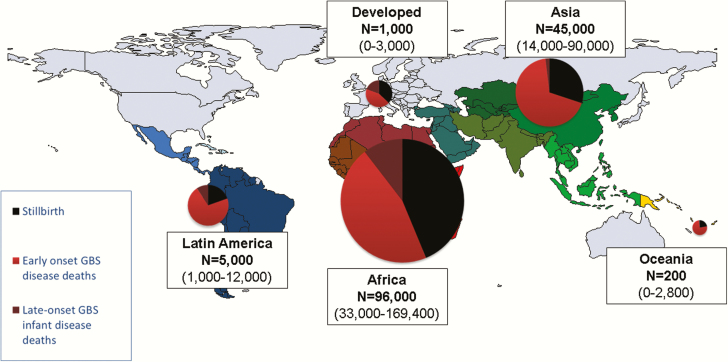
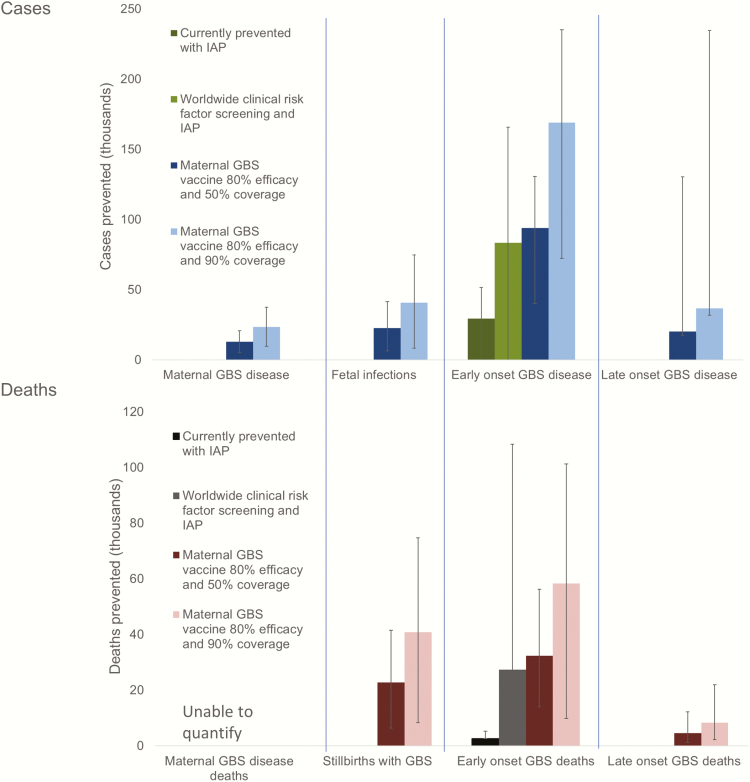
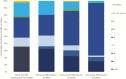
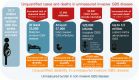
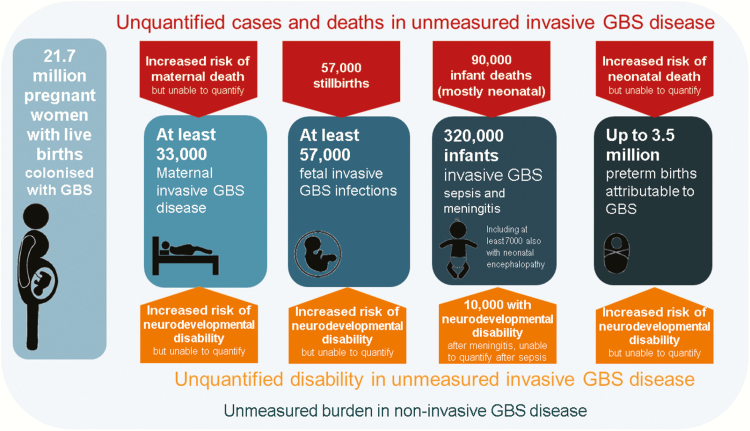
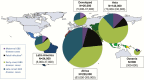
Worldwide in 2015, we estimated 205000 (uncertainty range [UR], 101000–327000) infants with early-onset disease and 114000 (UR, 44000–326000) with late-onset disease, of whom a minimum of 7000 (UR, 0–19000) presented with neonatal encephalopathy. There were 90000 (UR, 36000–169000) deaths in infants <3 months age, and, at least 10000 (UR, 3000–27000) children with disability each year. There were 33000 (UR, 13000–52000) cases of invasive GBS disease in pregnant or postpartum women, and 57000 (UR, 12000–104000) fetal infections/stillbirths. Up to 3.5 million preterm births may be attributable to GBS. Africa accounted for 54% of estimated cases and 65% of all fetal/infant deaths. A maternal vaccine with 80% efficacy and 90% coverage could prevent 107000 (UR, 20000–198000) stillbirths and infant deaths.
Conclusions
Our conservative estimates suggest that GBS is a leading contributor to adverse maternal and newborn outcomes, with at least 409000 (UR, 144000–573000) maternal/fetal/infant cases and 147000 (UR, 47000–273000) stillbirths and infant deaths annually. An effective GBS vaccine could reduce disease in the mother, the fetus, and the infant.
-
Subjects:
-
Source:Clin Infect Dis. 2017; 65(Suppl 2):S200-S219
-
Pubmed ID:29117332
-
Pubmed Central ID:PMC5849940
-
Document Type:
-
Funding:
-
Volume:65
-
Collection(s):
-
Main Document Checksum:urn:sha-512:492843e2485f446d8f4138f8b060e148410270e0a0209fcfd4a0df8f7564ca9dbe7b689d6ee7745592582d1509c74cceabddbcf78db571b9dc169ed06ee10aee
-
Download URL:
-
File Type:
 [PDF
- 8.48 MB
]
[PDF
- 8.48 MB
]
Supporting Files


File Language:
English
ON THIS PAGE






CDC STACKS serves as an archival repository of CDC-published products including
scientific findings,
journal articles, guidelines, recommendations, or other public health information authored or
co-authored by CDC or funded partners.
As a repository, CDC STACKS retains documents in their original published format to ensure public access to scientific information.
As a repository, CDC STACKS retains documents in their original published format to ensure public access to scientific information.
You May Also Like
COLLECTION
CDC Public Access