


24-Hour Profile of Serum Sclerostin and Its Association With Bone Biomarkers in Men
Supporting Files

-
Jul 26 2017
-
File Language:
English
Details
-
Alternative Title:Osteoporos Int
-
Personal Author:
-
Description:Purpose
The osteocyte exerts important effects on bone remodeling but its rhythmicity and effect on the rhythms of other bone cells are not fully characterized. The purpose of this study was to determine if serum sclerostin displays rhythmicity over a 24-hour (h) interval, similar to that of other bone biomarkers.
Methods
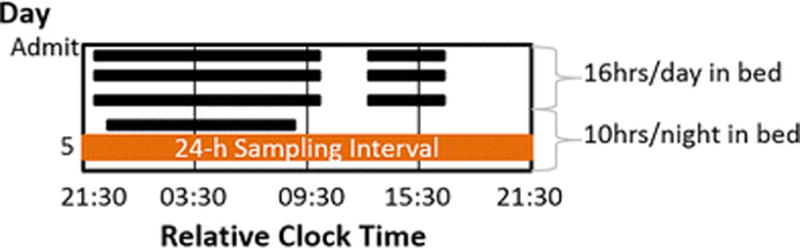
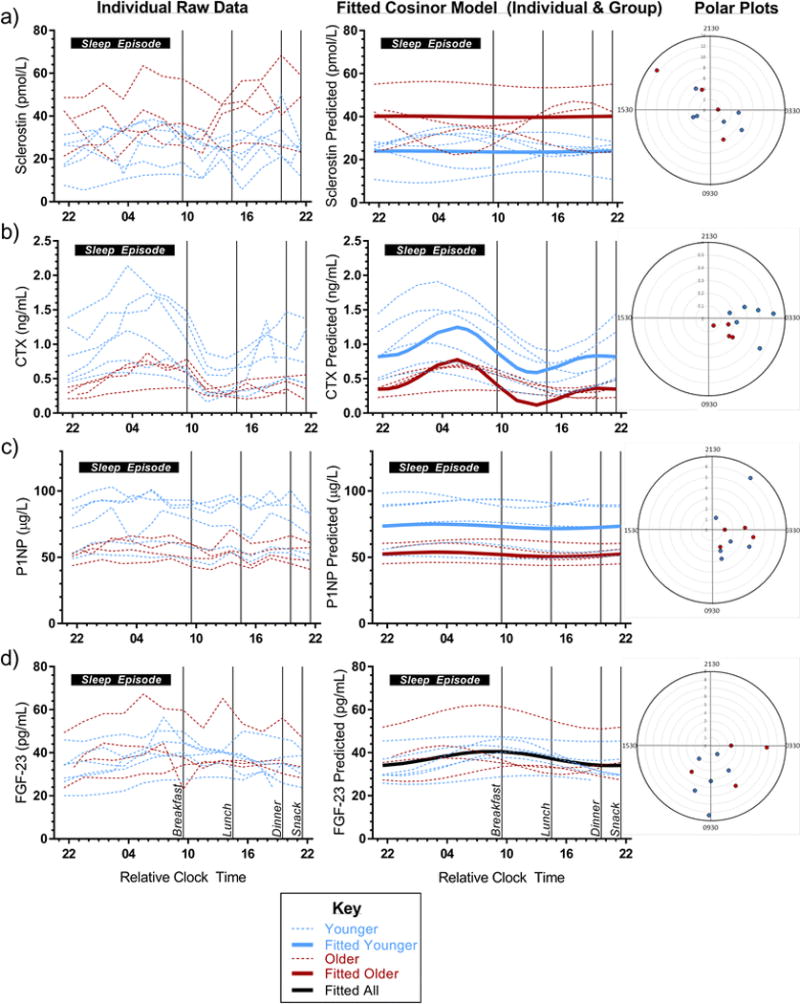
Serum sclerostin, FGF-23, CTX, and P1NP were measured every 2 hours over a 24-h interval on 10 healthy men aged 20-65 years. Maximum likelihood estimates of the parameters in a repeated measures model were used to determine if these biomarkers displayed a diurnal, sinusoidal rhythm.
Results
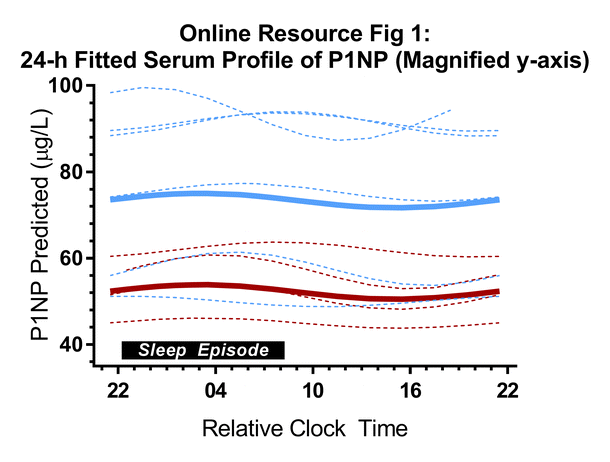
No discernible 24-h rhythm was identified for sclerostin (p = 0.99) or P1NP (p = 0.65). CTX rhythmicity was confirmed (p < 0.001), peaking at 05:30 (range 01:30–07:30). FGF-23 levels were also rhythmic (p < 0.001) but time of peak was variable (range 02:30-11:30). The only significant association identified between these four bone biomarkers was for CTX and P1NP mean 24-h metabolite levels (r = 0.65, p = 0.04).
Conclusions
Sclerostin levels do not appear to be rhythmic in men. This suggests that in contrast to CTX, serum sclerostin could be measured at any time of day. The 24-h profiles of FGF-23 suggest that a component of osteocyte function is rhythmic but its timing is variable. Our results do not support the hypothesis that osteocytes direct the rhythmicity of other bone turnover markers (CTX), at least not via a sclerostin mediated mechanism.
-
Subjects:
-
Source:Osteoporos Int. 28(11):3205-3213.
-
Pubmed ID:28744601
-
Pubmed Central ID:PMC5859541
-
Document Type:
-
Funding:R01 HL125893/HL/NHLBI NIH HHS/United States ; MRF515/Medical Research Foundation of Oregon/ ; UL1 TR000128/TR/NCATS NIH HHS/United States ; T32 DK007446/DK/NIDDK NIH HHS/United States ; T32 DK007674/DK/NIDDK NIH HHS/United States ; U01 AG042124/AG/NIA NIH HHS/United States ; U01 AG042145/AG/NIA NIH HHS/United States ; T32 DK007674/National Institute of Diabetes and Digestive and Kidney Diseases/ ; K23 AR070275/AR/NIAMS NIH HHS/United States ; M01 RR002635/RR/NCRR NIH HHS/United States ; P30 DK036836/DK/NIDDK NIH HHS/United States ; UL1TR000128/National Center for Advancing Translational Sciences/ ; U19 OH010154/OH/NIOSH CDC HHS/United States ; U01 AG042168/AG/NIA NIH HHS/United States ; U01 AG042140/AG/NIA NIH HHS/United States ; K23 AR070275/National Institute of Arthritis and Musculoskeletal and Skin Diseases/ ; P01 AG009975/AG/NIA NIH HHS/United States ; UL1 RR025758/RR/NCRR NIH HHS/United States ; U01 AG027810/AG/NIA NIH HHS/United States ; T32 DK007446/National Institute of Diabetes and Digestive and Kidney Diseases/ ; R01 HL107240/HL/NHLBI NIH HHS/United States ; P01 AG009975/National Institute on Aging/ ; U01 AG042143/AG/NIA NIH HHS/United States ; U01 AG042139/AG/NIA NIH HHS/United States ; U01 AR066160/AR/NIAMS NIH HHS/United States
-
Volume:28
-
Issue:11
-
Collection(s):
-
Main Document Checksum:urn:sha256:ae53e3d99fa4c9477f6b96fa107ff238f96bb377d17d91e421e9999ba01553d5
-
Download URL:
-
File Type:
 [PDF
- 561.63 KB
]
[PDF
- 561.63 KB
]
Supporting Files


File Language:
English
ON THIS PAGE


CDC STACKS serves as an archival repository of CDC-published products including
scientific findings,
journal articles, guidelines, recommendations, or other public health information authored or
co-authored by CDC or funded partners.
As a repository, CDC STACKS retains documents in their original published format to ensure public access to scientific information.
As a repository, CDC STACKS retains documents in their original published format to ensure public access to scientific information.
You May Also Like
COLLECTION
CDC Public Access