



A new methodological approach to adjust alcohol exposure distributions to improve the estimation of alcohol-attributable fractions
Supporting Files

-
11 2017 ; 11-2017
-
Available in CDC Stacks on 2018-03-15T00:00:00Z
File Language:
English
Details
-
Alternative Title:Addiction
-
Personal Author:
-
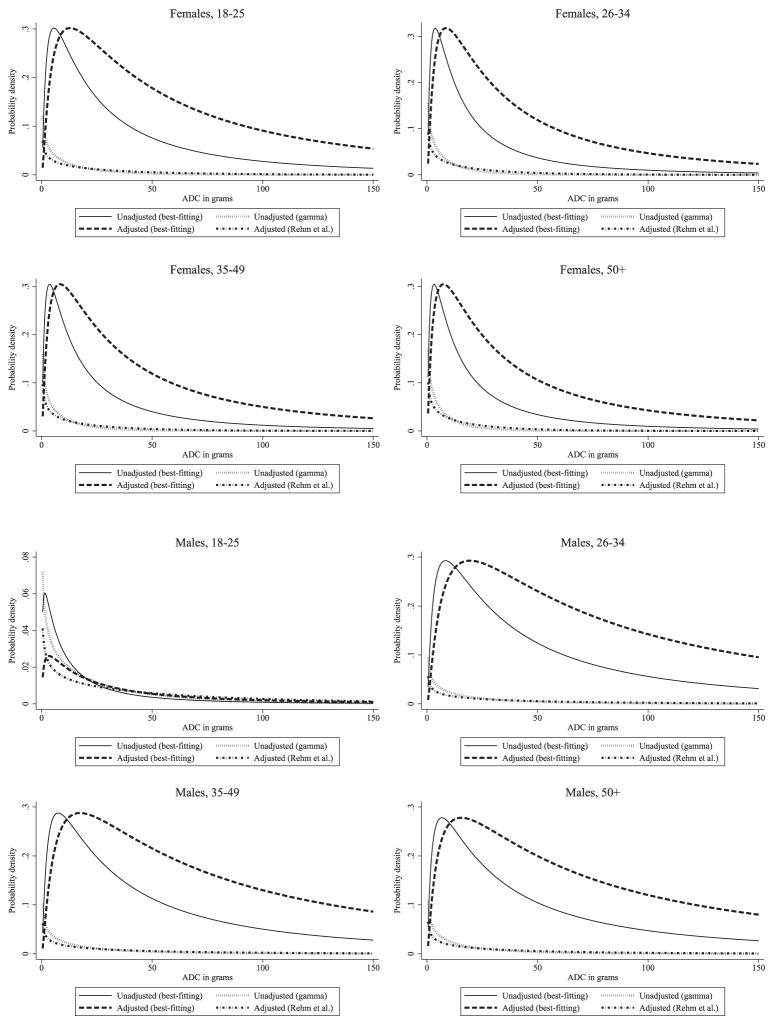
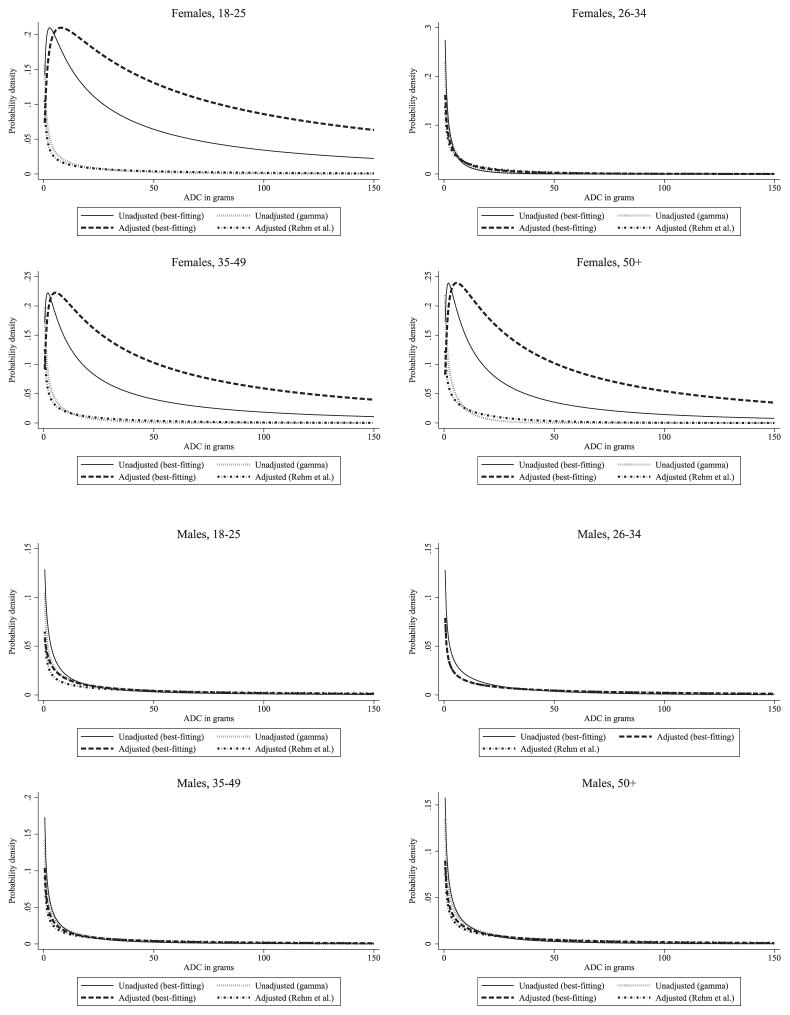
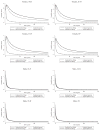
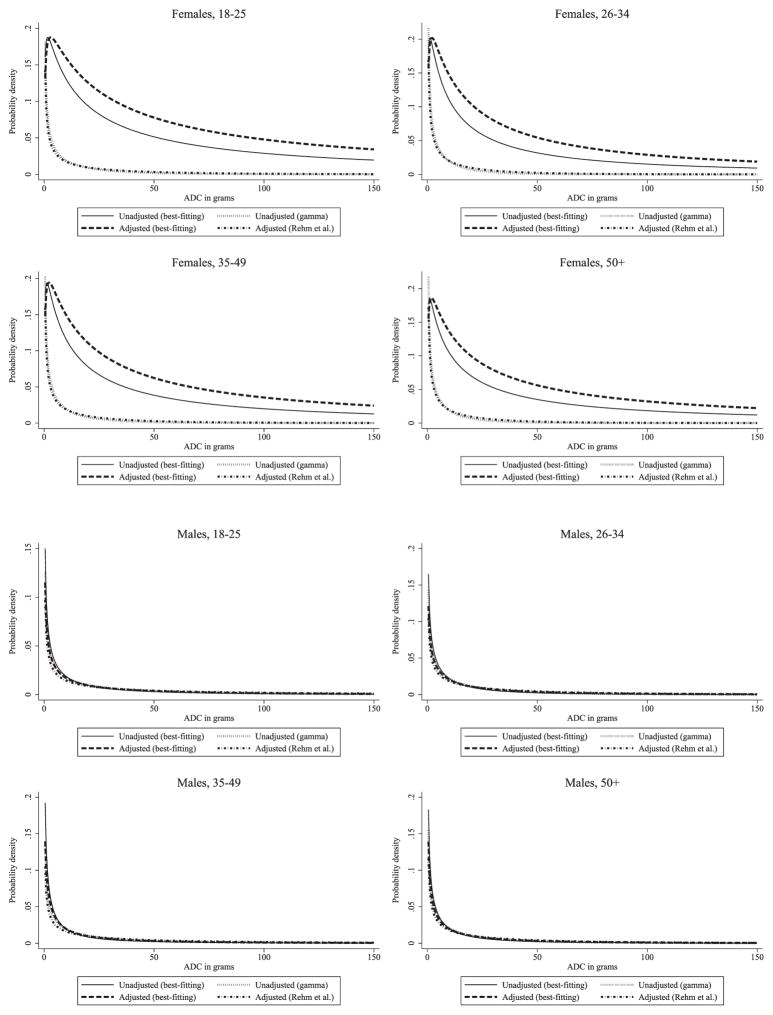
Description:Background and Aims ; To assess the burden of excessive alcohol use, researchers estimate alcohol-attributable fractions (AAFs) routinely. However, under-reporting in survey data can bias these estimates. We present an approach that adjusts for under-reporting in the estimation of AAFs, particularly within subgroups. This framework is a refinement of a previous method conducted by Rehm et al. ; Methods ; We use a measurement error model to derive the ‘true’ alcohol distribution from a ‘reported’ alcohol distribution. The ‘true’ distribution leverages per-capita sales data to identify the distribution average and then identifies the shape of the distribution with self-reported survey data. Data are from the National Alcohol Survey (NAS), the National Household Survey on Drug Abuse (NHSDA) and the National Epidemiologic Survey on Alcohol and Related Conditions (NESARC). We compared our approach with previous approaches by estimating the AAF of female breast cancer cases. ; Results ; Compared with Rehm et al.’s approach, our refinement performs similarly under a gamma assumption. For example, among females aged 18–25 years, the two approaches produce estimates from NHSDA that are within a percentage point. However, relaxing the gamma assumption generally produces more conservative evidence. For example, among females aged 18–25 years, estimates from NHSDA based on the best-fitting distribution are only 19.33% of breast cancer cases, which is a much smaller proportion than the gamma-based estimates of approximately 28%. ; Conclusions ; A refinement of Rehm et al.’s approach to adjusting for underreporting in the estimation of alcohol-attributable fractions provides more flexibility. This flexibility can avoid biases associated with failing to account for the underlying differences in alcohol consumption patterns across different study populations. Comparisons of our refinement with Rehm et al.’s approach show that results are similar when a gamma distribution is assumed. However, results are appreciably lower when the best-fitting distribution is chosen versus gamma-based results.
-
Subjects:
-
Keywords:
-
Source:Addiction. 112(11):2053-2063
-
Pubmed ID:28556274
-
Pubmed Central ID:PMC5854478
-
Document Type:
-
Funding:
-
Volume:112
-
Issue:11
-
Download URL:
-
File Type:
 [PDF - 964.52 KB]
 -
Collection(s):
-
Main Document Checksum:urn:sha256:65354fb815e445cf6820635eeb9a6c9646e23cf74c58fe952b37d49461b6b1b2
Supporting Files


File Language:
English
 Was this page helpful?
 Found an issue?

CDC STACKS serves as an archival repository of CDC-published products including
scientific findings, journal articles, guidelines, recommendations, or other public health information authored or
co-authored by CDC or funded partners.
As a repository, CDC STACKS retains documents in their original published format to ensure public access to scientific information.
As a repository, CDC STACKS retains documents in their original published format to ensure public access to scientific information.
You May Also Like
COLLECTION
CDC Public Access