


Mortality Risk Along the Frailty Spectrum: Data from the National Health and Nutrition Examination Survey 1999 to 2004
Supporting Files

-
Jan 25 2018
-
File Language:
English
Details
-
Alternative Title:J Am Geriatr Soc
-
Personal Author:
-
Description:OBJECTIVES
To determine the relationship between frailty and overall and cardiovascular mortality.
DESIGN
Longitudinal mortality analysis.
SETTING
National Health and Nutrition Examination Survey (NHANES) 1999–2004.
PARTICIPANTS
Community-dwelling older adults aged 60 and older (N = 4,984; mean age 71.1 ± 0.19, 56% female).
MEASUREMENTS
We used data from 1999–2004 cross-sectional NHANES and mortality data from the National Death Index, updated through December 2011. An adapted version of Fried’s frailty criteria was used (low body mass index, slow walking speed, weakness, exhaustion, low physical activity). Frailty was defined as persons meeting 3 or more criteria, prefrailty as meeting 1 or 2 criteria, and robust (reference) as not meeting any criteria. The primary outcome was to evaluate the association between frailty and overall and cardiovascular mortality. Cox proportional hazard models were used to evaluate the association between risk of death and frailty category adjusted for age, sex, race, smoking, education, coronary artery disease, heart failure, nonskin cancer, diabetes, and arthritis.
RESULTS
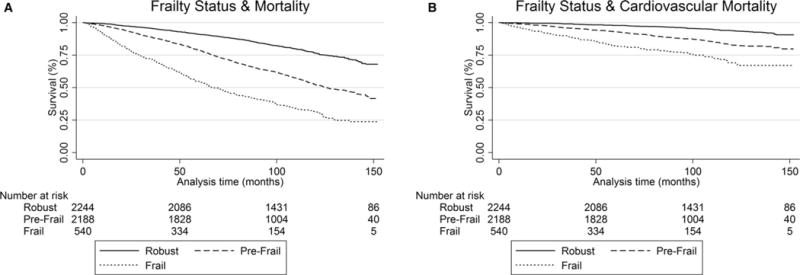
Half (50.4%) of participants were classified as robust, 40.3% as prefrail, and 9.2% as frail. Fully adjusted models demonstrated that prefrail (hazard ratio (HR) = 1.64, 95% confidence interval (CI) = 1.45–1.85) and frail (HR = 2.79, 95% CI = 2.35–3.30) participants had a greater risk of death and of cardiovascular death (prefrail: HR = 1.84, 95% CI = 1.45–2.34; frail: HR = 3.39, 95% CI = 2.45–4.70).
CONCLUSION
Frailty and prefrailty are associated with increased risk of death. Demonstrating the association between prefrail status and mortality is the first step to identifying potential targets of intervention in future studies.
-
Subjects:
-
Source:J Am Geriatr Soc. 66(3):496-502.
-
Pubmed ID:29368330
-
Pubmed Central ID:PMC5849536
-
Document Type:
-
Funding:R01 MH078052/MH/NIMH NIH HHS/United States ; R24 MH102794/MH/NIMH NIH HHS/United States ; T32 MH073553/MH/NIMH NIH HHS/United States ; R01 MH089811/MH/NIMH NIH HHS/United States ; UL1 TR001086/TR/NCATS NIH HHS/United States ; U48 DP005018/DP/NCCDPHP CDC HHS/United States ; T32 LM012204/LM/NLM NIH HHS/United States ; K23 AG051681/AG/NIA NIH HHS/United States ; R01 MH102325/MH/NIMH NIH HHS/United States ; KL2 TR001088/TR/NCATS NIH HHS/United States
-
Place as Subject:
-
Volume:66
-
Issue:3
-
Collection(s):
-
Main Document Checksum:urn:sha256:ecfe70d2ef0c3f4191b266c524dad0e469c91537c6e0b52853b126c46d647dc0
-
Download URL:
-
File Type:
 [PDF
- 140.67 KB
]
[PDF
- 140.67 KB
]
Supporting Files


File Language:
English
ON THIS PAGE


CDC STACKS serves as an archival repository of CDC-published products including
scientific findings,
journal articles, guidelines, recommendations, or other public health information authored or
co-authored by CDC or funded partners.
As a repository, CDC STACKS retains documents in their original published format to ensure public access to scientific information.
As a repository, CDC STACKS retains documents in their original published format to ensure public access to scientific information.
You May Also Like
COLLECTION
CDC Public Access