



Comorbidity Status and Annual Total Medical Expenditures in U.S. Hypertensive Adults
Supporting Files

-
12 2017 ; 12-2017
-
Available in CDC Stacks on 2018-03-05T00:00:00Z
File Language:
English
Details
-
Alternative Title:Am J Prev Med
-
Personal Author:
-
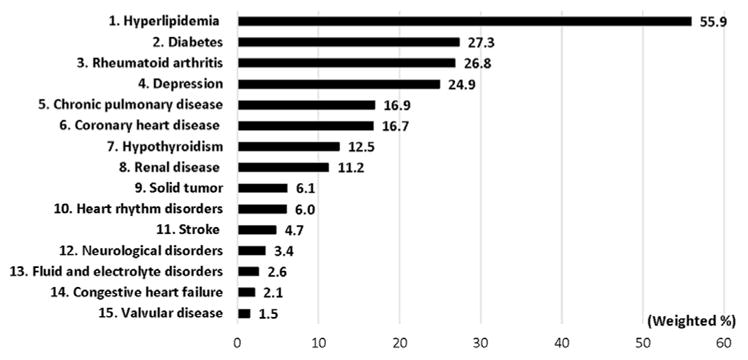
Description:Introduction ; The purpose of this study is to investigate comorbidity status and its impact on total medical expenditures in non-institutionalized hypertensive adults in the U.S. ; Methods ; Data from the 2011–2014 Medical Expenditure Panel Survey were used. Patients were included if they had a diagnosis code for hypertension, were aged ≥18 years, and were not pregnant during the study period (N=26,049). The Elixhauser Comorbidity Index was modified to add hypertension-related comorbidities. The outcome variable was annual total medical expenditures, and a generalized linear model regression (gamma distribution with a log link function) was used. All costs were adjusted to 2014 U.S. dollars. ; Results ; Based on the modified Elixhauser Comorbidity Index, 14.0% of patients did not have any comorbidities, 23.0% had one, 24.4% had two, and 38.7% had three or more. The five most frequent comorbidities were hyperlipidemia, diabetes, rheumatoid arthritis, depression, and chronic pulmonary disease. Estimated mean annual total medical expenditures were $3,914 (95% CI= $3,456, $4,372) for those without any comorbidity; $5,798 (95% CI=$5,384, $6,213) for those with one comorbidity; $8,333 (95% CI=$7,821, $8,844) for those with two comorbidities; and $13,920 (95% CI=$13,166, $14,674) for those with three or more comorbidities. Of the 15 most frequent comorbidities, the condition with the largest impact on expenditures for an individual person was congestive heart failure ($7,380). Hypertensive adults with stroke, coronary heart disease, diabetes, renal diseases, and hyperlipidemia had expenditures that were $6,069, $6,046, $5,039, $4,974, and $4,851 higher, respectively, than those without these conditions. ; Conclusions ; Comorbidities are highly prevalent among hypertensive adults, and this study shows that each comorbidity significantly increases annual total medical expenditures.
-
Subjects:
-
Source:Am J Prev Med. 53(6 Suppl 2):S172-S181
-
Pubmed ID:29153118
-
Pubmed Central ID:PMC5836318
-
Document Type:
-
Funding:
-
Volume:53
-
Download URL:
-
File Type:
 [PDF - 460.10 KB]
 -
Collection(s):
-
Main Document Checksum:urn:sha256:2246437413905a48b6efbe51fe3cb5bbe7853e0f3ef2738f9b3b5bc18c4760e7
Supporting Files


File Language:
English
 Was this page helpful?
 Found an issue?



CDC STACKS serves as an archival repository of CDC-published products including
scientific findings, journal articles, guidelines, recommendations, or other public health information authored or
co-authored by CDC or funded partners.
As a repository, CDC STACKS retains documents in their original published format to ensure public access to scientific information.
As a repository, CDC STACKS retains documents in their original published format to ensure public access to scientific information.
You May Also Like
COLLECTION
CDC Public Access