


Increasing Prevalence of Nontuberculous Mycobacteria in Respiratory Specimens from US-Affiliated Pacific Island Jurisdictions1
Supporting Files

-
Mar 2018
-
File Language:
English
Details
-
Alternative Title:Emerg Infect Dis
-
Personal Author:
-
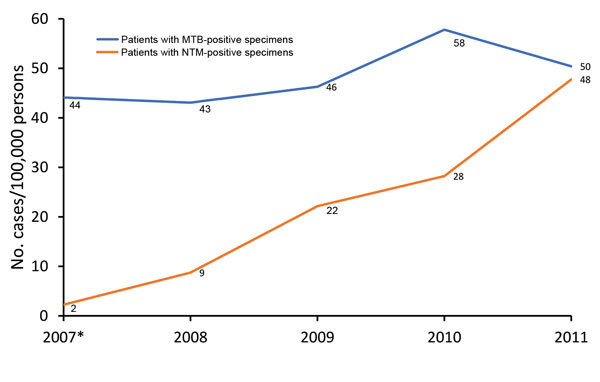
Description:Nontuberculous mycobacteria (NTM) respiratory infections represent a growing public health problem in many countries. However, there are limited published epidemiologic studies for the Western Pacific region. We reviewed respiratory specimens submitted to Diagnostic Laboratory Services in Hawaii, USA, for culture of Mycobacterium tuberculosis during August 2007-December 2011 to determine the NTM isolation rate. We observed a statistically significant increase in the rate of specimens with NTM isolated in respiratory culture (adjusted rate ratio per year 1.65, 95% CI 1.54-1.77; p<0.01). In contrast, the number of patients with respiratory cultures positive for M. tuberculosis showed no increase (adjusted rate ratio per year 0.98, 95% CI 0.94-1.01; p = 0.19). A 6-month subset of NTM isolates was identified by using a nucleic acid probe or 16S rRNA sequencing. M. avium complex and M. fortuitum were the most common NTM identified.
-
Subjects:
-
Source:Emerg Infect Dis. 24(3):485-491.
-
Pubmed ID:29460734
-
Pubmed Central ID:PMC5823340
-
Document Type:
-
Funding:
-
Place as Subject:
-
Location:
-
Volume:24
-
Issue:3
-
Collection(s):
-
Main Document Checksum:urn:sha256:386b315a7a7520e83f14888d223243cce047f903a5a27a2ed78ff35664322efa
-
Download URL:
-
File Type:
 [PDF
- 635.56 KB
]
[PDF
- 635.56 KB
]
Supporting Files


File Language:
English
ON THIS PAGE


CDC STACKS serves as an archival repository of CDC-published products including
scientific findings,
journal articles, guidelines, recommendations, or other public health information authored or
co-authored by CDC or funded partners.
As a repository, CDC STACKS retains documents in their original published format to ensure public access to scientific information.
As a repository, CDC STACKS retains documents in their original published format to ensure public access to scientific information.
You May Also Like
COLLECTION
Emerging Infectious Diseases