



Development of a Pediatric Ebola Predictive Score, Sierra Leone
Supporting Files
Public Domain

-
Feb 2018
File Language:
English
Details
-
Alternative Title:Emerg Infect Dis
-
Personal Author:Fitzgerald, Felicity ; Wing, Kevin ; Naveed, Asad ; Gbessay, Musa ; Ross, J.C.G. ; Checchi, Francesco ; Youkee, Daniel ; Jalloh, Mohamed Boie ; Baion, David E. ; Mustapha, Ayeshatu ; Jah, Hawanatu ; Lako, Sandra ; Oza, Shefali ; Boufkhed, Sabah ; Feury, Reynold ; Bielicki, Julia ; Williamson, Elizabeth ; Gibb, Diana M. ; Klein, Nigel ; Sahr, Foday ; Yeung, Shunmay
-
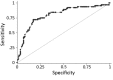
Description:We compared children who were positive for Ebola virus disease (EVD) with those who were negative to derive a pediatric EVD predictor (PEP) score. We collected data on all children <13 years of age admitted to 11 Ebola holding units in Sierra Leone during August 2014-March 2015 and performed multivariable logistic regression. Among 1,054 children, 309 (29%) were EVD positive and 697 (66%) EVD negative, with 48 (5%) missing. Contact history, conjunctivitis, and age were the strongest positive predictors for EVD. The PEP score had an area under receiver operating characteristics curve of 0.80. A PEP score of 7/10 was 92% specific and 44% sensitive; 3/10 was 30% specific, 94% sensitive. The PEP score could correctly classify 79%-90% of children and could be used to facilitate triage into risk categories, depending on the sensitivity or specificity required.
-
Subjects:
-
Source:Emerg Infect Dis. 24(2):311-319.
-
Pubmed ID:29350145
-
Pubmed Central ID:PMC5782873
-
Document Type:
-
Place as Subject:
-
Volume:24
-
Issue:2
-
Download URL:
-
File Type:
 [PDF - 1.01 MB]
 -
Collection(s):
-
Main Document Checksum:urn:sha256:2167e92750c09ddf5037d5a8b034a2ee7f756d088d4f42ed264342b15f6dc341
Supporting Files


File Language:
English
 Was this page helpful?
 Found an issue?



CDC STACKS serves as an archival repository of CDC-published products including
scientific findings, journal articles, guidelines, recommendations, or other public health information authored or
co-authored by CDC or funded partners.
As a repository, CDC STACKS retains documents in their original published format to ensure public access to scientific information.
As a repository, CDC STACKS retains documents in their original published format to ensure public access to scientific information.
You May Also Like
COLLECTION
Emerging Infectious Diseases