


Borrelia miyamotoi Infections in Humans and Ticks, Northeastern China
Supporting Files
Public Domain

-
Feb 2018
-
File Language:
English
Details
-
Alternative Title:Emerg Infect Dis
-
Personal Author:
-
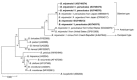
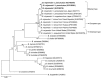
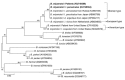
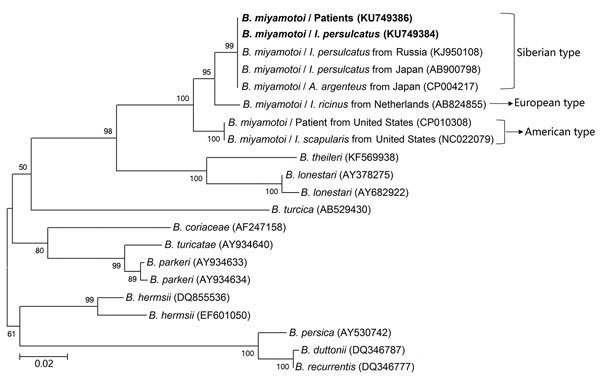
Description:We conducted an investigation of Borrelia miyamotoi infections in humans and ticks in northeastern China. Of 984 patients reporting recent tick bites, 14 (1.4%) were found to be infected with B. miyamotoi by PCR and genomic sequencing. The 14 patients had nonspecific febrile manifestations, including fever, headache, anorexia, asthenia, and arthralgia. Rash, eschar, and regional lymphadenopathy were each observed in 1 patient. Four (28.6%) patients were hospitalized because of severe disease. B. miyamotoi was detected in 3.0% (19/627) of Ixodes persulcatus, 1 (2.8%) of 36 Haemaphysalis concinna, and none of 29 Dermacentor silvarum ticks. Phylogenetic analyses based on sequences of a nearly entire 16s rRNA gene, a partial flagellin gene, and the glycerophosphodiester phosphodiesterase gene revealed that B. miyamotoi identified in patients and ticks were clustered in the group of the Siberian type. These findings indicate that B. miyamotoi is endemic in northeastern China and its public health significance deserves further investigation.
-
Subjects:
-
Source:Emerg Infect Dis. 24(2):236-241.
-
Pubmed ID:29350133
-
Pubmed Central ID:PMC5782893
-
Document Type:
-
Place as Subject:
-
Location:
-
Volume:24
-
Issue:2
-
Collection(s):
-
Main Document Checksum:urn:sha256:1ecf1811f9681ac60edb0c8e21cc230c102a25c0ba1c5275020d9b095219407f
-
Download URL:
-
File Type:
 [PDF
- 1.78 MB
]
[PDF
- 1.78 MB
]
Supporting Files


File Language:
English
ON THIS PAGE




CDC STACKS serves as an archival repository of CDC-published products including
scientific findings,
journal articles, guidelines, recommendations, or other public health information authored or
co-authored by CDC or funded partners.
As a repository, CDC STACKS retains documents in their original published format to ensure public access to scientific information.
As a repository, CDC STACKS retains documents in their original published format to ensure public access to scientific information.
You May Also Like
COLLECTION
Emerging Infectious Diseases