



Failure to Communicate: Transmission of Extensively Drug-Resistant blaOXA-237-Containing Acinetobacter baumannii—Multiple Facilities in Oregon, 2012–2014
Supporting Files

-
11 2017 ; 11-2017
-
Available in CDC Stacks on 2018-11-01T00:00:00Z
File Language:
English
Details
-
Alternative Title:Infect Control Hosp Epidemiol
-
Personal Author:Buser, Genevieve L. ; Cassidy, P. Maureen ; Cunningham, Margaret C. ; Rudin, Susan ; Hujer, Andrea M. ; Vega, Robert ; Furuno, Jon P. ; Marshall, Steven H. ; Higgins, Paul G. ; Jacobs, Michael R. ; Wright, Meredith S. ; Adams, Mark D. ; Bonomo, Robert A. ; Pfeiffer, Christopher D. ; Beldavs, Zintars G.
-
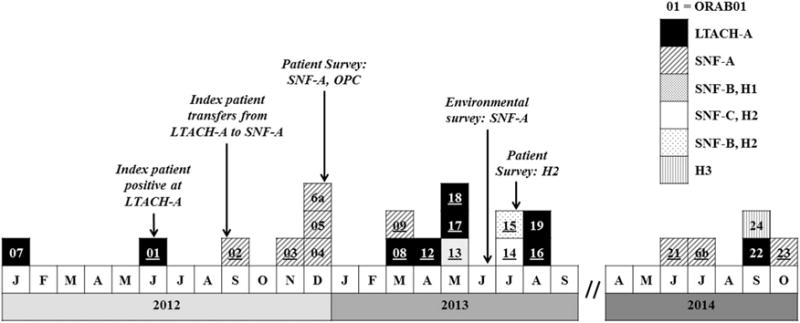
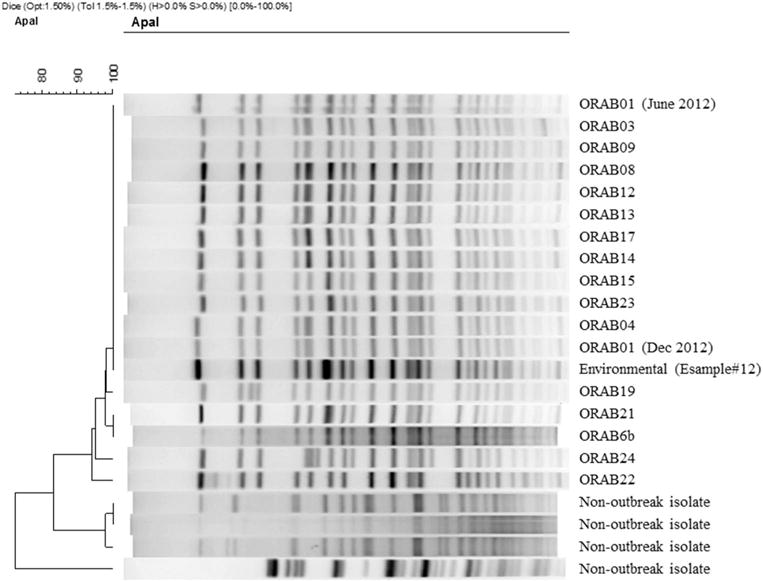
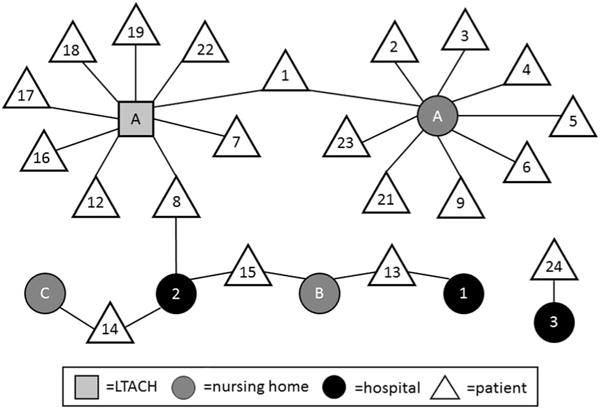
Description:OBJECTIVE ; To determine the scope, source, and mode of transmission of a multifacility outbreak of extensively drug-resistant (XDR) Acinetobacter baumannii. ; DESIGN ; Outbreak investigation. ; SETTING AND PARTICIPANTS ; Residents and patients in skilled nursing facilities, long-term acute-care hospital, and acute-care hospitals. ; METHODS ; A case was defined as the incident isolate from clinical or surveillance cultures of XDR Acinetobacter baumannii resistant to imipenem or meropenem and nonsusceptible to all but 1 or 2 antibiotic classes in a patient in an Oregon healthcare facility during January 2012–December 2014. We queried clinical laboratories, reviewed medical records, oversaw patient and environmental surveillance surveys at 2 facilities, and recommended interventions. Pulsed-field gel electrophoresis (PFGE) and molecular analysis were performed. ; RESULTS ; We identified 21 cases, highly related by PFGE or healthcare facility exposure. Overall, 17 patients (81%) were admitted to either long-term acute-care hospital A (n = 8), or skilled nursing facility A (n = 8), or both (n = 1) prior to XDR A. baumannii isolation. Interfacility communication of patient or resident XDR status was not performed during transfer between facilities. The rare plasmid-encoded carbapenemase gene blaOXA-237 was present in 16 outbreak isolates. Contact precautions, chlorhexidine baths, enhanced environmental cleaning, and interfacility communication were implemented for cases to halt transmission. ; CONCLUSIONS ; Interfacility transmission of XDR A. baumannii carrying the rare blaOXA-237 was facilitated by transfer of affected patients without communication to receiving facilities.
-
Subjects:
-
Source:Infect Control Hosp Epidemiol. 38(11):1335-1341
-
Pubmed ID:28870269
-
Pubmed Central ID:PMC5783543
-
Document Type:
-
Funding:R01 AI100560/AI/NIAID NIH HHSUnited States/ ; R01 AI072219/AI/NIAID NIH HHSUnited States/ ; R01 AI063517/AI/NIAID NIH HHSUnited States/ ; U19 AI110819/AI/NIAID NIH HHSUnited States/ ; I01 BX001974/BX/BLRD VAUnited States/ ; U54CK000484/ACL HHSUnited States/ ; U54 CK000484/CK/NCEZID CDC HHSUnited States/
-
Volume:38
-
Issue:11
-
Download URL:
-
File Type:
 [PDF - 457.83 KB]
 -
Collection(s):
-
Main Document Checksum:urn:sha256:794a0b436dbee18d6af83f783d10814f16c01122e02b6ea7c616f42d3723d90a
Supporting Files


File Language:
English
 Was this page helpful?
 Found an issue?



CDC STACKS serves as an archival repository of CDC-published products including
scientific findings, journal articles, guidelines, recommendations, or other public health information authored or
co-authored by CDC or funded partners.
As a repository, CDC STACKS retains documents in their original published format to ensure public access to scientific information.
As a repository, CDC STACKS retains documents in their original published format to ensure public access to scientific information.
You May Also Like
COLLECTION
CDC Public Access