


Changing Geographic Patterns and Risk Factors for Avian Influenza A(H7N9) Infections in Humans, China
Supporting Files
Public Domain

-
Jan 2018
-
File Language:
English
Details
-
Alternative Title:Emerg Infect Dis
-
Personal Author:Artois, Jean ; Jiang, Hui ; Wang, Xiling ; Qin, Ying ; Pearcy, Morgan ; Lai, Shengjie ; Shi, Yujing ; Zhang, Juanjuan ; Peng, Zhibin ; Zheng, Jiandong ; He, Yangni ; Dhingra, Madhur S. ; von Dobschuetz, Sophie ; Guo, Fusheng ; Martin, Vincent ; Kalpravidh, Wantanee ; Claes, Filip ; Robinson, Timothy ; Hay, Simon I. ; Xiao, Xiangming ; Feng, Luzhao ; Gilbert, Marius ; Yu, Hongjie
-
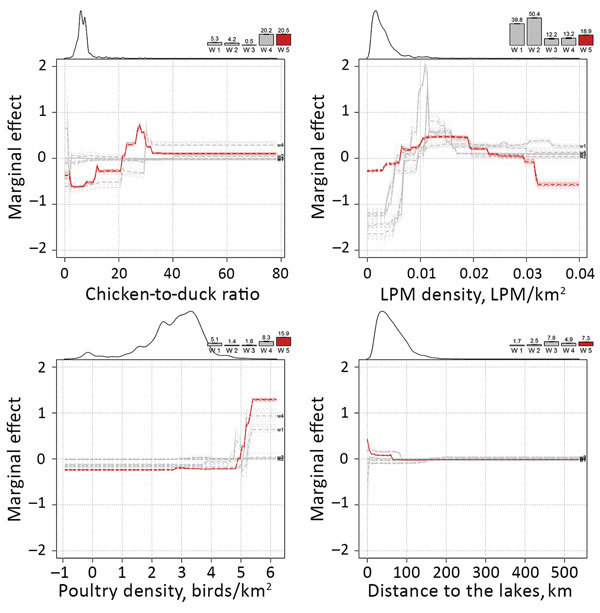
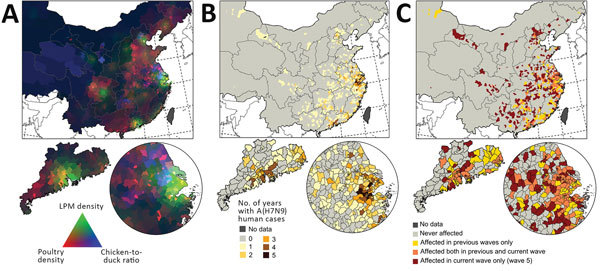
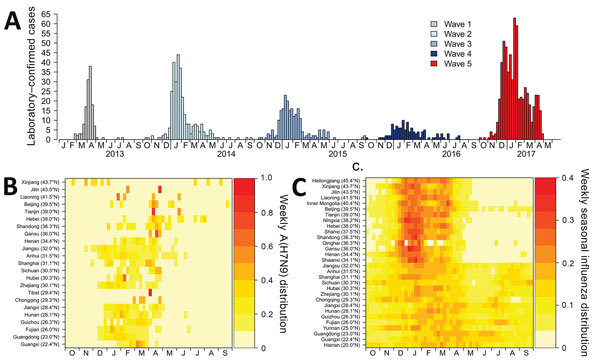
Description:The fifth epidemic wave of avian influenza A(H7N9) virus in China during 2016-2017 demonstrated a geographic range expansion and caused more human cases than any previous wave. The factors that may explain the recent range expansion and surge in incidence remain unknown. We investigated the effect of anthropogenic, poultry, and wetland variables on all epidemic waves. Poultry predictor variables became much more important in the last 2 epidemic waves than they were previously, supporting the assumption of much wider H7N9 transmission in the chicken reservoir. We show that the future range expansion of H7N9 to northern China may increase the risk of H7N9 epidemic peaks coinciding in time and space with those of seasonal influenza, leading to a higher risk of reassortments than before, although the risk is still low so far.
-
Subjects:
-
Source:Emerg Infect Dis. 24(1):87-94.
-
Pubmed ID:29260681
-
Pubmed Central ID:PMC5749478
-
Document Type:
-
Place as Subject:
-
Location:
-
Volume:24
-
Issue:1
-
Collection(s):
-
Main Document Checksum:urn:sha256:58243110907e3ad0432e6433613cc095e26a635886c28523211d70500b741406
-
Download URL:
-
File Type:
 [PDF
- 4.12 MB
]
[PDF
- 4.12 MB
]
Supporting Files


File Language:
English
ON THIS PAGE




CDC STACKS serves as an archival repository of CDC-published products including
scientific findings,
journal articles, guidelines, recommendations, or other public health information authored or
co-authored by CDC or funded partners.
As a repository, CDC STACKS retains documents in their original published format to ensure public access to scientific information.
As a repository, CDC STACKS retains documents in their original published format to ensure public access to scientific information.
You May Also Like
COLLECTION
Emerging Infectious Diseases